
Link to an article by Rob Hunter:
William S. Burroughs – The Best of William Burroughs from Giorno Poetry Systems
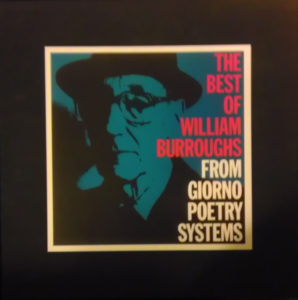
William S. Burroughs – The Best of William Burroughs from Giorno Poetry Systems Mercury 314 536 701-2 (1998)
Burroughs was the godfather of the Beats. And yet, his extensive career giving spoken word recitations is, in a way, just as significant as his writings themselves (most of his readings were of his own writings) — setting aside entirely his sonic cut-up audio field recordings and mixed media visual artworks. As a live performer, he worked his way through small venues, much like punk bands (and often in the same clubs that did punk shows). His intonation, pacing and inflection did evolve though. Listening to four CDs of material covering a long stretch of time reveals how he fine-tuned his delivery. He mastered his sneering, nasal delivery, with certain words drawn out for effect, speaking often in a kind of deadpan but breaking from it regularly for emphasis. And comparing these recordings from 1975 onward shows marked advancement over his 1960s recorded monologues.
Burroughs came from a fairly privileged upbringing and was highly educated. He mostly used that background to more effectively mock rich elites and to astutely document what goes on in the world outside the realm of respectability. He gets inside the self-important, smug and arrogant sense of entitlement in cutting, satirical narratives, which often explore basic countercultural themes and the realities of life for the poor. His aloof, profane, magnificently unsentimental, and often scowling demeanor had a way of depicting vileness with an icy frankness that makes his accounts endearing, in their own startling and unexpected way, fostering a kind of cabal or union of outcasts and freaks who are onto the cons too. As Barry Miles said about Burroughs in an interview,
“His overall concern was always to confront control systems and attack them. In literature it was usually done through humour . . . where he would take ideas to some absurd length which breaks through all the normal boundaries of good taste and decorum and it was often hilariously funny.”
No doubt, Burroughs exudes a kind of political libertarian populism, but it runs close anarchism. At his best (and this Best of collection surely lives up to delivering the man at his best) he could hilariously depict the “country simple” wisdom of the underclasses as fully aware of the grim power struggles playing out under the guise of “neutral” politics that just so happen to prop up elites (something that was most explicit in his essays and Cities of the Red Night). Burroughs was always on the look out for new techniques to disrupt the smooth functioning of oppressive social structures, taking particular glee in uncovering the overlooked (if not explicitly hidden) and elemental institutional mechanisms that maintain such relations between people. He can be delightfully ruthless in exposing the vile motives of the self-satisfied “pillars of the community,” like doctors, journalists, police, and so on. Burroughs’ characters are sometimes surprisingly conventional, even as he takes a very unconventional approach to developing and introducing them. Burroughs also knows how to deliver an iconic catchphrase, taking colloquialisms to new heights by building so much around them to contextualize their lasting value. He can also summon a sense of paranoia like few others. And all this is not to mention his pervasive interest in fringe theories: UFOs, orgone accumulators, and that sort of thing.
Burroughs’ writings were often picaresque, heavily influenced by Céline, but also drawing on the influence of Denton Welch, Rimbaud, Genet, Conrad and others. The picaresque style lends itself to short — and humorous — readings, the excerpts able to stand on their own. But from Welch, Burroughs also drew on an ability to describe the ordinary in an uncommon way, and how to reveal with honesty that which is obscured. Burroughs is able to summon and expand on those qualities in his readings.
As to the actual recordings here, they are mostly arranged chronologically by the date the underlying text was published — irrespective of when the audio was recorded, to some extent. Then the last disc features a segment called “Nothing Here Now But the Recordings,” which are not based on any previously published texts, but includes lectures and audio experiments, such as the “inching” technique Burroughs employed by manually moving magnetic audio tape through a recorder.
Burroughs actually made many, many commercially released recordings. This set is exclusively material released on John Giorno‘s label Giorno Poetry Systems, often originally released on albums with contributions from many different performers (rather than exclusively from Burroughs). There are many more Burroughs recordings out there, very few of which were ever sold in any quantity. What is here focuses primarily on spoken word recitations, mostly readings of Burroughs’ own published writings. The recordings not present here delve more fully into experimental sound collages (see Real English Tea Made Here) and collaborations with musical groups (see Spare Ass Annie and Other Tales, The Black Rider). But there are also various other spoken word albums Burroughs made that were simply made for other record labels (see Call Me Burroughs, Break Through in Grey Room, etc.).
Reading Burroughs is near mandatory. But a complete picture of the man’s work requires exploring his other efforts, especially his audio recordings. The Best of William Burroughs From Giorno Poetry Systems makes an ideal introduction to those audio recordings. And just as to Burroughs’ outlook, a world that continues to lurch closer to a police state can stand to learn from Burroughs’ intelligent studies in ways to counteract those tendencies.
Sand Avidar-Walzer – Welcome to Interzone
Link to an article by Sand Avidar-Walzer:
My Own Mag
Link to RealityStudio’s archive of issues of Jeff Nuttall’s independent magazine:
Public Enemy – There’s a Poison Goin On….

Public Enemy – There’s a Poison Goin On…. Atomic Pop AP001 (1999)
After attempting to rethink the basis of Public Enemy’s music on the He Got Game soundtrack, which garnered mixed reviews at best, PE rethought their music again on There’s a Poison Goin On. In a way, it sort of set the tone for a lot of what the rest of PE’s career would be about. He Got Game catered to the more melodic R&B-inflected style of hip-hop that was gaining popularity at the time. The title track was great, but the rest didn’t impress. With There’s a Poison Goin On the group sort of splits the difference between more melodic beats and singing/raps and their old style. The results? Well, music nerds and hip-hop heads debate the best Wu-Tang Clan solo albums. This might be the best Wu-Tang “solo” album made by people unaffiliated with Wu-Tang! Chuck D is political, but less so than a decade earlier. “World Tour Sessions” is the catchiest thing here, and it has a little bit of Chuck’s politics, but it has a softer hook than something like their early 1990s hit “Can’t Truss It.” “I” is great. This was DJ Terminator X‘s last album with the group until a surprise reunion with the group more than a decade later.
Aside from the purely musical aspects of the album, Public Enemy established their new business model here. They signed with a new label dedicated to online distribution (though this was released in physical format too). The label flopped, as broadband internet access was not widespread yet. But more than distribution channels, the group was ready to sidestep major labels and stick with a more independent path, allowing them to try new things and have more control over their work.
This is a middle-of-the-pack PE album, but one that is worthwhile for fans who have already heard the classics.
Ty Moore & Patrick Ayers – The Disastrous Failure of Lesser Evilism
Link to an article by Ty Moore & Patrick Ayers:
Critterjams – Scott Adams and Donald Trump
Link to an article on Critterjams:
Sebadoh – Bakesale

Sebadoh – Bakesale Sub Pop sp260b (1994)
Here’s a real classic of the grunge/alternative rock period. There is a clear affinity for rough, almost garage rock-ish fuzz, but overall there is much purpose and effort put into establishing a clear and consistent perspective in the recordings. The songwriting retains the emotionally bare confessional tone of much of Sebadoh’s work, while also having rhythmic drive, strong riffs, and a stylistic connection to current genre trends. Balancing — and indeed synthesizing — those sorts of seemingly contradictory impulses is what carries the album. Refreshingly, though, Bakesale avoids the self-pitying mopeyness (and vague graininess) that was the bane of much lo-fi music. Joey Ramone once gave an interview in which he said quite directly that rock ‘n roll was music for outsiders. Bakesale honors that tradition while at the same time serves to rally the freaks (gabba gabba!). Looking back, this album really highlights the best of what the entire grunge/alternative/indie rock scene had to offer.
Michael Hudson – Review of Welcome to the Poisoned Chalice
Link to a review by Michael Hudson of James K Galbraith‘s book Welcome to the Poisoned Chalice: The Destruction of Greece and the Future of Europe (2016):
“Review of James Galbraith, Welcome to the Poisoned Chalice (2016)”
Select quote:
“At first glance the repeated ‘failure’ of austerity prescriptions to ‘help economies recover’ seems to be insanity – defined as doing the same thing again and again, hoping that the result may be different. But what if the financial planners are not insane? What if they simply seek professional success by rationalizing politics favored by the vested interests that employ them, headed by the IMF, central bankers and the policy think tanks and business schools they sponsor? The effects of pro-creditor policies have become so constant over so many decades that it now must be seen as deliberate, not a mistake that can be fixed by pointing out a more realistic body of economics (which already was available in the 1920s).”
This is reminiscent of a quote frequently attributed to Donald Berwick (among others): “Every system is perfectly designed to get the results it gets.” In the economic context, this notion is also explored further in Economists and the Powerful (2012).
Robert Kuttner – Hidden Injuries of Class, Race, and Culture
Link to an omnibus book review by Robert Kuttner:
“Hidden Injuries of Class, Race, and Culture”
Bonus links: “What Drives Trump Supporters?: Sociologist Arlie Russell Hochschild on Anger & Mourning of the Right” and “I Spent 5 Years With Some of Trump’s Biggest Fans. Here’s What They Won’t Tell You.” and “Rural Voting from Group Identity Resentment of Other Groups Not Ideology” and “Janesville: Microcosm of the Heartland Rustbelt” (but see “On the Differences of Comedy in the Time of Alt Right Transgression” — essentially rejecting the core premise of Hochschild’s affective sociology as an infantalization)