
Link to an article and book review by Anastasia Klimchynskaya:
Tag: Fiction
Essential Left Books and Articles
- Der Ursprung der Familie, des Privateigenthums und des Staats [The Origin of the Family, Private Property and the State] (1884), Friedrich Engels
- Государство и революция. Учение марксизма о государстве и задачи пролетариата в революции [The State and the Revolution: The Marxist Doctrine of the State and the Tasks of the Proletariat in the Revolution] (1917), Vladimir Lenin [Vladimir Ilyich Ulyanov]
- Les Damnés de la Terre [The Wretched of the Earth] (1961), Frantz Fanon
- Zur Psychopathologie des Alltagslebens [The Psychopathology of Everyday Life] (1901), Sigmund Freud
- Pedagogía del oprimido [Pedagogy of the Oppressed / Pedagogia do Oprimido] (1968), Paulo Freire
- Man Makes Himself (1951 ed. [originally published 1936]), V. Gordon Childe
- Discours sur l’origine et les fondements de l’inégalité parmi les hommes [Discourse on the Origin and Basis of Inequality Among Men / Second Discourse] (1755), Jean-Jacques Rousseau
- Du contrat social; ou, Principes du droit politique [On the Social Contract; or, Principles of Political Right] (1762), Jean-Jacques Rousseau
- “The Driving Forces of Imperialism” in Spheres of Influence in the Age of Imperialism (1972), Ernest Mandel
- Die Maßnahme [The Measures Taken] (1930), Bertolt Brecht (plus the complete works of Brecht from about 1930 onward)
Others:
- Ten Days that Shook the World (1919), John Reed
- Der deutsche Bauernkrieg [The Peasant War in Germany] (1850), Friedrich Engels
- The Sublime Object of Ideology (1989), Slavoj Žižek
- Das Kapital. Kritik der politischen Ökonomie [Capital: A Critique of Political Economy] (1867), Karl Marx
- Manifest der Kommunistischen Partei [Manifesto of the Communist Party] (1848), Karl Marx and Friedrich Engels
- La Distinction: Critique sociale du jugement [Distinction: A Social Critique of the Judgement of Taste] (1979), Pierre Bourdieu
- L’An 1 de la révolution russe [Year One of the Russian Revolution] (1930), Victor Serge
- History of the Peloponnesian War (late 5th century BC), Thucydides
- “‘Why Are You Acting the Marxist?’ Frédéric Lordon on Thomas Piketty’s ‘Capital and Ideology’” (Jan. 31, 2020), Frédéric Lordon
- “The Lesson We Should Have Learned from ‘Silent Spring,'” Canadian Dimension (Jan. 3, 223), Nick Gottlieb
- “Against Georg Lukacs,” New Left Review I/84 (March-April 1974), Bertolt Brecht
- “Bolshevism Is a Menace—To Whom?” The Dial, Vol. 66 (Feb. 22, 1919), Thorstein Veblen
- Ideas and Opinions (1973), Albert Einstein
- “The Tyranny of Structurelessness” Jo Freeman (AKA Joreen) (~1972-73)
- What Is Sex (2017), Alenka Zupančič
- “The Apocalypse is (Still) Disappointing,” S: Journal of the Circle for Lacanian Ideology Critique, Vol. 11, 16-30 (2018), Alenka Zupančič
- Poor People’s Movements: Why They Succeed, How They Fail (1977), Frances Fox Piven and Richard A. Cloward
- The Triumph of Conservatism: A Reinterpretation of American History, 1900-1916 (1963), Gabriel Kolko
- “The Soul of Man Under Socialism,” Fortnightly Review (Feb. 1891), Oscar Wilde
- Clarence Darrow, “Crime and Criminals: Address to the Prisoners in the Chicago Jail” (1902)
- Looking Backward: 2000-1887 (1888), Edward Bellamy
- Malcolm X Speaks (1965), George Breitman ed.
- Walking With the Comrades (2011), Arundhati Roy
And a few films:
- Complete films of Jean-Luc Godard, including Week End (1968)
- The Murder of Fred Hampton (1971), dir. Howard Alk
- Our Daily Bread (1934), dir. King Vidor
Ursula K. Le Guin – The Ones Who Walk Away From Omelas | Review
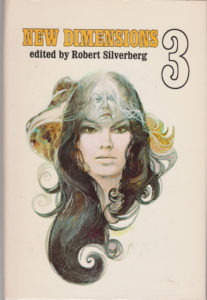
Ursula K. Le Guin – “The Ones Who Walk Away From Omelas” from New Dimensions 3, Robert Silverberg, ed. (1973)
Ursula K. Le Guin’s short story “The Ones Who Walk Away From Omelas” presents an excellent example of what Alenka Zupancic described as “liberal blackmail”. Le Guin tells a story of a “utopian” city that has a child imprisoned in essentially a torture dungeon. The liberal blackmail is stated quite succinctly by her:
“If the child were brought up into the sunlight out of that vile place, if it were cleaned and fed and comforted, that would be a good thing, indeed; but if it were done, in that day and hour all the prosperity and beauty and delight of Omelas would wither and be destroyed. Those are the terms. *** The terms are strict and absolute; there may not even be a kind word spoken to the child.”
This is blackmail because it insists on a reductionist binary. Either people stay in the city and keep torturing the child, or they walk away from Omelas. No third option is permitted. It is liberal because the first option (where the child is tortured) is basically standard liberalism. Domenico Losurdo has explained this in books like Liberalism: A Counter-History (2014). Liberalism is a politics of exclusion, a kind of false universalism that separates the society of the free from those unworthy of freedom. Le Guin’s short story is basically an extremely blunt depiction of this basic — if disavowed — premise of political liberalism. Sure, other social structures like feudalism oppress certain groups but they don’t profess freedom like the society of Omelas that Le Guin describes in the story.
The other option, of “walking away from Omelas,” is basically what the philosopher Hegel called the “Beautiful soul” problem. Here, Zupancic explains the dynamic well:
“The rise of the affect(s) and the sanctimony around affective intuition are very much related to some signifiers being out of our reach, and this often involves a gross ideological mystification. Valorization of affectivity and feelings appears at the precise point when some problem — injustice, say — would demand a more radical systemic revision as to its causes and perpetuation. This would also involve naming — not only some people but also social and economic inequalities that we long stopped naming and questioning.
“Social valorization of affects basically means that we pay the plaintiff with her own money: oh, but your feelings are so precious, you are so precious! The more you feel, the more precious you are. This is a typical neoliberal maneuver, which transforms even our traumatic experiences into possible social capital. If we can capitalize on our affects, we will limit out protests to declarations of these affects — say, declarations of suffering — rather than becoming active agents of social change. I’m of course not saying that suffering shouldn’t be expressed and talked about, but that this should not ‘freeze’ the subject into the figure of the victim. The revolt should be precisely about refusing to be a victim, rejecting the position of the victim on all possible levels.
***
“this bind derives precisely from the subjective gain or gratification that this positioning offers. (Moral) outrage is a particularly unproductive affect, yet it is one that offers considerable libidinal satisfaction. By ‘unproductive’ I mean this: it gives us the satisfaction of feeling morally superior, the feeling that we are in the right and others are in the wrong. Now for this to work, things must not really change. We are much less interested in changing things than in proving, again and again, that we are in the right, or on the right side, the side of the good. Hegel invented a great name for this position: the ‘beautiful soul.’ A ‘beautiful soul’ sees evil and baseness all around it but fails to see to what extent it participates in the perpetuation of that same order of things. The point of course is not that the world isn’t really evil, the point is that we are part of this evil world.”
“Too Much of Not Enough: An Interview with Alenka Zupančič”
If her explanation still seems difficult to grasp, the concept can be more succinctly summed up this way:
“They play the Beautiful Soul, which feels superior to the corrupted world while secretly participating in it: they need this corrupted world as the only terrain where they can exert their moral superiority.”
Slavoj Žižek, Refugees, Terror and Other Troubles with the Neighbors: Against the Double Blackmail (2016).
Those who “walk away from Omelas” do nothing to change its underlying horror. They only go away to exist outside its geographic borders, thereby using the existence of Omelas to exert their moral superiority. In other words, they need Omelas and its torture dungeon in order to self-identify as morally superior individuals — walking away actually supports the continued functioning of Omelas and its torture dungeon. The “beautiful souls” who walk away merely turn the traumatic experience of confronting the torture dungeon into social capital, but rationalize its continuation.
In the 1970s, Le Guin took a turn towards neoliberal feminism, or what might be called cultural feminism or even bourgeois feminism. Usually portrayed as her becoming more politically conscious, rather the opposite is true. She really made a turn much like the so-called “new philosophers” to the political right. She embraced the tactics of identity politics and the valorization of victimhood status. She was much more of a careerist opportunist than she is often portrayed by supporters, cynically invoking certain concepts to enhance her public status (and boost her book sales) without doing a whole lot to meaningfully change anything beyond a few gendered pronouns, with at most a slightly populist twist. Her best work was in the 1960s and early 1970s, and it dealt with typical concerns of the time. For instance, A Wizard of Earthsea (1968) deals with the destructive power of envy, something that French writers were grappling with under the rubric of ressentiment. She jettisoned those things in the 70s and instead dwelt on identity politics. There is reason to suggest that “The Ones Who Walk Away From Omelas” is at bottom anti-communist propaganda. Little if any of her writing after her anarchist masterpiece The Dispossessed (1974) is very highly regarded by readers.
So, back to the short story. Le Guin cited William James, and his “The Moral Philosopher and the Moral Life,” claiming that only those who remain in Omelas are accepting a bargain. But this is demonstrably false — those who walk away from Omelas are bargaining too and merely offer a different rationalization. The most obvious ethical response that avoids an element of bargaining is to simply reject Le Guin’s stupid Manichean premise and do precisely what she states is impossible: change the structure of the society of Omelas. An excellent analogy in (science-)fiction is the way Captain James T. Kirk in the Star Trek franchise defeated the “Kobayashi Maru test” as a student at “Starfleet Academy” by reprogramming the test computer to make the no-win scenario winnable—reminiscent of the legend of Alexander the Great cutting the Gordian Knot. Or Josef Stalin’s famous retort to a journalist who asked him which deviation is worse, the Rightist one (Bukharin) or the Leftist one (Trotsky), responding, “They are both worse!” Franz Kafka‘s The Trial (1925) included the parable of the door to the law, which is also more or less a relevant counterpart, if a more individual and pessimistic one about overcoming seemingly impossible obstacles. The point is to reject the false binary choice the short story presents as a form of blackmail, conspiracy, or propaganda. Or, let’s tentatively grant Le Guin her conceit that the “terms are strict and absolute” in this Omelas society. Then, the solution is Bartleby politics, after the character in Herman Melville‘s short story “Bartleby, The Scrivener” who did nothing to carry out his social role but to answer, “I would prefer not to.” Would you stay in Omelas? “I would prefer not to.” Would you walk away from Omelas? “I would prefer not to.” Ah, but then the terms would suddenly not be so strict and absolute as the society fails to reproduce itself and disappears…at great peril and cost to those who prefer not to, like Melville’s Bartleby who dies in jail. So, it would be Bartleby politics or you walk away from Omelas and come back with an army to destroy it…
Ross Wolfe – About Two Squares
Link to an article by Ross Wolfe:
“About Two Squares: El Lissitzky’s 1922 Suprematist Picture Book for Kids”
Tariq Ali – How Lenin’s Love of Literature Shaped the Russian Revolution
Link to an article by Tariq Ali:
“How Lenin’s Love of Literature Shaped the Russian Revolution”
Bonus links: “The Legacy of Vladimir Lenin” and “How to Begin From the Beginning”
Lee Konstantinou – On William Gaddis’s “J R”
Link to a review by Lee Konstantinou of William Gaddis‘ novel J R (1975):
“Too Big to Succeed: On William Gaddis’s ‘J R’”
Bonus link: “Geoff’s Review of ‘J R'”
William S. Burroughs – The Best of William Burroughs from Giorno Poetry Systems

William S. Burroughs – The Best of William Burroughs from Giorno Poetry Systems Mercury 314 536 701-2 (1998)
Burroughs was the godfather of the Beats. And yet, his extensive career giving spoken word recitations is, in a way, just as significant as his writings themselves (most of his readings were of his own writings) — setting aside entirely his sonic cut-up audio field recordings and mixed media visual artworks. As a live performer, he worked his way through small venues, much like punk bands (and often in the same clubs that did punk shows). His intonation, pacing and inflection did evolve though. Listening to four CDs of material covering a long stretch of time reveals how he fine-tuned his delivery. He mastered his sneering, nasal delivery, with certain words drawn out for effect, speaking often in a kind of deadpan but breaking from it regularly for emphasis. And comparing these recordings from 1975 onward shows marked advancement over his 1960s recorded monologues.
Burroughs came from a fairly privileged upbringing and was highly educated. He mostly used that background to more effectively mock rich elites and to astutely document what goes on in the world outside the realm of respectability. He gets inside the self-important, smug and arrogant sense of entitlement in cutting, satirical narratives, which often explore basic countercultural themes and the realities of life for the poor. His aloof, profane, magnificently unsentimental, and often scowling demeanor had a way of depicting vileness with an icy frankness that makes his accounts endearing, in their own startling and unexpected way, fostering a kind of cabal or union of outcasts and freaks who are onto the cons too. As Barry Miles said about Burroughs in an interview,
“His overall concern was always to confront control systems and attack them. In literature it was usually done through humour . . . where he would take ideas to some absurd length which breaks through all the normal boundaries of good taste and decorum and it was often hilariously funny.”
No doubt, Burroughs exudes a kind of political libertarian populism, but it runs close anarchism. At his best (and this Best of collection surely lives up to delivering the man at his best) he could hilariously depict the “country simple” wisdom of the underclasses as fully aware of the grim power struggles playing out under the guise of “neutral” politics that just so happen to prop up elites (something that was most explicit in his essays and Cities of the Red Night). Burroughs was always on the look out for new techniques to disrupt the smooth functioning of oppressive social structures, taking particular glee in uncovering the overlooked (if not explicitly hidden) and elemental institutional mechanisms that maintain such relations between people. He can be delightfully ruthless in exposing the vile motives of the self-satisfied “pillars of the community,” like doctors, journalists, police, and so on. Burroughs’ characters are sometimes surprisingly conventional, even as he takes a very unconventional approach to developing and introducing them. Burroughs also knows how to deliver an iconic catchphrase, taking colloquialisms to new heights by building so much around them to contextualize their lasting value. He can also summon a sense of paranoia like few others. And all this is not to mention his pervasive interest in fringe theories: UFOs, orgone accumulators, and that sort of thing.
Burroughs’ writings were often picaresque, heavily influenced by Céline, but also drawing on the influence of Denton Welch, Rimbaud, Genet, Conrad and others. The picaresque style lends itself to short — and humorous — readings, the excerpts able to stand on their own. But from Welch, Burroughs also drew on an ability to describe the ordinary in an uncommon way, and how to reveal with honesty that which is obscured. Burroughs is able to summon and expand on those qualities in his readings.
As to the actual recordings here, they are mostly arranged chronologically by the date the underlying text was published — irrespective of when the audio was recorded, to some extent. Then the last disc features a segment called “Nothing Here Now But the Recordings,” which are not based on any previously published texts, but includes lectures and audio experiments, such as the “inching” technique Burroughs employed by manually moving magnetic audio tape through a recorder.
Burroughs actually made many, many commercially released recordings. This set is exclusively material released on John Giorno‘s label Giorno Poetry Systems, often originally released on albums with contributions from many different performers (rather than exclusively from Burroughs). There are many more Burroughs recordings out there, very few of which were ever sold in any quantity. What is here focuses primarily on spoken word recitations, mostly readings of Burroughs’ own published writings. The recordings not present here delve more fully into experimental sound collages (see Real English Tea Made Here) and collaborations with musical groups (see Spare Ass Annie and Other Tales, The Black Rider). But there are also various other spoken word albums Burroughs made that were simply made for other record labels (see Call Me Burroughs, Break Through in Grey Room, etc.).
Reading Burroughs is near mandatory. But a complete picture of the man’s work requires exploring his other efforts, especially his audio recordings. The Best of William Burroughs From Giorno Poetry Systems makes an ideal introduction to those audio recordings. And just as to Burroughs’ outlook, a world that continues to lurch closer to a police state can stand to learn from Burroughs’ intelligent studies in ways to counteract those tendencies.
My Own Mag
Link to RealityStudio’s archive of issues of Jeff Nuttall’s independent magazine:
Munro Leaf & Robert Lawson – The Story of Ferdinand
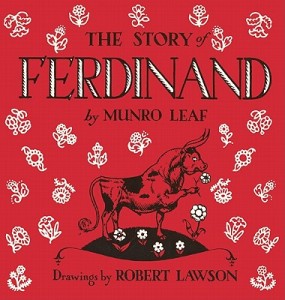
Munro Leaf and Robert Lawson – The Story of Ferdinand (The Viking Press, 1936)
One of the great children’s books. Robert Lawson’s black and white illustrations are exceptional in their detail and clarity, yet those qualities are focused on distinct characters and objects with much white space creating a sense of freedom. The story by Munro Leaf is a kind of happier version of Herman Melville‘s short story Bartleby, the Scrivener. Ferdinand is a bull in Spain who does not want to be a part of bullfights. He wants to sit quietly under his favorite cork tree and smell the flowers. When stung by a bee and jumping about in pain, he confuses a group of men, who have come to select a bull for fights in Madrid, making them think that he is ferocious. But when brought to a bullfighting ring (to his death), he merely sits down in the middle of the ring to smell the flowers in the hair of the ladies in the audience, and refuses to participate. So Ferdinand is taken back to the country where he can smell the flowers. And he was happy. In this story, which describes the power of an individual to resist the violence of institutions, it is one of the most radical bestselling books in America (following the likes of Looking Backward).
Stanisław Lem – Solaris

Stanisław Lem – Solaris (MON 1961)
A work of science fiction, yes, but Solaris is also as much about humanity as anything else. Psychologist Kris Kelvin travels to a space station on the planet Solaris, where strange things have been happening. The thoughts of the cosmonauts are made corporeal, as “visitors”, by the planet itself. A kind of pink slime “ocean” covers the planet. It is sentient. The ocean is even able to adjust the planet’s orbit between two suns. A fascinating (and horrifyingly realistic) subplot is the way that Kelvin uncovers a conscious/unconscious plot by scientists to suppress the nature of the planet in published reports, relegating certain information to an Apocrypha and discrediting those whose findings contradict official dogma, with scientists acting like the guardians of religious institutions rather than seekers of knowledge as they profess to be. The scientists are only able to apply language that is internally consistent, like mathematics, but never explains the mystery of the planet itself. The planet remains an impenetrable other, its motivations inscrutable and unknown to the scientists. Is it experimenting on the scientists? Is it trying to help them? No one knows. Comparing the novel to Moby Dick, Lem said that he “only wanted to create a vision of a human encounter with something that certainly exists, in a mighty manner perhaps, but cannot be reduced to human concepts, ideas or images.” But what dominates the story about scientists who cannot hope to understand the planet Solaris, is that they also fail to understand themselves. Everything they experience about the planet is filtered through their own, flawed consciousnesses first. The premise of the book maps directly onto the work of Jacques Lacan, Alain Badiou, and continental philosophy — Lem called the Freudian interpretation “obvious”. Certainly, one of the greatest of 20th Century Sci-Fi novels.