The Swan Silvertones – You Pray On

You Pray On

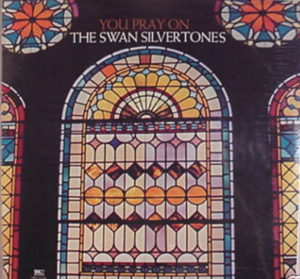
The Swan SilvertonesYou Pray On HOB HBX 2146 (1972)


A pretty mediocre album.  It’s in the soul-inflected style of It’s a Miracle.  However, producer John Bowden has done an absolutely atrocious job recording this.  The instruments seem incredibly muddy and indistinct.  At times the recordings are so murky that it seems like the instrumentalists are just plain out of sync with the vocalists.  The murkiness of this recording is just as bad as on In God’s Hands.

The Swan Silvertones – You’ve Got a Friend

You've Got a Friend

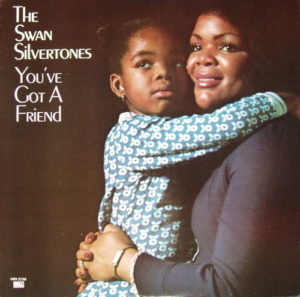
The Swan SilvertonesYou’ve Got a Friend HOB HBX 2156 (1973)


You’ve Got a Friend is among the more listenable of the albums The Swan Sivertones recorded for HOB Records.  The group has better success here melding their vocals with the instrumental backing than in subsequent years.  Of note is the increasingly prominent use of raw, slightly twangy electric guitar and rock-inflected organ.  Though there really are no standout tracks, the version of the gospel standard “Well, Well, Well” and covers of James Cleveland‘s “Prayer Will Move It” and the recently popular “You’ve Got a Friend” are nice.

The Swan Silvertones – I’ll Keep On Loving Him

I'll Keep on Loving Him

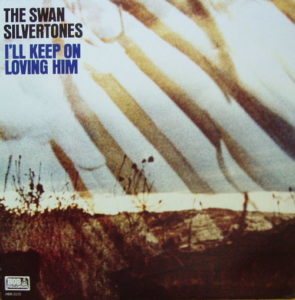
The Swan SilvertonesI’ll Keep On Loving Him HOB HOB LP 2172 (1974)


A solid effort.  Longtime member John Myles was still around for this mid-1970s album, though his input seems to have been waning.  Louis Johnson and Sam Hubbard take lead vocal duties.  Most of these songs are respectable but not particularly remarkable.  The best of the bunch are the title track, the organ-drenched “Happy With Jesus Alone”, and “Life of a Sinner”.  The last of those finds Louis Johnson going much further than usual with some of his most subtly complex songwriting and arranging, with vocals punctuated by a somber horn and a jittery, rambunctious piano.  The group does seem to run a bit low on ideas in places.  So they borrow a guitar riff straight out of Al Green‘s “Love and Happiness” to open their version of “Leak in This Old Building”.  But generally The Swans bring enough energy to the table that it’s easy to let the album’s weaknesses slip by.  On the whole, this is a characteristic effort from the group’s tenure on HOB Records, and worth a listen for anyone with an interest in soul-inflected gospel.

The Swan Silvertones – Try Me Master

Try Me Master

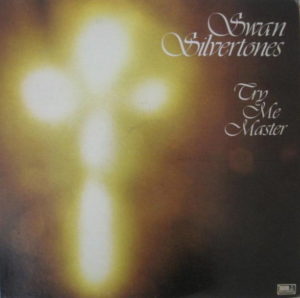
The Swan SilvertonesTry Me Master HOB HOB LP 2182 (1975)


Try Me Master was the final album The Swan Silvertones released for HOB Records, and their last album with longtime member John Myles.  It’s a decent album for the period, with better production values than their many low-budget releases of the previous eight or nine years.  The group remakes their perennial favorite “Jesus Remembers” and adapts a few gospel standards.  The title track and “Please Help Me” (with keyboards a little like Joy Division‘s “Love Will Tear Us Apart,” of all things) are the highlights.  The material is listenable throughout, if a little thin on side two.  Fans will probably enjoy this even though it doesn’t break any new ground.

Sun Ra – When Sun Comes Out

When Sun Comes Out

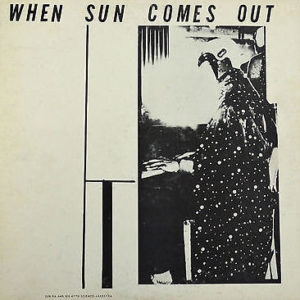
Sun Ra and His Myth Science ArkestraWhen Sun Comes Out El Saturn LP 2066 (1963)


Though a bit patchy in places, Calling Planet Earth is an unequaled showcase for the Arkestra’s mighty sax section of John Gilmore, Pat Patrick, Marshall Allen and Danny Davis.  Sun Ra had a harder time recruiting brass players after relocating to New York City.  But the move actually strengthened the sax lineup, as Patrick came back into the fold—he tears up his solo on “Calling Planet Earth.”  [side note: Pat Patrick had relocated to New York ahead of Ra and had left his family behind in Chicago, including his son and future Massachusetts governor Deval]

Juçara Marçal – Encarnado

Encarnado

Juçara MarçalEncarnado (self-released) (2014)


Comes across vaguely like a low-budget version of Tom Zé‘s Vira Lata na Via Láctea (2014), with more conventionally pretty vocals.  Marçal is an excellent vocalist.  The album’s major limitation is the “math rock” guitar style of Kiko Dinucci and Rodrigo Campos (Dinucci appeared as a guest on the Zé album), which more often than not uses the raw repetition of riffs as a way to cover up a general lack of ideas.  The experimentalism of the music also falls prey to self-indulgence at times.  Yet Marçal has a way of making just about anything she sings captivating, which often counteracts the overbearing (and mostly boring) guitar.  The album improves somewhat in the second half, with shorter songs that have less guitar (and sometimes when it appears, it is more as a novelty and a contrast or change-of-pace, rather than with a serious “rock” sound, which works better).  There are a few promising aspects to this album (especially the songs “João Carranca” and “Canção Pra Ninar Oxum”), but for the most part it seems insufficiently thought-through and burdened by the very mediocre guitar playing.

Esperanza Spalding – Esperanza

Esperanza

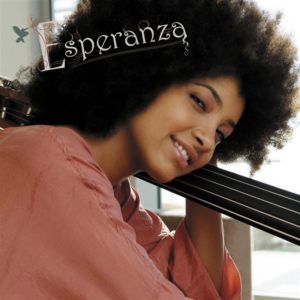
Esperanza SpaldingEsperanza Heads Up International HUCD 3140 (2008)


I suppose I’m spoiled in having heard strong female artists like PJ Harvey, tUnE-yArDs.  Esperanza Spalding is not one of those women.  On Esperanza she accedes to a rather bland, established formula for vocal jazz, with hushed, breathy vocalizations, and warm, soft and non-confrontational backing, with a lot of rather vague third world-isms laced through.  It comes across as something between Sade and Diana Krall, with the kind of emphasis on lightweight pop rather than jazz that Norah Jones established as the dominant commercial form.  The lyrics here are banal, though there seems to be little attempt to make them the focus.  The album has finely crafted production values, but Spalding makes no attempt to establish her own voice.  She plays bass competently but not remarkably.  This album just drifts by without making its mark.

Esperanza Spalding – Chamber Music Society

Chamber Music Society

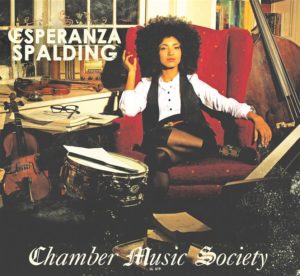
Esperanza SpaldingChamber Music Society Heads Up International HUI-31810-02 (2010)


I bagged on Esperanza’s last album (Esperanza) because she followed a formula too closely.  Well, on this time out she certainly breaks from formula.  Now she dabbles in a mixture of third-stream and pop.  Problem is, she doesn’t pull it off.  The songs are too complex for their own good.  Cluttered.  It seems like she’s aiming for something a little more ambitious than she’s able to pull off as a writer and arranger, even if well within her means as a performer.  Oh well.

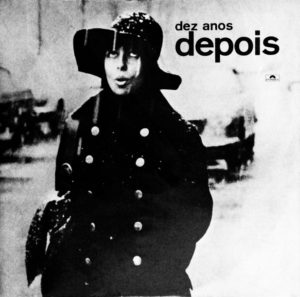
Nara Leão – Dez anos depois

Dez anos depois

Nara LeãoDez anos depois Polydor 2.388.004/5 (1971)


The history of bossa nova runs through Nara Leão, to the point that some claim the original bossa nova scene coalesced in her parents’ living room.  She became a star in her native Brazil, and was one of the more popular bossa nova singers.  But with the military coup, she first turned toward protest music, then left the country in 1969.  She lived in Paris, and in August of 1969 announced in an interview that she had retired from professional singing.  Her retirement proved short-lived.  Soon enough she was back to recording and in 1971 released the double LP Dez anos depois, which featured new recordings of older bossa nova songs.  The first LP was minimalist, and recorded in Paris.  The second LP, only slightly less minimalist, featured some backing arrangements (by Roberto Menescal mostly, plus Luis Eça and Rogério Duprat for two tracks each), and was recorded in Rio.

Dez anos depois (translation: “ten years later”) is sort of a sister album to Françoise Hardy‘s La question (1971). Both have an intimate, melancholy feel, and expatriate Brazilian guitarist Tuca (Valeniza Zagni da Silva) appears on both.  It might even be said that both put forward musical personas that were unique to the heyday second-wave feminism — not in terms of overt feminist militancy but instead (and somewhat paradoxically) by being unassuming thinking-woman’s music of a kind that simply wasn’t given much of an airing in prior times.

Tuca’s guitar is wonderful.  Unlike the pure sublime gracefulness of João Gilberto or the sentimentality of Baden Powell, she leavens the angelic melodies with a hint of punky, plucky impertinence.  “Fotographia” illustrates that point in its hypnotic strummed line unsettled by a dissonant, sour note lingering in the chords but never brought to the forefront.  Across much of the first LP (seemingly the only disc on which Tuca appears) the melodic statements on guitar often seem rushed, almost, to emphasize the rhythmic aspects.  This is both the essence of bossa nova, and a contrarian act of defiance.

Of course, Nara’s vocals are a big part of the album’s appeal.  There is an insouciance to her delivery.  The “ten years after” of the album title seems to refer to beginning her (then amateur) singing career that many years before.  This is an album that looks back to a musical genre that she had left behind.  But it looks back from a place and time in which Nara was living in Paris not long after the May 1968 student uprising came and went, and, in her own career, after a period of protest singing and retirement.  So, rather than the cynical (anti-)flashiness of bossa nova in its early-/mid-1960s commercial peak, full of brash hope and revolutionary optimism thinly veiled behind leisurely tempos and sunny harmonies, Dez anos depois has a more deeply restrained and somber attitude, aware of the limitations of the first wave of bossa nova but still ready to draw on core elements that had weathered the intervening few years.  That is to say that Nara’s renditions of these songs draw on the elements of bossa nova that precisely were not what garnered the music international success in the prior decade.  This album makes attempts to find new meanings in the genre’s history.  In that respect this album also does what any good “comeback” does: find something that was there before but overshadowed and emphasize it anew.

If much Brazilian music of the 1960s and 70s has maintained a cultish appeal internationally, thanks partly to limited geographic distribution of reissues in the CD era (and even the digital distribution era), Dez anos depois is somewhat doubly a dark horse given the timing of its original release and the superficial appearance as a mere recapitulation of the past.  This is really an album that tries to right the wrongs of commercial bossa nova, giving the genre a new life of sorts.  Even if the recording fidelity of the Paris sessions is only mediocre, this is an excellent collection of chamber-style bossa nova recordings from a surprisingly fertile period after the international commercial spotlight moved on to other genres, up there with Gilberto’s self-titled João Gilberto (1973) and Elis Regina and Antônio Carlos Jobim‘s Elis & Tom (1974).