
“Quis custodiet ipsos custodes? [Who can watch the watchmen?]”
Sun Ra – Cosmos
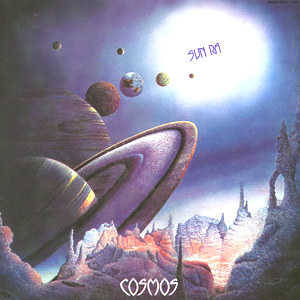
Sun Ra – Cosmos Cobra COB 37001 (1976)
In July of 1976 The Sun Ra Arkestra played the Montreux festival. Afterward, they lived in Paris for a couple months. During that time they recorded Cosmos for the obscure French label Cobra. The album has a laid-back, feel-good vibe. Yet it is never too easy. There are still some skronky horn solos, but they blend into mellow electric bass lines and leisurely accompaniment tempos. John Gilmore lends a really beautiful inside/outside solo on “Jazz From an Unknown Planet” toward the end too. The album also has that characteristically 1970s warm and round production aesthetic. The music might be viewed as a synthesis of a lot of typical Arkestra styles, going back to stuff from the 1950s up through the fusion era, blended together as opposed to alternating to and fro. Nothing here a Sun Ra fanatic hasn’t heard elsewhere, but the overall chilled-out ambiance is quite nice and this sustains itself well from start to finish. A really nice one — among the more pleasant Arkestra discs of the era.
Ugo Fuscolo Quote
“Le ricchezze e la povertà sono le più antiche e mortali infermità delle repubbliche. [An imbalance between rich and poor is the oldest and most fatal ailment of a republic.]”
Ugo Fuscolo, Monitore Italiano (Milan, 5 Feb. 1798), paraphrasing Plutarch‘s Licurgus
Anthony Braxton – 3 Compositions (EEMHM) 2011
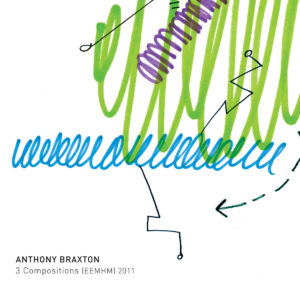
Anthony Braxton – 3 Compositions (EEMHM) 2011 Firehouse 12 FH12-01-02-020 (2016)
According to an official Braxton web site, “In this ensemble, all the musicians wield iPods [portable digital music players] in addition to their instruments, while navigating scores that combine cartography and evocative graphic notation, creating a musical tapestry combining live performance and sampled sound from Braxton’s extensive recorded discography.” He calls this his “Echo Echo Mirror House” (EEMH) musical system. Some of the digital recordings played back by the performers are easy to spot, because they include excerpts of vocalists from Braxton’s operas (none of the performers here sing) and include big band recordings that obviously include more than the septet currently performing.
Seem confusing? In the liner notes, Braxton says, “Don’t worry about it – have a fun listening experience in a music that more and more is like life itself”. But what life is that? If there is a comparison, it is like being in an apartment building or house in which people in different rooms are playing recordings and performing music, and the listener drifts around hearing bits of everything, which overlap in different ways most of the time.
This music bears some resemblance to the heyday of “free jazz” in the 1960s — one comparison might be The Marzette Watts Ensemble. But the zeitgeist of that era is long passed. So it says a lot about Braxton’s eccentric methods that they can so effectively recreate some of that same old feeling in a new way for a new time.
Connor Kilpatrick – Everybody Hates Cornel West
Link to an article by Connor Kilpatrick:
Bonus link: “Cornel West on Donald Trump: This is What Neo-Fascism Looks Like”
Sun Ra – The Soul Vibrations of Man
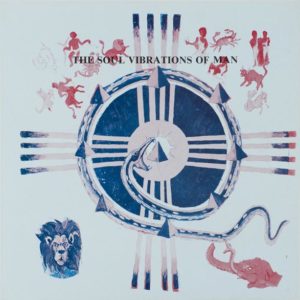
Sun Ra – The Soul Vibrations of Man El Saturn 771 (1977)
A live recording from the Jazz Showcase in Chicago in November of 1977. The first side of the original LP is a lot of odd stuff, meandering around and then ending with a space chant that blends typical Ra afro-futurism with bits of a gospel song (“I Got Shoes” AKA “Walk Over God’s Heaven” etc.). Side two has some horn charts that actually seem rehearsed or pre-written, in contrast to just about everything to that point, but then concludes with some fiery, shrieking sax playing from one or both of the altoists then Ra on keyboards. While this has an intimate feel of a casual live show, it is only on side two that it starts to seem really worthwhile. Not one for Ra newcomers.
Roland Kirk – Triple Threat
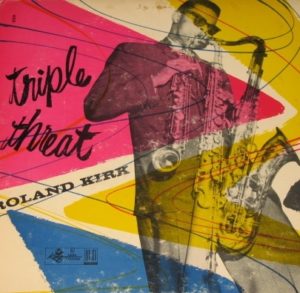
Roland Kirk – Triple Threat King Records 539 (1957)
Roland Kirk’s debut album Triple Threat is fairly solid, even if much of the best stuff seems like only rough drafts for what he would refine later. He plays with a charismatic forcefulness, leavened by some occasional (and comparatively tame) experiments and eccentric humor. Bits of this adhere too close to forgettable hard bop genre conventions of the day. Still, this is stronger than his next two albums as a leader, Introducing Roland Kirk and Kirk’s Work. Fans of his later (and better) recordings will find things to like, as will general admirers of progressive hard bop. Not an essential album, but a fairly decent one from a period when jazz was somewhat stagnating before a period of big upheaval.
Ornette Coleman – The Music of Ornette Coleman
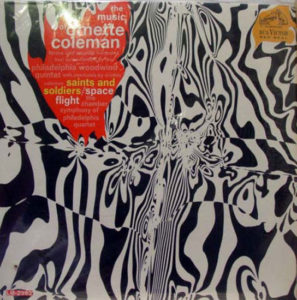
Ornette Coleman – The Music of Ornette Coleman RCA Victor LM-2982 (1967)
Ornette frequently stated that he considered himself a composer who performed. Among his greatest achievements in recording compositions for a Euro-classical ensemble is certainly The Music of Ornette Coleman (AKA Forms and Sounds). This live recording is much superior to the 1972 release of Skies of America, perhaps the best-known of Coleman’s “classical” compositions and recordings. It builds on “Sadness” and “Dedication to Poets and Writers” from his self-produced Town Hall, 1962 concert (and accompanying album).
The opening “Forms & Sounds” is an astounding piece — comparable in some regards to stuff like Stockhausen‘s “Zeitmaße” (1956) or “Kontra-Punkte” (1953). It is performed entirely on wind instruments. A density is achieved through having woodwinds players (The Philadelphia Woodwind Quintet) perform almost independently, which is to say that the notes played by each of the performers seem built from independent lines and notations rather than through overarching themes or motives. Passages with the woodwind players are interspersed with (and separated by) Coleman playing trumpet solo. Much of what he does would be classified as “extended technique” in the Euro-classical realm. His performances are stunning — as much or more captivating than what the whole woodwind quintet achieves (and they perform excellently, by the way). What really distinguishes this from European avant-garde music (Stockhausen, etc.) is the way the music shifts back and forth between the chamber ensemble and Ornette playing solo, with Ornette’s own playing being organized differently than the ensemble parts, with the occasional R&B/blues riff and offhand jazz phrasing. There are differences between the two types of playing, but they are complementary. This juxtaposition of differences without the two ever really meeting, and without one dissolving into the other, is the innovative contribution Ornette makes. Of course, the parts that resemble prior avant-garde music are simply excellently conceived and executed.
The piece “Forms and Sounds” here was recorded live. An earlier live version recorded in England appeared on An Evening With Ornette Coleman. Ornette used the money he received to record a soundtrack to the film Chappaqua (a soundtrack ultimately not used in the film, but released on an album) to finance a European tour. However, protectionist British Ministry of Labour quotas required that as a “jazz musician” certain British musicians must be engaged to play in the United States in order for Ornette’s band to be permitted to play in England. That reciprocity didn’t happen. These policies were notoriously discriminatory against pop and rock and roll music. However, the country quota regulations had a loophole for “concert artists”, a category that included Euro-classical musicians and Asian improvising musicians. So Ornette wrote “Forms and Sounds” in mid-August 1965, two weeks before the scheduled concert, and because of those efforts was successfully reclassified as a “concert artist” to enable the concert to proceed. In spite of all this, the British union still retaliated by demanding different performers for the opening act and then later blacklisted the people who helped Ornette organize the concert. The British musicians union pulled the same stunt when he returned years later, forcing him to compose “Emotion Modulation” (a backstage rehearsal of the “Aos” section of that piece appears on Yoko Ono/Plastic Ono Band). In spite of its unusual origins, “Forms and Sounds” is still a notable composition, and the version here is superior to the earlier recording, which lacked the trumpet interludes performed by Ornette himself.
“Saints and Soldiers” is Ornette’s reflection on how the remains of both revered saints and lowly soldiers end up in jars after their deaths. Strings (The Chamber Symphony of Philadelphia Quartet) are used instead of wind instruments — Ornette does not perform on the track. It is yet another instance of Ornette’s politics influencing the way he writes music, with a dogged interest in radical egalitarianism showing through. From a technical perspective, it is less innovative than “Forms & Sounds.” In a way, this piece might be one of the first to highlight a question that would take on increasing relevance in Coleman’s music, especially in the 1970s and 80s with his fusion band Prime Time. That question might be framed as one of federalism. Fredric Jameson wrote about Thomas More‘s book Utopia (1516):
“More’s solution — to make all the subdivisions of his utopia equal in all respects — is a mechanical one, which casts some doubt on the equally mechanical uniformity of its citizens. Federalism is the central political problem of any utopia…” Fredric Jameson, An American Utopia: Dual Power and the Universal Army (2016), p. 79.
This echoes a criticism that can be leveled at Ornette and his “Harmolodics” system of musical performance. He organizes the music very mechanically sometimes. Here on “Saints and Soldiers,” he locks some of the woodwind players into rather rigid roles to hold them all equal. The piece, on the whole, is still moody and effective.
“Space Flight” is the closer, and the shortest piece on the album. It is played very staccato, again all on strings. It has a punchiness or fire not found on “Saints and Soldiers.” While hinting at afro-futurism, this might be seen more generally as part of Ornette’s ongoing fascination with space exploration — he later composed for NASA — and technocracy — in a later interview he described techno futurist R. Buckminster Fuller as his number one hero. The song makes a fitting closer to the album, looking forward to the “space age” with hope and determination.
Today Ornette’s recorded work from the later 1960s is less known than what came before or after, partly due to fewer reissues, but The Music of Ornette Coleman is a crucial recording in his catalog. It presents a unique and important facet of his career. Even if less widely available than many other Coleman recordings, this one is worth seeking out.
The Stooges – The Weirdness
The Stooges – The Weirdness Virgin 7243 8 64648 2 8 (2007)
So wrong, so wrong, so wrong. Reviewer BradL wrote about Dylan‘s Christmas in the Heart that “[a]nyone can make a mediocre record. It takes true genius to make a wretched one.” Iggy Pop has earned some ignoble piece of genius here because this is about as bad as they come. You have a band calling itself The Stooges that only manages to sound like a tenth-rate Stooges knock-off. File this alongside Heard Ya Missed Me, Well I’m Back and 15 Big Ones as another “comeback” album that should have never been.
Timothy Shenk – When Slaveholders Controlled the Government
Link to an interview with Matthew Karp, author of This Vast Southern Empire: Slaveholders at the Helm of American Foreign Policy (2016), by Timothy Shenk:
“Booked: When Slaveholders Controlled the Government, with Matthew Karp”
Bonus links: “When the South Held the Keys” and “Abolitionism: a Study Guide”