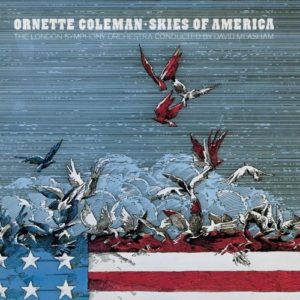
Ornette Coleman – Skies of America Columbia KC 31562 (1972)
Skies of America is one of the most perplexing — and frustrating — albums in the Ornette Coleman discography. For one, it was recorded with significant technical and logistical restrictions: the performance would not fit on a single LP and had to be edited for release; it was recorded in the UK and local musicians union rules prohibited Ornette’s desired staging (which would have included his regular band alongside a full symphony orchestra); and rehearsal time for the symphony was limited to the point of inadequacy.
This album was an unmistakable signpost that Ornette was having what can only be described as delusions of grandeur. The humility that was always one of the most attractive features of his music was receding. In his early career he sought to find any avenues to pursue his music, first by finding musicians who would play with him, then to having paying gigs and some recognition by other musicians. Those things seemed like enough for him for a while, though he was notoriously fickle about compensation and sought to sidestep the music industry through self-staged performances like the famous Town Hall 1962 concert. Now he seemed to be seeking external validation and acceptance by the musical establishment, the general public, and the bourgeois. These weren’t exactly humble goals. By the end of the 1970s he seemed genuinely convinced (according to his mangers at the time) that he should achieve popular fame to equal that of any pop superstar, and also that he should earn millions of dollars (as he noted in interviews). If these things don’t seem to bear directly on the music, a quick comparison of his recordings from a decade earlier reveal significant departures, and these are plausible explanations for them.
The music itself is what is typically called “third stream” music: a synthesis of jazz and classical music, usually in the form of completely notated, scored music that resembles the improvisations of jazz. Ornette has mostly written music for a full symphony that sounds a bit like what his small jazz combos played, with him soloing in brief passages. Yet a nagging issue with the score is the orchestration. It makes scant use of the possibilities of a full orchestra. Mostly the players play homophonically, with the entire orchestra moving in unison (for what it is worth, conductor John Giordano re-orchestrated the entire piece in the mid-1980s, with Ornette’s assistance, and that version was performed multiple times). This brings up a number of contradictions. Ornette often spoke about “unison” as a principle of his music, but in the jazz context that meant having independently improvising players choosing to work cooperatively, whereas in the symphonic context it meant merely a kind of dictatorial power over the score that the entirely symphony plays. Also, using a full symphony seemed decadent, and the same results could seemingly be achieved using a smaller chamber group. For instance, Ornette had composed other (and underappreciated) pieces for smaller chamber groups, like “Dedication to Poets and Writers” (on Town Hall, 1962) and “Forms and Sounds” (on The Music of Ornette Coleman). In some ways, these things seemed less like musical achievements than social grandstanding, with Ornette putting a feather in his cap to say that he had commanded the sorts of resources necessary to have a full symphony perform a composition. Moreover, the insertion of Ornette playing jazz saxophone solos on a few songs seems to add little to the piece, other than to insert Ornette as a distinct and individual personality into proceedings that are otherwise dominated by the collective sound of the orchestra — though “The Men Who Live in the White House” does point to his light, airy later-career performance style. The syncopation added by the symphonic percussionists at times also seems a bit clumsy.
In all, this is a problematic recording to say the least. The underlying compositions do have merit, which does shine through. However, the way it was realized and recorded leaves much to be desired. In hindsight, this was a sign that the 1970s were going to be rocky when it came to Ornette Coleman recordings.
My own view of the album tends to vary widely depending on when I hear it. I can listen to it and think that Ornette is a complete dilettante, and another time listen to it and think it is inspired if still hampered in how it was recorded. My feelings are mixed. I can say that I find a 1987 bootleg recording of a live Italian performance of a re-orchestrated version of the piece to be far superior to this one.