Johnny Cash – Orange Blossom Special

Orange Blossom Special

Johnny CashOrange Blossom Special Columbia CS 9109 (1965)


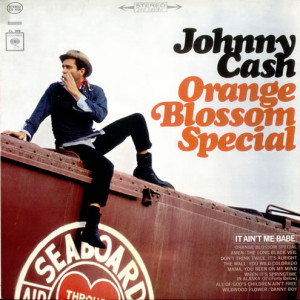
Johnny Cash didn’t always make great albums.  Sometimes, especially into the 1970s, he was more of a live performer and going to the studio to record was an afterthought.  As a result there was frequently a great song or two and a bunch of mediocre filler.  In the 1960s he did a number of concept albums.  These would often get off on the wrong foot, like Blood, Sweat & Tears opening with an overly-long “The Legend of John Henry’s Hammer.”  Orange Blossom Special fits into his concept album era.  It was Cash making overtures to the urban folk revival movement.  He had already appeared at the Newport Folk Festival in July of 1964, and later that year he was in the studio recording this album.  It’s an odd thing really.  There is an offhand quality to this, and Cash hardly seems to be pushing himself.  But it’s still a fun one.  The opening “Orange Blossom Special” is a railroad song — Cash loved railroad songs.  It’s a weaker, almost forced performance.  But the album picks up.  Cash considered himself a collector of songs.  So it’s no wonder he came to Bob Dylan pretty early on.  While recording At San Quentin he even announced to the audience that Dylan was a great songwriter.  There are three Dylan songs here.  “It Ain’t Me Babe” is the pick of the bunch.  It may just be the definitive reading.  “When It’s Springtime in Alaska (It’s Forty Below),” a duet with June Carter but not a Dylan song, is the other classic here.  In all, the song selection is superb.  It’s eclectic enough to include The Carter Family‘s standard “Wildwood Flower,” the Irish folk tune “Danny Boy,” and the rousing religious number “Amen.”  There may be better performances of some of the songs like “Long Black Veil” and “The Wall” on At Folsom Prison, but the quirky performances here keep things fresh so that even listing to this back to back with other versions nothing would drag.  It may take a few listens to come around to this one.  But it is such a pleasant, unassuming little album that touches on so many classic themes of love, god, murder and liberty that run through Cash’s entire body of work that fans may find themselves coming back to this one more than most.
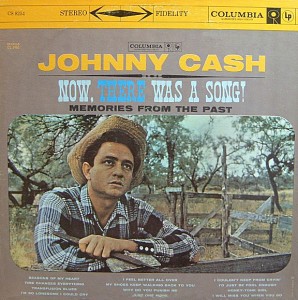
Johnny Cash – Now, There Was a Song! Memories From the Past

Now, There Was a Song! Memories From the Past

Johnny CashNow, There Was a Song! Memories From the Past Columbia CS 8254 (1960)


When Cash moved to Columbia Records, his first few albums continued where he had left off at Sun Records.  There was a mixture of teen-idol material, now having more elaborate production, with gospel and folk.  These early Columbia albums were produced by Don Law.  Now, There Was a Song! featured the addition of producer Frank Jones.  Law and Jones would continue to work with Cash for most of the decade.  Together, the three created a series of concept albums — though the “concept” is more stylistic than thematic here.

Most of Cash’s music revolves around his trademark boom-chicka-boom rhythm and relatively simple instrumentation, with rock ‘n roll influences that separate it from most commercial country music.  Now, There Was a Song! paired Cash and The Tennessee Two with a fiddle, pedal steel guitar, and piano, with more conventional honky tonk settings and rhythms.  The thing is, it works!  The covers are perfectly selected — even if “Cocaine Blues” is forced to appear as the censored version “Transfusion Blues”.  Cash sounds like he loves these songs and is thrilled to be performing them.  He was on top of the world at this point in his career.  He was enjoying plenty of success, and drugs and the grind of touring had yet to take their tolls on him.  Sure, this one clocks in at barely over 26 minutes, but it’s nice to have nothing but great tunes rather than a set bogged down by a lot of inferior filler.  This is one of the man’s most consistently good albums, even if paradoxically it’s probably least representative of his trademark sound and somewhat like a lot of other country recordings of the 40s and 50s.

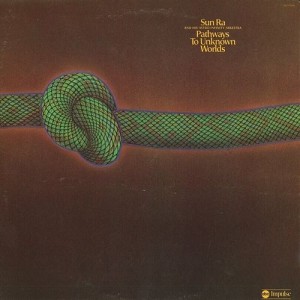
Sun Ra – Pathways to Unknown Worlds

Pathways to Unknown Worlds

Sun Ra and His Astro Infinity ArkestraPathways to Unknown Worlds Impulse! ASD-9298 (1975)


Just three tracks on this album, but the opener “Pathways to Unknown Worlds” and the closer “Cosmo-Media” are great ones.  My friend Patrick says there isn’t another album in the Sun Ra catalog quite like this.  It has some of the sparse, fluttering free soloing popular with European free jazz (AKA free improv) players, which Sun Ra had already featured on The Heliocentric Worlds of Sun Ra, Volume 2, and even the two Nuits de la Fondation Maeght albums.  But especially from about three-quarters into the title track, and throughout “Cosmo-Media,” there are also more electronics, which makes this more like some of the primarily solo keyboard excursions on The Solar-Myth Approach, Vol. 1, even Atlantis and bits of Space Is the Place.  Ra was incorporating early synthesizer sounds into a small combo setting, which he would do a lot more of later in years to come (Disco 3000, Media Dreams, Oblique Parallax).  The freely improvised soloing found here would not be as relentless in the later years, instead used a bit more sparingly as a change of pace.  Still, nothing in the Sun Ra catalog has such abstract soloing while still managing to be a part of music that is mellow and calm — to a point.  If that isn’t clear, what I mean to say is that this mostly isn’t played like a continuous wall of noise.  There is a lot of space between the notes and some separation between individual performances, but also some semblance of a futuristic sonic fabric at the same time.  Bassist Ronnie Boykins plays boldly and he’s a big feature throughout.  Rarely is an acoustic bassist so prominent on a Ra album.  This one seems like it looks back and ahead at the same time, to things few people paid attention to at any point before, during, or since!  The quality of the solos and the openness of the soling will please Ra fans, though newcomers (at least those not keyed into free jazz) may wish to start elsewhere.  A reissue of the original Pathways to Unknown Worlds adds a bonus track from the original session that was on defective magnetic tape, restored with the aid of modern technology, plus an entire rejected, previously unreleased album tentatively entitled Friendly Love that is a bit less challenging in the solos and coupled with a more persistent base of percussion (yet is still quite nice).

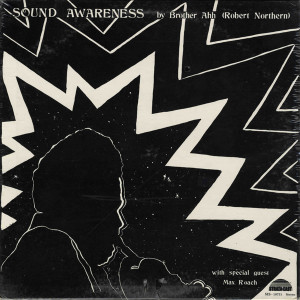
Brother Ahh – Sound Awareness

Sound Awareness

Brother Ahh (Robert Northern)Sound Awareness Strata-East SES19731 (1972)


Robert Northern (A/K/A Brother Ah) was a noted French horn player and flautist who worked with Sun Ra, The Jazz Composer’s Orchestra, The Thelonious Monk Orchestra, and others.  Sound Awareness, his debut as a leader, features two side-long suites.  The first side employs a psychedelic echo/phasing effect like some of Sun Ra’s early 1960s recordings (Secrets of the Sun) blended with Third Stream compositional detail and refinement.  An Afro-conscious worldview is also at work, something with quite a bit of momentum in 1972, relatively speaking.  That is particularly apparent on the second side with a sort of rapped/spoken word recitation set against a percussive backing.

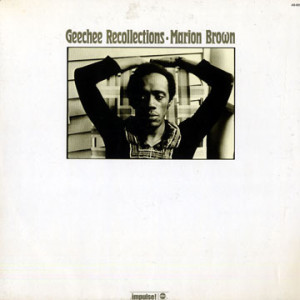
Marion Brown – Geechee Recollections

Geechee Recollections

Marion BrownGeechee Recollections Impulse! AS-9252 (1973)


Excellent album from Marion Brown, who never quite achieved the renown he probably deserved.  Geechee Recollections is sort of a mixture of free jazz and a touch of acoustic jazz fusion.  It’s like a more low-key version of stuff coming out of St. Louis around the same time period (Julius Hemphill et al.).  There is something pretty unique and likable about this mellow vision of avant jazz.  Though Sweet Earth Flying might be a little better-known, this one is my favorite Brown so far.

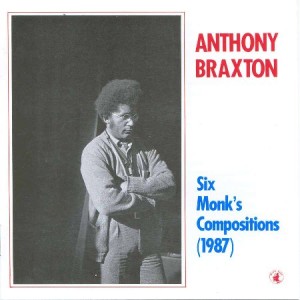
Anthony Braxton – Six Monk’s Compositions (1987)

Six Monk's Compositions (1987)

Anthony BraxtonSix Monk’s Compositions (1987) Black Saint 120 116-1 (1988)


Anthony Braxton regularly played standards — some of those efforts from the 1980s being quite abysmal — but a whole album dedicated to one jazz composer was unique (even if Braxton returned to that concept later).  Six Monk’s Compositions (1987) is something of a doppelganger of Steve Lacy‘s Reflections: Steve Lacy Plays Thelonious Monk from almost three decades previous.  Consider this: four of the six tracks here appeared on Lacy’s album, and both Mal Waldron (p) and Buell Neidlinger (b) played on both albums.  Braxton is at his most approachable.  He strikes a pleasant balance between faithfully playing these great songs and twisting things about just a bit in his solos.  It helps that these are Monk‘s songs, where the winding melodies and jittery rhythms seem like a perfect fit for Braxton’s biting, intellectually playful style.  This is a rather good Braxton release, and really must be one of his best “straight jazz” outings.  “Brilliant Corners,” “Reflections” and “Played Twice” are standouts.

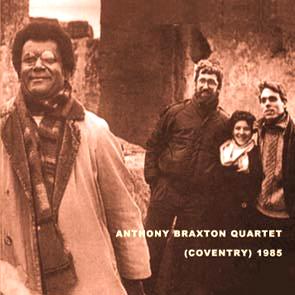
Anthony Braxton Quartet – Quartet (Coventry) 1985

Quartet (Coventry) 1985

Anthony Braxton QuartetQuartet (Coventry) 1985 Leo CD LR 204/205 (1993)


Recorded on the same tour as Quartet (London) 1985 and Quartet (Birmingham) 1985, also documented in Graham Lock‘s book Forces in Motion: Anthony Braxton and the Meta-Reality of Creative Music (A/K/A Forces in Motion: The Music and Thoughts of Anthony Braxton).  This was the final show.  Supposedly the group made an extra effort to perform well in that last tour performance for the benefit of the recording.  Braxton had by this point clearly broken away from the sorts of things he was doing with his first great quartets with Altschul, Holland and Wheeler or Lewis in the previous decade.  His compositions and methodologies had undergone great changes too.  Each musician has a “territory” specified beforehand by Braxton, which serves to facilitate interaction and provide a starting point, but ultimately there is no limit on what each performer can do in his or her territory.  Like composer Ruth Crawford Seeger, he was also using material that could be played simultaneously — he called it coordinate music.  In hindsight, these methods laid the foundations for the more elaborate renderings of Braxton’s Ghost Trance Music of the next decade.  This double-CD set also includes recorded interviews between Braxton and Lock used as the basis for parts of Lock’s book.  The cover photo is of the quartet at Stonehenge, with Braxton wearing one of Evan Parker‘s old coats because he absentmindedly forgot to bring one of his own for the tour.

Marianne Faithfull – Broken English

Broken English

Marianne FaithfullBroken English Island ILPS 9570 (1979)


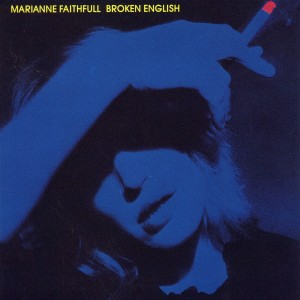
When rock and roll arrived in the 1950s, it was fundamentally a young person’s game.  It took a while, until a generation of people who came of age after the birth rock grew up, for rock to adapt to the context of — if not middle age — at least the age when the energy, idealism and intransigence of youth wear off.  So like a late 70s counterpart of Neil Young‘s Tonight’s the Night, and something of a partial precursor to Lou Reed‘s The Blue Mask, Broken English is a chronicle of trying to pull one’s self together at a time in life when there are plenty of mistakes to look back on.  You could maybe even throw Magazine‘s Secondhand Daylight into that category too.  There is no doubt this album sounds at least a little dated, with a tinge of the disco era lurking in the softened bass-heavy grooves.  Even if it doesn’t completely succeed, this album makes attempts at opening up new territories for rock music.  There is a sense of looking back and finding yourself to blame for every misstep and missed opportunity.  Imagine it this way: an effervescent and up-and-coming French chanson star is giddily on her way into a recording studio, but a coughing, wheezing figure walks out — nearly staggering — from a dark corner and with a gruff voice she offers a forbidding warning about how the future will really turn out, offering the disheartening forecast in…”broken English.”

Scott Walker – Scott 3

Scott 3

Scott WalkerScott 3 Philips SBL 7882 (1969)


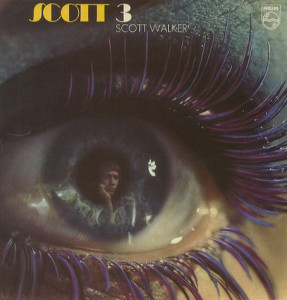
Mr. Walker washed away every trace of duality on Scott 3. The beauty of his music comes through its resilience. Like a purple and sepia whirlwind. Fiercely strong from some inner source he taps. The primary mystery of Mr. Walker’s music is the absurdity of its context, casting Frank Sinatra or Tony Bennett as steadfast existentialists. Each grand orchestral piece finely feeds personal concerns that meander about without dogma to guide or crush them. The great achievement is the dive into the void of pop crooning. In that void is the perfect space to make something happen. Mr. Walker’s gift was perhaps the vision to find his space, that invisible blank abyss which seemed to have always been in plain view. He recognized something was possible in his space, his nothingness.

This album lives in daylight, like a vista warmed into life by the sun. It is quite a different experience from the nighttime torment of Scott 4. It is lyrically imposing. The songs are difficult to penetrate, alien to prevailing reason. Still, the detached experience of hearing Mr. Walker question prevailing reason is what makes the album such a major achievement.

Though Mr. Walker’s name always carried little cachet in his American homeland, worldwide success wouldn’t have led to Scott 3. To parrot his lyrics, “In a world filled with friends/ you lose your way.”

Johnny Cash – Man in Black

Man in Black

Johnny CashMan in Black Columbia 30550 (1971)


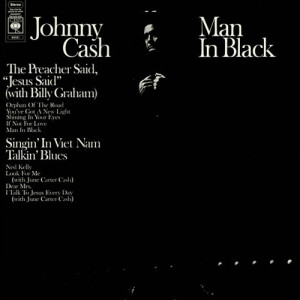
The accepted wisdom is that sometime around the 1970s Johnny Cash’s music became effete.  It would be unfair to place any blame for that on Man in Black, which, aside from the still-better Ragged Old Flag, has to be one of his best offerings until the American Recordings two decades later.  Here he adopted a folky, singer-songriter style reminiscent of Orange Blossom Special or Hello, I’m Johnny Cash but more stripped down.  It works, and it works well.  Now, let’s get one thing out of the way.  The opening song “The Preacher Said, ‘Jesus Said,'” with its grating narration by Billy Graham (whom Malcolm X called a “white nationalist” and who advocated war crimes during the Vietnam War), is difficult to stomach.  Cash’s “born again” christian sentiments get the better of him, and it certainly wouldn’t be the last time.  If you can look past that first track, the rest is a lot more rewarding.  “Orphan of the Road” is a highlight, and makes it interesting to contemplate how a collaboration with John Fahey might have sounded.  Other songs like “You’ve Got A New Light Shining In Your Eyes,” with its clear and bright vocals, and “Man in Black,” with its empowered tone, are quite good too.  Side two features some interesting songwriting from Cash.  The beautifully honest “Singing in Vietnam Talking Blues” (sung to the same rhythm as “A Boy Named Sue”) is an autobiographical account of a USO performance for U.S. troops fighting in Viet Nam.  He sings:

we did our best
to let ’em know that we care
for every last one of ’em
that’s over there
whether we belong over there or not

That last line — just sort of tossed in — is really the sort of thing that separates Johnny Cash from so many other country musicians.  Reactionary populism runs pretty thick with a lot of country stars (check: Merle Haggard‘s The Fightin’ Side of Me), but few are or were willing to even imply sympathy with protest or peace movements.  But Cash was always cut from a different cloth.  He sang songs about the North, about Alaska and Minnesota.  He also would sing songs for prisoners, like “Dear Mrs.” here.  It’s hard to pin down Johnny Cash on his politics.  He always dodged those issues pretty successfully, in part because he sometimes seemed to play both sides (“Ragged Old Flag” or “The One on the Right Is on the Left” anyone?).  In concert he once called himself a “dove with claws.”  But his ability to successfully and quite matter-of-factly broach a lot of difficult and unpopular subjects (Bitter Tears: Ballads of the American Indian) and still maintain celebrity status was impressive.