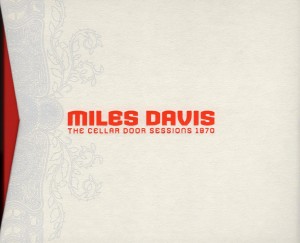
Miles Davis – The Cellar Door Sessions 1970

The Cellar Door Sessions 1970

Miles DavisThe Cellar Door Sessions 1970 Legacy C6K 93614 (2005)


I have some opinions on Miles’ electric period, and on his early 1970s electric period in particular (like what we have here), that might differ from the conventional wisdom.  I think the 1970s might have been Miles’ most consistently interesting period.  I think you can get more from a single song in this period that you get in entire albums the man put out in the 1950s.  There is an open-mindedness, a fluidity that I don’t think any other recording artist has ever really achieved on such a massive scale.  With this particular band, I think there a number of interesting developments that make this set stand out.  These are probably the best recordings Keith Jarrett has ever made.  I know that he talks trash about playing electric with Miles, but frankly, his later solo stuff is just plain boring.  Then there is Gary Bartz.  Compared to the next few saxophonists Miles used up through his silent period, I think Bartz was the most interesting.  He played these long, extended lines — I would even call them thin lines too.  I dig ’em.  The clarity of his lines doesn’t overwhelm the songs, but provide a constant thread throughout his solos despite the looseness of the accompaniments.  I don’t think anyone else really took that approach on a sax in an electric setting.  It adds a cohesiveness by making it difficult to focus on any little bit of the music for too long.  Bartz also could blast his way through a funky, rock-oriented setting without being drowned out better than Miles’ previous sax man Wayne Shorter.

Another area of disagreement with the conventional thinking for me is that I think Miles and Teo Macero did a good job of editing material for release.  People complain about the At Fillmore: Live at the Fillmore East album being heavily edited, but I think the final results sound great, whereas some of the unedited material from roughly the same period (In Concert: Live at Philharmonic Hall) sounds terribly unfocused.  And I think this plays into my belief that Miles was actually fine tuning his approach through the 1970s.  He was more consistent just before his temporary retirement than when the 70s opened.  So, getting back to this Cellar Door set, I think it has a very loose, jammy sound to it.  Occasionally, the band muffs something or other.  Bassist Michael Henderson sometimes hasn’t fully integrated himself into the band until some of the later sets.  You also might not call this the strongest playing from Miles himself, at least not consistently.  But no matter.  I think this is very enjoyable and interesting stuff.  Lots of energy.  Perhaps the edited, reorganized presentation that ended up forming most of Live-Evil sounds just a bit better on the whole.  But this unedited presentation still sounds fine — actually better than just fine most of the time.  With adequate time to sit back and enjoy this whole damn collection on its own terms, with the occasional missteps and the more tentative early sets all included, the band still can cook.  That’s what it was always about.

Kelan Phil Cohran & Legacy – African Skies

African Skies

Kelan Phil Cohran & LegacyAfrican Skies (1999)


An eclectic and cool album from shamefully neglected Chicago musician Phil Cohran and his group Legacy.  Cohran was a one-time member of Sun Ra‘s Arkestra and a co-founder of the long-running and influential AACM organization.  African Skies was recorded live in 1993 at the Adler Planetarium in Chicago.  “White Nile” and “Blue Nile” are calm and fragile songs, with lots of strings, including harps — reminiscent of Brother Ah‘s Key to Nowhere. “Cohran Blues” has an almost rag-style beat, and it probably wouldn’t surprise if Leon Redbone had popped in for a vocal.  “The Dogon” features Cohran on his Frankiphone (his custom modified African thumb piano), which will take some listeners back to songs like “The Minstrel” from Cohran’s classic On the Beach with the Artistic Heritage Ensemble.  “Kilimanjaro” gets to that distinctive Cohran rhythmic style.  All this music takes influence from around the world. It’s an approach a little like Don Cherry but more composed.  It’s wonderful to see so many Cohran recordings in print on CD.  These things are more available now than ever.

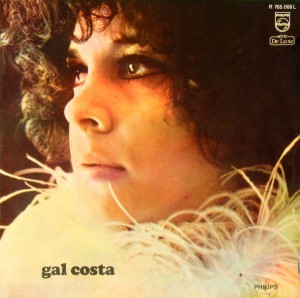
Gal Costa – Gal Costa

Gal Costa

Gal CostaGal Costa Philips R 765.068 L (1969)


Recorded for the Philips label, there are definite parallels between Gal Costa and the recordings of other Philips artists working elsewhere around the globe — Nina Simone, Scott Walker — plus psychedelic rock akin to The Beatles or even The Monkees circa Headquarters.  Costa’s second album has a more immediately recognizable internationalist flavor though.  She brings together uniquely Brazilian music with that of the UK and USA.  The album is the product of the turbulent times of the late 1960s, when it seemed like there was this force building to topple the corrupt, oppressive forces that ran governments and institutions around most of the globe.  Rather than pushing overt and militant protest music, Costa and her cohorts just sort of assumed that context in a sympathetic way, urging it, yes, and subduing some of their intents, but also adapting to what was happening elsewhere and connecting those things to their own lives.  As part of the Tropicália movement, this was a counterculture, working its way out from a military dictatorship in a South American country on the periphery of the global economy.  What makes the music still sound so fresh decades later is that it really puts effort into adapting so many influences in a way that is not beholden to the specific contexts of any of them.  This was a very modern project, expanding on the (fundamentally christian) idea of universalism (in a secular way) by taking away the oppressive meaning of existing musical symbols and trying to establish a new more open cultural platform where everything is equal.

The album opens with the stupendous “Não identificado” (English translation: “unidentified”).  There is some psychedelic noise in the intro, but then the song adopts a warm walking bass line, briefly features a leisurely organ melody, and builds a cautiously bright string treatment before Gal starts singing a bossa nova melody.  It is a densely layered arrangement, which later on calls back various elements introduced early in the song in new ways, never quite settling into any sort of repetitive verse-chorus-verse template.  The vocals are light, unmistakably Brazilian.  Gal sings with an airy touch without resorting to meek breathiness.  No doubt, arranger Rogério Duprat is a key to the success of the song.  Much like Paul Buckmaster on various projects in the UK and USA, he took a deeply sympathetic approach to his work with Costa.  He had studied with Karlheinz Stockhausen and Pierre Boulez, bringing those modern European classical influences into popular music (just like Buckmaster).  Duprat places different music forms usually segregated by the economic classes of their audiences on a level plane, so that low, high and middlebrow cultures rub shoulders amicably.  It isn’t that he creates meaning through juxtaposition, but that he fosters a scenario in which a new meaning emerges that is not really strictly directed by the coordinates of the constituent elements — it is a crude analogy, but think of a connect-the-dots picture than when completed renders an optical illusion.

Much in the vein of Frantz Fanon and the spirit of the Third World project (from the Bandung Conference to the Non-Aligned Movement), musicians like Duprat sought to overcome colonial subordination and be viewed as equals on an international basis.  From that standpoint, the music of Gal Costa makes perfect sense.  It blends musical styles from around the globe.  And rather than use those varied styles merely for superficially “exotic” effect, there are real, substantive contributions to each of those genres, in a kind of post-Einstein relativist framework that treats each as valid in its own ways.  Unlike music that made a complete revolutionary break with what came before, Gal Costa — like other contemporary Tropicália recordings — maps a kind of path from legacies and external music to new international music trends.  This music never doubts its connections to everything from the May 1968 French student uprising to the Summer of Love to the 1968 Democratic National Convention, while facing arguably greater repression from a military dictatorship in Brazil.  They were making an argument for revolution in South American terms, more like the Salvador Allende government in Chile, or the civil part of the Carnation Revolution in Portugal, positing that radical change could happen through the force of peaceful argument.

“Lost in the Paradise” has lyrics in English and a more uptempo soulful groove.  As the song begins, a muted trumpet (or cornet) plays in the style of a Miles Davis & Gil Evans collaboration (Porgy and Bess, Quiet Nights).  The song is followed by “Namorinho de portão,” with fuzzed-out psychedelic guitar — although the backing musicians are uncredited, and aside from the strings and horns, it is likely the band Os Brazões who supported Costa at live shows around this time.

Another highlight is Caetano Veloso‘s “Baby.”  It was kind of a movement standard, though many consider Costa’s the definitive reading.  Here it opens with slow rapping on a wood block, then a guitar strums a few times.  The vast space present between raps on the wood block and the few strums of the guitar make it almost impossible to sense or predict how the song’s rhythms will settle out.  Just as the rhythmic ambiguity threatens to become disconcerting, a drum kit presents a samba-like beat and a string section enters.  The strings play shimmering harmonies in layers, with overlapping washes of sound that move to a new, higher-pitched layer before the last fully resolves.  The impression is of rapid reconfiguration of the basic aims of the song, as if it heads in directions never contemplated when the song opens — just seconds earlier!  Once Gal starts singing a fairly conservative (by comparison) melody that recalls a typical love song, it locates a human constant amid the radical arrangement by Duprat.

Elsewhere on the album, the songs are a little more conventional, if that is a fair characterization.  Some of the horn charts are not too far off from Sérgio Mendes & Brasil ’66, just a little punchier.  Gal’s vocals are always smooth and elegant.  It is easy to look past this album to others of the Tropicália movement with more far-out and funky psychedelic guitar and more electronic and reverb effects.  Yet there is a lot about Gal Costa that is daring.  Gal Costa came to the Tropicálists a bit late, in some ways, and was one of the most conventional singers of that cadre.  Yet it is a testament to the movement that it was open to a singer like Costa, and to her that she could blends in so well with the scene and deliver an album as good as this, and as hard to pigeonhole in any one (or two or three) discrete genres.  For those reasons the themes and intents behind the album are deeply consistent in a way that goes well beyond most such efforts.  Maybe that is why this has remained a kind of watershed recording for so long.

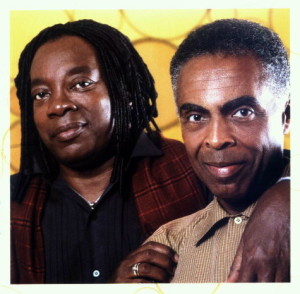
Gilberto Gil & Milton Nascimento – Gil & Milton

Gil & Milton

Gilberto Gil & Milton NascimentoGil & Milton WEA 857382810-2 (2000)


Brazilian tropicalia legend Gilberto Gil teams up with longtime Brazilian pop star Milton Nascimento for Gil & Milton. The results are unspectacular. At times the record is downright boring but not without the occasional gem. As nothing more than a slick commercial album, dredging through the entire album is a chore. This is a far cry from the vibrant music these fellows made in their youth.  The main problem here is the heap of gloomy songs lacking an edge. There just is not enough camp to salvage this one from easy listening hell. There is much better tropicalia/bossa nova type stuff out there than this trite, sentimental crapola.

“Trovoada” is brilliant (by far the best song). It features split songwriting by the duo. On the next cut, the watery reggae on a cover of George Harrison’s “Something” spoils the moment. Then drum machines pop up in annoying fashion on “Maria.” You may get your hopes up occasionally but those good vibes fade quickly. Generally, the new compositions are the better tracks. Even those better ones hardly deserve a yawn.

Superb individual vocals are wasted. All the arrangements are predictable, save some nice instrumental moments — like Gilberto Gil’s accordion on “Duas Sanfonas” and acoustic guitar on quite a few others. The duo almost never sings harmony. They trade verses but in an eerie way never seem to sing together. Vocal recordings happened separately and only came together later on a mixing board, much to the chagrin of listeners.

Without any offense to some fine artists, this is a poor album. At best, Gil & Milton sounds like self-parody. Some of the lyrical impact may be lost on those of us who only speak English, but no lyrics could rescue Gil & Milton. This album is quite a disappointment.

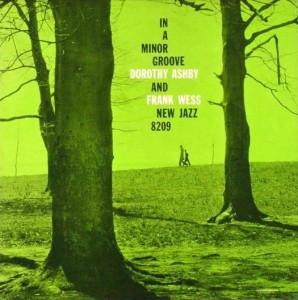
Dorothy Ashby and Frank Wess – In a Minor Groove

In a Minor Groove

Dorothy Ashby and Frank WessIn a Minor Groove New Jazz NJLP 8209 (1959)


Jazz music tends to be played on a fairly well-defined set of instruments.  The bagpipes, accordion, cimbalom, any sort of double-reed instrument… there are plenty of things that just don’t pop up that often, and when they do they are used sometimes only for a novelty effect.  Harpist Dorothy Ashby and flautist Frank Wess bring together two such rarely played instruments for what turns out to be an impressive hard bop album, In a Minor Groove.  The mood is that of a hip, bohemian club (sort of a whole album along the lines of Sun Ra‘s “Lullaby for Realville” or maybe some early Eric Dolphy recordings).  The delicate timbres of the harp and flute contrast with the punchy qualities of the drums and acoustic bass, giving the music an inherent interest even when rooted in familiar hard bop structures.  Yet the players don’t content themselves with merely offering some unusual instrumentation.  The playing is superb.  Ashby was widely regarded as the best harpist in jazz.  Her and Wess play with assurance.  Drummer Roy Haynes is particularly effective.  He lays back and uses brushes a lot, with embellishments limited to just a slightly harder attack now and then.  But his happy-sounding and very understated performances is perfect for the music.  This is forward-looking bop, and about as good as “inside” music of the era got.

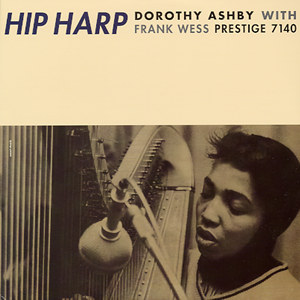
Dorothy Ashby With Frank Wess – Hip Harp

Hip Harp

Dorothy Ashby With Frank WessHip Harp Prestige PRLP 7140 (1958)


Dorothy Ashby’s second album expands upon her debut.  It’s jazz firmly in the hard bop mode, yet striving to do something different with the sub-genre.  She deploys some of the same techniques as she used on The Jazz Harpist before to imitate a guitar and sweep the strings on her harp to play glissandos.  But now it sounds a bit more purposeful, like she has more to express than just getting across those little tricks.  Flautist Frank Wess is with her again.  He plays more fluidly than on the debut, though his tone is a little harsh.

Dorothy Ashby – The Jazz Harpist

The Jazz Harpist

Dorothy AshbyThe Jazz Harpist Regent MG-6039 (1957)


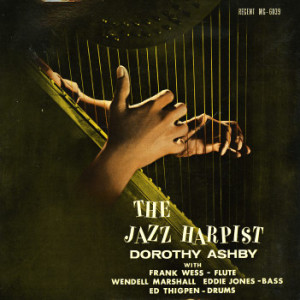
Dorothy Ashby’s debut album as a leader The Jazz Harpist gives a taste of what was to come from the woman who seems to be unanimously regarded as the greatest jazz harpist.  But at the same time this recording relies a bit too much on the novelty of having a harp in a jazz setting.  It wallows in a few gimmicks.  She uses two in particular on many of the songs: the stereotypical harp glissando (sweep) and imitation of guitar.  For the latter, she strums and plays a few melodic notes, which gives the impression of two guitarists.  It is kind of a neat trick, but she doesn’t do that much with it.  Her frequent collaborator Frank Wess is here, though his playing on flute is a little stiff compared to on the pair’s later recordings.  Ashby would just get better over her next few albums, exploring hard bop and cool jazz idioms, before she would take a turn toward soul jazz and eastern-flavored spiritual jazz.

Bobby McFerrin – Bobby McFerrin

Bobby McFerrin

Bobby McFerrinBobby McFerrin Elektra Musician E1-60023 (1982)


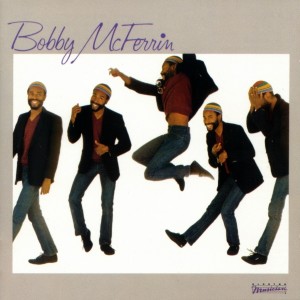
On his debut Bobby McFerrin bore some resemblance to jazz singers like Al Jarreau and Betty Carter, but lots of this material is relatively straight 80s pop that wouldn’t sound out of place on a Hall & Oates album.  Some of the pop stuff is actually decent, as on “Feline”.  Unfortunately, there are only a few a cappella (or mostly a cappella) tracks that demonstrate the unique vocal abilities McFerrin possessed.  His next album The Voice, recorded live, completely a cappella, was a major step forward, stripping away the overt commercialism of this debut.

James Carter Organ Trio – At the Crossroads

At the Crossroads

James Carter Organ TrioAt the Crossroads EmArcy B0016081-02 (2011)


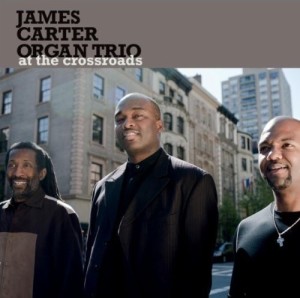
At the Crossroads has some of the benefits and all the drawbacks of any typical James Carter album. He plays to the audience, recontextualizing bits of the past with a lot of charisma.  Maybe he doesn’t reach to do this as much as he has elsewhere, but he still does it.  But he also plays in front of a band that seems a little too conservative for his solos.  When I’m feeling unkind, I would even say he pulls a Sidney Bechet and purposefully has the band sandbag by playing dull tropes to make him sound more impressive by comparison.  Anyway, there is a bit too much lazy blues and lounge-y stuff here, and the occasional vocals seem to lack any sort of edge, but occasionally it hits, like on “The Hard Blues” and “Aged Pain.”  If all this sounds like a pretty tepid endorsement, then it suits this lukewarm effort.

Mekons – Journey to the End of the Night

Journey to the End of the Night

MekonsJourney to the End of the Night Quarterstick QS60CD (2000)


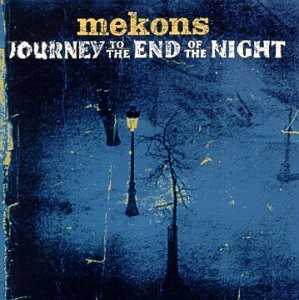
When I was listening less than a week after Lou Reed died, I contemplated how Journey to the End of the Night (like much of Reed’s later work) represents middle-aged rock.  Mekons bandmembers were in their 40s when they recorded this.  It is tempered and softened like you might expect a rock album by middle aged persons to be.  But it also has noisier guitar (“Cast No Shadows”) and harder meaning in the lyrics than the sort of “adult contemporary” or “dad rock” pabulum that is passed off as what mainstream rock audiences of comparable ages should listen to.  But this is music with more substance than that, even when it draws some cues — and it certainly does — from those more insipid genres.  Take one of the album’s best songs, “TINA”.  It’s the acronym Margaret Thatcher’s brutal regime used to declare: “there is no alternative” to her political program (still in place as of this writing).  By that she meant that her cronies in finance, who cast her in the role of “useful idiot”, were given free reign to run roughshod over the UK’s welfare state, selling off public assets for a fraction of their worth and terminating social programs, all to make the rich richer on the backs of the poor and working classes.   But this song talks about how “it looks like an accident / caused by the government”  but the singer can still say that “I can still dream of things / that have never been / but someday will be.”  It’s an attempt to convey how there is indeed an alternative, with a human face, and it’s inevitable.  This is the sort of stuff adults should care about, and here it is in a rock song with a light reggae beat.  Rather than confining rock to the endless loop and infinite permutations of personal relationships — key amongst the famous compromises in “formal freedoms” granted after the 1968 uprisings–this is making the music about the political.  Upping the ante, perhaps, is “Last Night on Earth,” which, if you can believe it, is about the origins of printed money.  A few years after this album was released, anthropologist David Graeber published Debt: The First 5,000 Years, which explains how money in human society arose to replace moral debts (not to replace a barter system, as is mindlessly repeated by most orthodox economists).  It tells the same story as this song.  So this begins, “life is a debt / that must someday be paid.”  That is the story of money.  Note also that the liner insert for this CD features photos of the signs outside an exploitative check cashing business.

Hey, but all this talk of politics and economics doesn’t really hit you at all at first.  The music sounds refined, acceptable.  That’s what makes it special.  The Mekons certainly have better albums.  But with Journey to the End of the Night (sharing its title with Céline‘s best novel, «Voyage au bout de la nuit») they demonstrate a faculty with the most difficult of prospects, that of making rock and roll that is both mature and yet still rock and roll.  It’s softened more than most, and unlike Lou Reed they take a few more shades off the driving guitar sound, leaving hardly a guitar solo to be found.  Still, it’s all within the realm of rock.  As I’ve said before, the concept of middle-aged rock is categorically rejected by many who feel rock is a young person’s game.  I think it’s a difficult proposition, a narrow terrain prone to failure, but I think rock should be open-ended enough to allow it, and I think the concept can succeed.  Journey to the End of the Night is such a minor success, not without its own flaws.