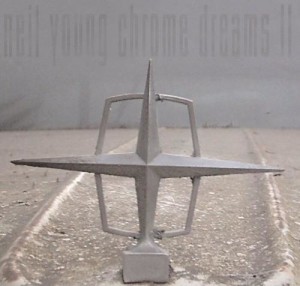
Neil Young – Chrome Dreams II

Chrome Dreams II

Neil YoungChrome Dreams II Reprise 936 249 917-2 (2007)


A very eclectic album without being uneven.  You get a real sampling of almost all aspects of Young’s music, from mellow country-rock to angry rockers.  This was the sequel (of sorts) to the unreleased 1977 album Chrome Dreams.  The highlight is “Ordinary People.”  Operating in Bruce Springsteen mode, Young really delivers on a working man’s epic.  It was dug up from the archives (from the This Note’s for You era) for this release.  The only problem at this point is that younger listeners may have no context for a song about factory workers losing jobs.  The song was from just after the first wave of the neoliberal assault on working America, wresting power and wealth away from industry and average folks (labor) to be placed in the hands of the Capital class and the FIRE sector (finance, insurance and real estate).  The first assault was against unions (key in the auto industry), shifting election funding toward purely business sources, with corporate raiders (like in the popular movies Wall Street and Pretty Woman) pillaging assets and pensions, and in adjusting tax codes to drastically reduce taxes on the rich and drastically reducing payments toward programs that benefited the poor and middle class.  The second wave of the neoliberal assault would be completed in a few years, with “free trade” agreements eliminating the possibility that domestic industry could be viable any longer, instead shifting focus to currency speculation that pillaged foreign central banks and with labor arbitrage “offshoring” jobs to distant locations with pauper labor.  So Chrome Dreams II comes during the “post-industrial” era of the USA.  Most factory jobs are long gone, so there haven’t been any to lose in a while.  Its ambitions are futile now, but Young’s “Ordinary People” narrative still resonates with conviction the heartbreak and sadness and grim determination that transcends changed circumstance — today the narrative would be about a Midwest Methland where the factory is long gone and rural methamphetamine labs open up amid the whirlwind of lives and local economies circling the drain.  In the end Chrome Dreams II proves that Neil Young is a more honest and genuine rock and roller than just about anybody else out there.  Here’s to lost causes like that.
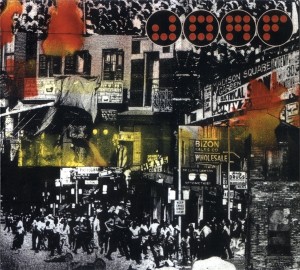
Jackie-O Motherfucker – Change

Change

Jackie-O MotherfuckerChange Textile TCD 02 (2002)


Jackie-O Motherfucker’s (JOMF’s) approach to music is syncretic. Percussive elements draw out and expand other sounds lurking in guitars and other noisemakers. The sounds are distantly familiar, but they now seem to slowly rise to a conscious level. Once a part of the music has made itself felt, JOMF move on. The progression is slow. It is also steady. JOMF pull together folk, ragas, turntablism, jazz, blues, rock. Actually, they do a good job summing up their many influences. They look upon those influences as raw material for new combinations and presentations.  This is a strange and friendly mélange of urban and rural elements.  Part of the so-called “free folk” movement, this is vaguely like psychedelic jam band music but far less prone to showiness and guitar wankery than that label suggests.

Change is a very good album. Part of what makes it so good is that each song elaborates its themes. Solos and impressive technical feats aren’t the attraction; the shifting, almost pastoral musical landscape is. This takes attention away from the individual band members. The album offers the chance experience the concepts through many perspectives. The result is big; you have to step back to take it all in. Change is an opportunity to consider where you are, in relation, then to ask if you are ready for whatever comes next. Because whatever music has in store tomorrow, it will have to be different. JOMF have covered a lot of territory, and for anyone to retrace any of their steps would be too boring. And deep under the guitars that sound like sitars, the mumbled vocals, and the saxophone that makes its humble appearances, JOMF have a positive outlook as to where things are headed. Attention: Now leaving the terrordome.

Sole – Selling Live Water

Selling Live Water

SoleSelling Live Water anticon. ABR 0026 CD (2003)


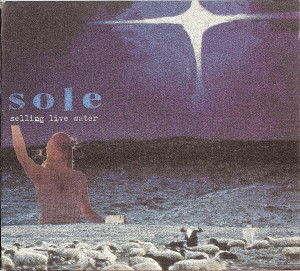
Selling Live Water is hip-hop that can’t take for granted that it is hip-hop at all.  It is music made to engage an audience and provoke critical thought.  Hip-hop is just a convenient form that it adopts.  Sole pursues his music with a fervor that concedes nothing but complete, honest commitment to his agenda.  The most appealing part of this is the self-reflexive aspect. Hip-hop has been around long enough now that a more complex look at the genre itself is due. Sole contorts traditions with no hesitation.

On “Da Baddest Poet,” Sole admits how he isn’t smart enough for any techniques other than hip-hop. The necessity of his place amidst hip-hop culture means he really is making some sort of contribution to it. Sole is just trying to keep hip-hop as good as it was, and promised to be, in the age of “conscious hip-hop”, just… different. He says, “in the immortal words of Ice-T/ shoulda killed me last year/ but in the mere mortal words of me . . . ”  There is humility here that is quite the opposite of the materialistic, misogynistic, violent subject matter promoted most heavily in the genre, combined with an awareness that Sole is tilting toward something else.

“Shoot the Messenger” goes off with “I never learned to kill for oil/ but then again I never learned to sit still/ and probably never will.” “Respect pt. 3” even seems to be a little anarchistic.  There are politics all over this album — not in the sense of passing news, but in the sense of a commitment to bottom-up social transformation away from corruption and domination (Sole has noted that material on the album was inspired by Howard Zinn‘s A People’s History of the United States).

Sole is a good lyricist though he has only a passable delivery, something still impressive given what Sole does. His lyrics are very busy, giving him the difficult task of fitting it all in. He is either silent or in vocal bombardment mode. What turns out to make it work is the jokey attitude — full of gags and purposeful contradictions. By some manner of calculation he is aware of precisely how much ferocity separates his mind and his voice. Even though his rhythms don’t stretch and his dynamics are flat, deadly words still ooze from each of Selling Live Water’s cuts.  Nonetheless, he steps up for some more impressive vocal rhythms, shifts and drawls on “Salt on Everything.”

The anticon collective producers on board (Alias, Odd Nosdam, Telephone Jim Jesus) cultivate a sort of blurred, hazy melange of oversaturated sounds, while keeping to a sense of syncopated rhythm.  The beats contribute to the bleary feeling of being overwhelmed by media and the numbing spectacle of mass culture.  This complements Sole’s way of rapping that often seems like shouting out as many words as possible without planning his delivery beforehand.

Sole makes good on the idea of personal hip-hop. He may not have expansive vocal talents to rely on, but he has still made some great music here.  To appreciate Selling Live Water, a listener must accept that important statements can be made without access to large resources or authorization by the powerful, without being a supplicant or sycophant, by anybody who puts in the effort.  If you reject those premises, then realize that this is an album made against what you believe.

Willie Nelson – Let’s Face the Music and Dance

Let's Face the Music and Dance

Willie Nelson and FamilyLet’s Face the Music and Dance Legacy 88765425852 (2013)


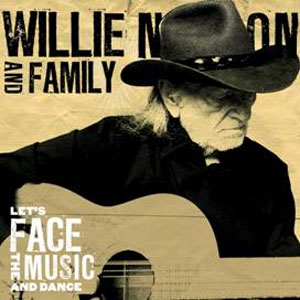
If you have followed Willie Nelson’s later career — and before his surprise hit Band of Brothers you probably haven’t — he has continued to shuffle between styles.  The occasional effort sounds a little more contemporary, but plenty look back to old-time western swing and early 20th Century pop, and sometimes jazz.  Let’s Face the Music and Dance is a grab bag.  The title track is an easy listening version of the sound from arguably Willie’s best late-career album, the austere Tex-Mex album Spirit.  “Is the Better Part Over” is yet another re-visitation of one of his old songs (from the late 1980s effort A Horse Called Music).  Most of the standards here seem to build on his American Classic, but with his regular touring band providing more country flavor than the jazz combos of that earlier effort.  Not surprisingly, the best here is “You’ll Never Know,” with Willie’s not-so-secret weapon his sister Bobbie featured prominently on piano.  This one is par for the course for Willie’s august years and hardly a standout, but it is more proof, if any more was needed, that he’s still not finished yet.

Nick Drake – Five Leaves Left

Five Leaves Left

Nick DrakeFive Leaves Left Island ILPS 9105 (1969)


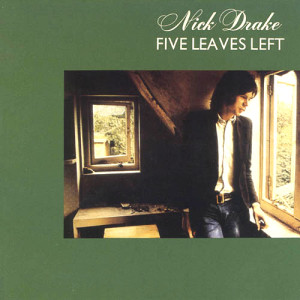
Nick Drake’s debut album Five Leaves Left was a rather unique recording that didn’t seem enmeshed in any sort of widespread movement.  Fans often remark that his music seemed to come from “nowhere”.  He never achieved much commercial success before his early death, partly due to his limited efforts to tour or promote his recordings.  Still, his renown has grown tremendously since his death.  Nick Drake is the sort of musician who came along ahead of of more widespread efforts to render a feeling of failed promise, which is to say failure to live up to potential.  This is very inward-looking artistry.  Extroverts may appreciate Drake from a distance without really warming to him more intimately.  His music is somewhat elitist.  Its lyrics are informed by the sort of poetry studied in “classics” courses in elite universities, and the orchestral treatments and delicate guitar playing (Drake was an impressive guitarist) pay homage to Euro-classical compositions.  Yet these are pop songs, which underscores the way the music has a familiarity with highbrow culture but turns away from it, if only slightly.  It is the devastating earnestness of Drake’s songwriting and performances that keeps this from being pretentious.  This album leans toward the counterculture, but from a privileged place that manages to satisfy every criterion of dominant culture.  More than anything, that was Drake’s real achievement.  He managed to hold together seemingly incompatible forms in a way that never for a second seems like a juxtaposition at all.  The stark, flawless Pink Moon may well be Drake’s finest album, but Five Leaves Left is great too, and hardly a step back at all (saying so is a matter of splitting hairs).

David Ruffin – Feelin’ Good

Feelin' Good

David RuffinFeelin’ Good Motown MS696 (1969)


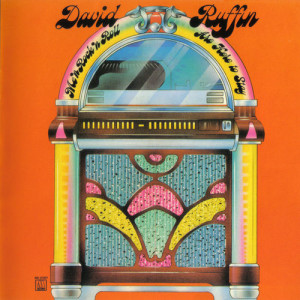
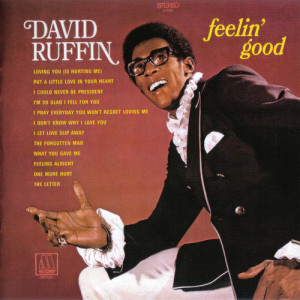
Made up of leftovers from the My Whole World Ended sessions plus some additional material that leans a little toward psychedelic soul, Feelin’ Good seems to fall just short of something bigger.  There’s great singing and all, but sometimes the strings and backing seem underwhelming set against Ruffin’s leads (“What You Gave Me”).  Decent but forgettable next to My Whole World Ended.

Sun Ra – Live at the Hackney Empire

Live at the Hackney Empire

Sun Ra and The Year 2000 Myth Science ArkestraLive at the Hackney Empire Leo Records LR 214/215 (1994)


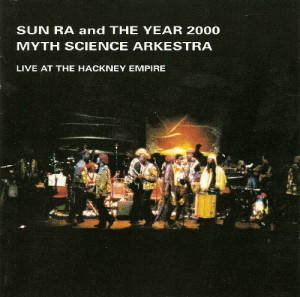
Live at the Hackney Empire was recorded in London just a few weeks before a series of strokes severely curtailed Sun Ra’s ability to perform.  That makes it the last great Sun Ra album.  The most challenging material is up front, with the bulk of the rest of the album focusing on back catalog favorites and standards (many of which, like “Prelude to a Kiss,” “Somewhere Over the Rainbow,” and “Yeah, Man!,” had become regular features in concerts).  There is overlap in the set list with other live recordings from the group’s late period (compare Live at Praxis ’84 and Cosmo Omnibus Imagiable Illusion: Live at Pit-Inn Tokyo, Japan, 8,8,1988).  But the length of this set, and the wonderfully warm and effortless performances still make it stand out.  A few guest appearances — Talvin Singh, India Cooke, Elson Dos Santos Nascimento — might also be of interest.  Although some late period records sound like they were made by a band ready for retirement, there is no indication of that here.  Certainly, this only occasionally reaches for the more abrasive sounds the band was known to utilize.  That is hardly a concern.  Even in the mellower moments the performers sound thrilled to be making music.  This might not be a bad place to get your feet wet with Sun Ra and his Arkestra, and longtime fans will probably find this stands in the top tier of the many seemingly similar live albums out there.  It is simply great music with nothing to prove.  If it is autumnal work, it manages to be that in the best possible way.

Scott Walker – We Had It All

We Had It All

Scott WalkerWe Had It All CBS 80254 (1974)


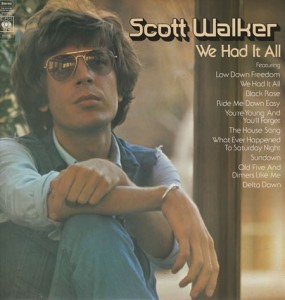
While Stretch hinted at a country sound, the follow-up Any Day Now fully invests in it.  But the result is something less interesting.  Walker proves ill-suited to much of the material here.  “The Black Rose”, for instance, with the lyrics Well, the devil made it do it the first time/ the second time I done it on my own, just seems ridiculous coming out of his mouth.  “Sundown” and “Delta Dawn” are perhaps reasonable offerings, but, by and large, this album is a low point in Walker’s catalog.  It is consistently uninspired.  Scott puts too little effort into this.  At best, it’s adequately performed.

Faust – Faust

Faust

FaustFaust Polydor 2310 142 (1971)


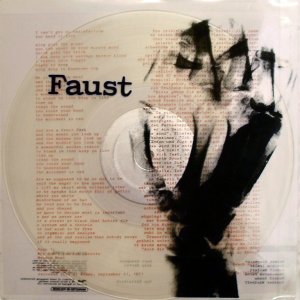
Goethe‘s Faust tells a myth that originated with the life of Simon Magus, a Gnostic who died in Rome while attempting to fly — at least one account indicating he “flew” with an intention to destroy his own body. The German rockers Faust had an approach not so very different from Simon Magus. Faust were more than willing to break from all the commercially viable music of the day.  Screw the usual consequences.  Isolating themselves in a converted schoolhouse in Wümme, the group recorded the album in three days to satisfy their record label. In doing so, Faust moved towards something confounding by conventional standards, but they did so with an offhand charm that is very special.  Mechanized rhythms appear, then melt away.  Melody is faint.  They include snippets of other music (like The Beatles’ “All You Need Is Love” and The Rolling Stones‘ “(I Can’t Get No) Satisfaction”), with the opening segment of “Why Don’t You Eat Carrots” sounding like tuning in a radio to different channels (like Kurzwellen, Hymnen, “Program” from Silver Apples, or “Radio Play” from Unfinished Music No. 2: Life With the Lions) amid waves of static.  The music unfolds at a lethargic pace.  This stands in contrast to the industrial sounds the band makes.  Industrial society is usually about efficiency, and that tends to mean speed and precision.  That is sort of the crux of this (anti-)music:  it has a contrarian way of turning music of an industrial age into almost pastoral collection of vague non sequiturs.  The album self-consciously tries to be different (perhaps The ResidentsMeet the Residents is a rare attempt to follow-up on this style of music).  Faust’s later work is better, but this debut still stands as a defiant remnant of the tail end of the psychedelic era, when it seemed like the world could be reshaped in new and unexpected ways.  If lots of the hippie stuff of the late 1960s got co-opted, Faust is one album that resists assimilation more than most.  The packaging of this album also bears mention for its uniqueness:  a clear vinyl record in a transparent sleeve showing a x-ray of a clenched fist (the word “faust” means “fist” in German), with a transparent lyric sheet.  It captures well the spirit of the music it contains.