Good Social Science

A major contribution of (good) social science is to uncover and articulate implied meanings, as well as to refute false denials of meaning.  This is to say that human beings are often disingenuous in their explicit statements.  While that statement is hardly shocking (or original), it nonetheless stands in marked contrast to the work of a large swath of academic studies that rely on surveys and take all survey responses at face value, for instance.  More useful is an analysis — often statistical — that largely disregards (or diminishes) stated intents and rationales and instead draws out hidden motivations and benefits.  Take for instance accusations of discrimination, like racism.  Many racists deny that they are in fact racist (often because they rationally understand that such admissions are treated with derision and, sometimes, are prosecuted/redressed), frequently relying instead on a professed mantra of individual choice (or “states rights”, etc.).  These are often subtle attempts to re-frame the discussion away from the kinds of statistical analyses that would show how those purportedly benign personal choice in fact rely upon and support discriminatory “social constructs”.  In a broader sense, this ties in to reliance on a very binary analytical system of individual subjectivity vs. scientific/observable fact that is overly simplistic.  More pernicious are things like “implicit bias” theorizing, which is really a characteristically Liberal response to this issue, and which still accepts the basic individual choice framework (largely side-stepping analysis of “social constructs”) but admits to errors of isolated individuals in order to leave the pre-existing (and unexamined) “social constructs” in place.  Well, and the outright hostility to the very idea of “social constructs,” to wit Margaret Thatcher’s infamous quip, “There is no such thing as society.”

Selected illustrative links: See “A Southern City With Northern Problems” and “Marx’s ‘Capital’ at 150: History in Capital, Capital in History”

David King – Red Star Over Russia

Red Star Over Russia: A Visual History Of The Soviet Union From 1917 To The Death Of Stalin Posters Photographs And Graphics From The David King Collection

David KingRed Star Over Russia: A Visual History Of The Soviet Union From 1917 To The Death Of Stalin Posters Photographs And Graphics From The David King Collection (Abrams 2009)


Red Star Over Russia is one of the best English-language overviews of the birth and early decades of the Soviet Union.  This is primarily a collection of visual materials, presented in large format with high-quality printing/reproduction.  There are extensive annotations to contextualize the images, which increases the value of the book tremendously.  This is really an essential collection.  It is a very nearly necessary supplement to written histories and biographies of the era in question. For instance, the war photographs from the Great Patriotic War (WWII) are quite indescribable, and are, alone, the sorts of things every human being should be exposed to as part of a historical education.

There are, however, a few things to note about this book.  King is a Trotskyist.  So there is a disproportionate amount of material on Lev (Leon) Trotsky, and essentially no criticisms of Trotsky (such as of his well-documented arrogance).  There is also a staunchly anti-Stalinist perspective.  While documenting Stalin’s crimes is necessary, readers should be aware that the book is tilted against Stalin (and others) in a typical Troskyist way — without, say, the acknowledgment that many Troskytists have made in recent years that elements of Stalinism were inevitable in the USSR or recognizing some of Stalin’s achievements.  Anyway, as a book that focuses on visual art, with tangential discussions of the text on propaganda posters and such, readers will have to look elsewhere to lean more about the music and writing over the early Soviet era — like the great writers Andrei Platonov and Mikhail Bulgakov.  Moreover, there are a few misleading comments in the book.  Take for instance an indication on page 308 that TASS window posters were “hand-painted”.  As detailed in Windows on the War, the TASS news agency did release a few window paintings that were free-hand painted on easel, in the manner King implies, but they were very limited in number.  More common were (small-scale) reproduced stenciled posters with painterly effects (what today might be called “artisinal” in the West).  Although maquettes may have been initially hand-painted, these stencil posters were not free-hand painted.  The images on pages 308 and 309 of King’s book are stenciled reproductions (evident by the individual sheets glued together to form the overall image).

The criticisms of this book are all ultimately minor.  King’s Trotskyist slant should, however, be noted by readers.  Yet King certainly does not hide his outlook, which is commendable.  Everyone has an outlook — there is no such thing as “objectivity” in these matters.

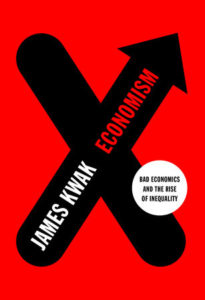
James Kwak – Economism: Bad Economics and the Rise of Inequality

Economism

James KwakEconomism: Bad Economics and the Rise of Inequality (2017)


Probably everything readers need to know about James Kwak’s book Economism comes from this quote by Richard Wolff (which, incidentally, pre-dates the writing of Kwak’s book):

“over the last 50 years, the major debate in mainstream economics has been between neoclassical devotees of laissez-faire and Keynesian devotees of government economic interventions. From the Great Depression through the 1960s, Keynesian economics prevailed and neoclassicals were marginalized. Since then the reverse situation has obtained. The crisis since 2007 shifted some influence back to the Keynesians, but the old debates continue. While both sides disagree on much, they do both endorse capitalism as ‘the best’ economic system and they do both cooperate to exclude Marxian economists from their debates, discussions, journals, and campuses.”

Kwak is kind of a “new Keynesian”, so naturally he fights against neoclassical monetarist economic theocracy, at a time when Keynesians have regained some prestige, while subtly joining with them to declare “there is no alternative” to their shared capitalist assumptions — a form of “university discourse”.  What is most embarrassing about his book is that the title, “Economism,” is a term coined by Marxists like Lenin to describe bourgeois economists who sought to exclude class struggle from discourse and pursue trivial reformist trends.  In other words, Lenin would have excoriated Kwak as guilty of “economism”!  Then again, like all Keynesians, Kwak is quite explicit that he would consider a democratic, Bolshevik-style revolution to be terrible — an outcome to avoid at all costs.  He makes a concerted effort to signal that he is an anti-communist cold warrior.  This is part of a larger trend of substituting “inequality” for class-based study of capitalism against alternatives in economics.  Anyway, Kwak’s book is pretty superfluous.  There are many, many books like this already in print.  Kwak’s is very readable, maybe more so than some others.  Yet the way it tries to paint neoclassical economists as ideologues while implying that its new Keynesian perspective is non-ideological is a joke — Kwak can fairly be accused of promoting ideology masquerading as a critique of ideology.

Carl Hart Quote on the War on Drugs

Quote of Carl Hart from the interview “Neuroscientist Carl Hart: We Need to Stop Jeff Sessions from Escalating the Racist War on Drugs”:

CARL HART: Well, what it means is that he—well, as you know, under [former U.S. Attorney General] Eric Holder, Eric Holder has suggested—or his memo said that we shouldn’t engage in those mandatory minimums [i.e., mandatory minimum criminal prison sentences]. So he gave judges flexibility, whereas [Attorney General] Jeff Sessions is encouraging the judges to go back to mandatory minimum. What that means is that people will get harsher sentences for drug-related violations now. And what that means ultimately—as [Anthony] Papa has said, we all know the drug war didn’t work. That’s not entirely true, because the drug war did work for certain segments of our population. And that’s where the crux of this policy really needs to be interrogated. It allows—Jeff Sessions is allowing us or is using drug policy to separate the people who we like from the people who we don’t like. And it provides a way to go after those people we don’t like, usually poor minority folks, without explicitly saying we don’t like those people. And that’s how drug law—that’s how drug law or drug policy has been enforced in this country. And so, if we allow Sessions to turn back the hands of time, then shame on all of us. The blood is on all of our hands, because we know the consequences of his proposed actions.

(Emphasis added)


Bonus link: Mladen Dolar on “University Discourse”