
Shamus Cooke – History Blinded by Anti Socialism

It never ceases to amuse me how the insight of philosophy and psychoanalysis that ideology determines what is or is not a “fact” is proven again and again.  As Rex Butler put it,

“in the analysis of ideology, it is not simply a matter of seeing which account of reality best matches the ‘facts’, with the one that is closest being the least biased and therefore the best. As soon as the facts are determined, we have already — whether we know it or not — made our choice; we are already within one ideological system or another. The real dispute has already taken place over what is to count as the facts, which facts are relevant, and so on.”

Lenin also wrote (in What Is to be Done?):

“the only choice is — either bourgeois or socialist ideology. There is no middle course (for mankind has not created a ‘third’ ideology, and, moreover, in a society torn by class antagonisms there can never be a non-class or an above-class ideology).”

Along these lines, Shamus Cooke has reviewed Ken Burns & Lynn Novick‘s mini-series The Vietnam War (2017):

“History Blinded by Anti Socialism: Ken Burns’ Vietnam”

The general tone of Cooke’s criticism reflects this statement by Malcolm X:

“If you’re not careful, the newspapers will have you hating the people who are being oppressed, and loving the people who are doing the oppressing.”


Bonus quote:

“How close we could look into a bright future should two, three or many Vietnams flourish throughout the world with their share of deaths and their immense tragedies, their everyday heroism and their repeated blows against imperialism, impelled to disperse its forces under the sudden attack and the increasing hatred of all peoples of the world!”

Che Guevara, “Message to the Tricontinental,” April 16, 1967


Bonus links: The Battle of Chile and “A Victory for Historical Accuracy and the Peace Movement: Not One Emmy for Ken Burns and ‘The Vietnam War'” and “It’s a Fact: Supreme Court Errors Aren’t Hard to Find” (this article engages in a certain kind of criticism that is largely blind to the issue Butler described)
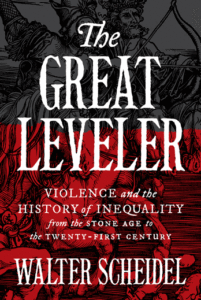
Walter Scheidel – The Great Leveler

The Great Leveler: Violence and the History of Inequality from the Stone Age to the Twenty-First Century

Walter ScheidelThe Great Leveler: Violence and the History of Inequality from the Stone Age to the Twenty-First Century (Princeton University Press 2017)


Ah, more liberal-conservative historical revisionist drivel.  Scheidel’s book follows in the ignoble footsteps of Steven Pinker‘s moronic The Better Angels of Our Nature: Why Violence Has Declined and Carmen Reinhart and Kenneth Rogoff‘s discredited This Time Is Different: Eight Centuries of Financial Folly.  That is to say it sidesteps and obscures crucial philosophical and ideological (and moral) questions in favor of lots and lots of quantitative data, analyzed with dubious methodologies.

I didn’t actually read this book.  What I did do is a litmus test.  I looked up anything about the Bolshevik revolution in the index, and read those pages.  Scheidel cites Niall Ferguson (!!!!) primarily, and, in much the same way soviet history scholar Moshe Lewin has eloquently described regarding similar writings, engages in the lowest kind of anti-communist propaganda by singling out isolated incidents stripped of context and presenting them as representative.

Fortunately there is a book that already existed to (premptively) rebut Scheidel’s: War and Revolution: Rethinking the 20th Century, by Domenico Losurdo, which aimed to offer a “vigorous riposte” to “imperial revivalists”.  The aim of Scheidel and his ilk is to assert that “there is no alternative” to inequality, and anything that redresses inequality (i.e., revolution) cannot be contemplated.  But why can’t it be contemplated?  Scheidel does not engage this question in any serious way.  But that is his aim: to bracket that question out of consideration and normalize the “structural violence” of actually-existing inequality, by lamenting it from a distance but taking any pragmatic solutions to it off the table.  He is not concerned with the horrors of the status quo, only the alleged horrors that accompany any change of the status quo.  To put it more bluntly, The Great Leveler is nothing but an apology for the status quo.  As Robespierre put it long ago in response to odious fools much like Scheidel with their cynical “humanitarian” concerns, “A sensibility that wails almost exclusively over the enemies of liberty seems suspect to me. Stop shaking the tyrant’s bloody robe in my face, or I will believe that you wish to put Rome in chains.”

Take the opportunity to make a hard pass on Scheidel’s book and perhaps instead look to something by Losurdo.