Michael Hudson – The Return of the Repressed Critique of Rentiers

Link to an article by Michael Hudson, excerpted from the book Absentee Ownership and its Discontents: Critical Essays on the legacy of Thorstein Veblen (2016):

“The Return of the Repressed Critique of Rentiers: Veblen in the 21st Century Rentier Capitalism”

Bonus link: “The Legacy of Veblen in the Age of Post-Industrial Capitalism”

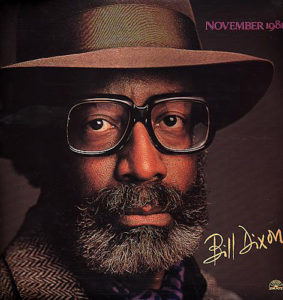
Bill Dixon – November 1981

November 1981

Bill DixonNovember 1981 Soul Note SN 1037/38 (1982)


The thoroughly factually-titled November 1981 features a combination of live and studio recordings made in Italy that month.  The double-LP release featured the studio tracks on the first disc and the live tracks on the second, while the CD release put the live recordings first (minus some stage announcements) and the studio recordings last.  The quartet of Dixon (t), Alan Silva (b), Mario Pavone (b), and Laurence Cook (d) has a good feel for each others’ talents.  The two-bass lineup is reminiscent of the quartet Ornette Coleman led in the late 1960s — a bootleg of a Rome concert of that quartet came out in 1977.  The bassists are able to alternate between pizzicato (plucked) and acro (bowed) playing, so that they avoid blending together too much.  And yet the two bass lineup keeps the brightness of Dixon’s trumpet in the foreground.   As usual, Dixon plays whinnies and squeaks, plus the occasional melodic figure, using space to structure his performances as much around what he doesn’t play as what he does.  Cook plays decisively yet unobtrusively.  Silva and Pavone add a lot in terms of distinctive riffs and textural coloring.  Between the bassists and the drummer, at least one player always seems to suggest (if not outright deliver) some type of syncopation, which gives the music a sense of engagement, despite the highly abstract solos.  On the whole, this music is characterized by each player making independent contributions that work together.  Likely as not, at any given time there are multiple solos occurring simultaneously, without any player relegated to “accompaniment” as such.  The results are dense, but given the way the doubling up of bassists makes this sound almost like a trio, it is not overpowering.  The recording fidelity is very good, minimalistic with a deep low end and an almost ominous feeling.  Dixon largely eschewed marketing and commercialism, and as a result his name and recordings are less known than they might be, though he remains one of the singular talents of the free jazz era.  During the entirety of the 1970s, for instance, he released only one album under his own name (though archival recordings from that decade were later released).  His recordings on the Italian Soul Note label, like this one, are the most widely available.  Dixon had worked toward the sound employed here for some time, and these performances might be considered the culmination of that effort.  In the coming years he would make music that was more abstract, without the grounding and contrasts of the syncopation from the rhythm section — not necessarily better or worse, just different.  November 1981 is definitely a highlight in Dixon’s discography, and one of the more interesting and unique offerings in 1980s jazz.

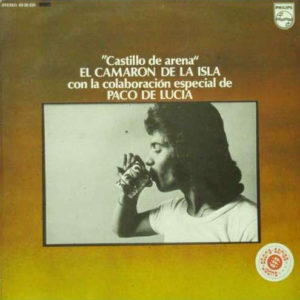
El Camarón de la Isla – Castillo de arena

Castillo de Arena

El Camarón de la Isla con la colaboración especial de Paco de LucíaCastillo de arena Philips 63 28 255 (1977)


Castillo de arena (translation: “Sandcastle”) was the culmination of years of collaboration between noted flamenco performers Camarón de la Isla (vocals) and Paco de Lucía (guitar).  Camarón is strongly associated with raising the prominence of flamenco music among international audiences.  Both performers also helped develop what is called “nuevo flamenco,” which incorporated elements of non-flamenco music.  While Camarón’s next album, the pathbreaking La leyenda del tiempo, is most strongly associated with a transition to nuevo flamenco, there are subtler gestures in that direction already present here.  And, anyway, to insist on flamenco purism is a bit ridiculous anyway, given the already syncretic nature of the music.  It shares aspects of a variety of ancient musics, including — in brief segments, especially in the vocal phrasing — some striking resemblances to Moroccan berber music (and specifically Jbala sufi trance music) from the likes of The Master Musicians of Joujouka/Jajouka, which, after all, comes from merely a few hundred kilometers away to the south across the Straight of Gibraltar.

Brook Zern has said,

“He was known for afinacion, which means the ability to be perfectly on pitch but not necessarily on the notes of a Western scale. Flamenco music uses microtonal intervals all the time, and nobody cut them closer and did them more precisely technically than this young artist.”

Camarón was Romani (gypsy) by birth.  He definitely imbues in his music the defiant character of his upbringing in a (notoriously) dominated social group, evidenced by his willingness to break from tradition and use of afinacion.  His voice is husky, almost sandpaper coarse, yet precisely pitched and expertly controlled.  Paco de Lucía complements the singing perfectly, with intricate strumming and embellished melodic lines that flow back and forth smoothly and seamlessly.  Flamenco style guitar playing really represents one of the most interesting ways of strumming a guitar, with far more rhythmic (not to mention melodic/harmonic) intricacy than the often lazy manner of strumming chords on a guitar in many Western traditions that hardly do more than establish a chord progression.

Like much flamenco music, this album has a melancholic and bitter yet emotionally fiery feeling.  “Y mira que mira y mira” and “Como castillo de arena” have the most modern “nuevo flamenco” elements, with a vocal chorus on the former and layered, almost mechanical (motorik?) handclaps on the latter.

Flamenco music, in general, has been described this way:

“A typical flamenco recital with voice and guitar accompaniment, comprises a series of pieces (not exactly “songs”) in different palos [styles]. Each song of a set of verses (called copla, tercio, or letras), which are punctuated by guitar interludes called falsetas. The guitarist also provides a short introduction which sets the tonality, compás and tempo of the cante.”

Castillo de arena definitely follows the format of such a traditional flamenco recital, lacking only a traditional dancer.

This is another excellent effort by some of flamenco’s more highly regarded performers on the 20th Century.  Although in some ways the experimentation of La leyenda del tiempo is more intriguing, those not ready or interested in synthesizers and electric instruments in flamenco often cite Castillo de arena as these performers’ best recording.  There is certainly no need to pick a favorite, as both are excellent and come from a peak period in the careers of both Camarón and Lucía.

Costas Lapavitsas & Ivan Mendieta-Muñoz – The Profits of Financialization

Link to an article by Costas Lapavitsas & Ivan Mendieta-Muñoz:

“The Profits of Financialization”

Parts of this resemble conclusory, almost aristocratic dismissals of concepts (not backed up by any rationale or evidence), but mostly this article focuses on a very important topic.

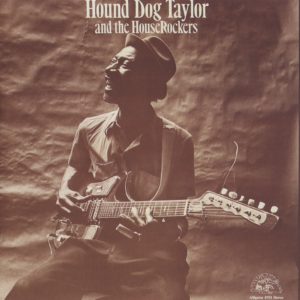
Hound Dog Taylor and The HouseRockers – Hound Dog Taylor and The HouseRockers

Hound Dog Taylor and The HouseRockers

Hound Dog Taylor and The HouseRockersHound Dog Taylor and The HouseRockers Alligator AL 4701 (1971)


Here is a blues album that is nothing if not a good time.  Hound Dog Taylor played electric slide guitar (always on cheap guitars and amps) with a raw boogie-woogie feeling — he was highly influenced by Elmore James.  If you have heard streetside buskers playing solo guitar with a battery-powered amp carried on a rolling luggage cart, you probably have a sense of a second- or third-rate version of what Hound Dog sounded like.  He was born with six fingers on each hand, but cut one off as an adult (supposedly in a drunken stupor).  This album, the first for the now-revered Alligator Records, was hugely influential for “primitive” rock acts.  This isn’t music for obsessive (or simply lame) blues aficionados.  This is party music.  While Hound Dog plays standard blues chord progressions, he has a tendency to start riffs very high up on the neck of his guitar, then move down.  Despite being “blues”, that approach gives the music an relatively upbeat quality.  Considering that all the songs are lively and mid- or up-tempo also helps in that regard.  The songs may be about heartbreak and down-and-out circumstances, but Hound Dog delivers the lyrics with a kind of “roll with the punches” irreverence that suggests life is what you make it.  I once read a characterization of the writings of Andrei Platonov as being about finding utopia in what most would consider a dystopia.  Maybe that applies here too.

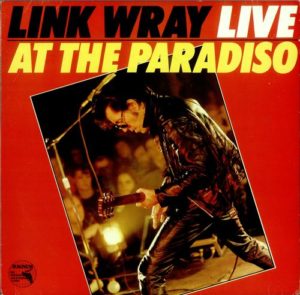
Link Wray – Live at The Paradiso

Live at the Paradiso

Link WrayLive at The Paradiso VISA 7010 (1980)


Link Wray had an amazingly varied rock ‘n roll career.  His early hit “Rumble” practically redefined rock guitar, introducing fuzz and distortion as desirable qualities.  But he found little momentum in the years immediately after that, pursuing more surf-styled garage rock (Jack the Ripper, the “Missing Links” series) while also flirting with more clean-cut teen idol pop/rock (White Lightning: Lost Cadence Sessions ’58).  Then by the late 1960s he briefly considered hippie rock (Yesterday — Today), before delivering a cult classic of swamp rock, Link Wray, and continuing in a country-rock vein (Be What You Want To) in the early 1970s.  Then, along with a stint backing rockabilly crooner Robert Gordon, he transitioned to a slick hard rock sound in the mid/late 70s (Stuck in Gear).  His rather good Bullshot featured a mostly modern rock sound, with a versatile band.  That was followed by the concert recording, Live at the Paradiso.  If the rest of his career drifted into retro revivalism, it still seemed worthwhile in that he kept the flame alive and stuck to a path that was good-natured and earnest — and at times quite decent (Barbed Wire).  But maybe there was something more to the way he doggedly stuck with elements of rural elements in his music.

Point nine in the list of demands in The Communist Manifesto (1848) by Karl Marx and Friedrich Engels asked for:

“gradual abolition of all the distinction between town and country by a more equable distribution of the populace over the country.”

In a related way, one can look at purely urban “rock” (not “rock ‘n’ roll”) styles as being isolated from rural music.  Of course, there have been a few artists who have tried to bridge this gap.  Names like Ricky Nelson belong in that conversation.  But so does Link Wray.  (Much of the “country rock” and “insurgent country” genres — though certainly not all — actually doesn’t belong, given that these are mostly examples of ways that bourgeois urban artists appropriated and co-opted rural musical techniques while undermining any actual rural perspective).

Live at the Paradiso follows through with the hard rock sheen of Bullshot, drawing on heavy metal and even maybe slicker punk rock.  There are plenty of Wray’s old hits or quasi-hits here (“Rumble,” “Rawhide”), plus some other early rock ‘n’ roll classics (“Shake, Rattle and Roll,” “Blue Suede Shoes,” “Be-Bop-a-Lula“).  Even if nothing here reaches the heights of the single “It’s All Over Now Baby Blue” from Bullshot, it’s all pretty good from start to finish.  There is plenty of energy (not a given, considering that Wray had one lung removed long ago and was 50 years old when he cut this record). But what shines through is an attempt to bridge the realms of urban and rural music, without subordinating one to the other.  There is just something very likeable about this music, which doesn’t impose itself but stands firmly in its own place.

Christopher Ketcham – Above the Law: On the Prospects of Prosecutorial Reform

Link to an article by Christopher Ketcham:

“Above the Law: On the Prospects of Prosecutorial Reform”

Bonus link: “Corrupted Evidence: How the Department of Justice is Blocking Forensic Evidence Reform” (it should be noted that this bonus link article largely gives judges a free pass, for reasons not explained)

Full Frontal With Samantha Bee

Full Frontal With Samantha Bee (2016- )

TBS

Director: unknown

Main Cast: Samantha Bee


For a time, it seemed like Samantha Bee had launched the most successful post-Colbert Report, post-Daily Show (with Jon Stewart) spinoff.  It was a rare show with a feminist perspective.  And yet, with her show’s unprincipled, theocratic endorsement of Hillary Clinton leading up to the 2016 Presidential Election, engaging in all the worst irrational tropes and hypocrisies, her show really undermined everything it might have achieved.  The show regularly denounces Donald Trump and his supporters; Hillary Clinton and her supporters are hardly given any criticism — the tenor of the election cycle episodes has been, “well, obviously Hillary is better” without any substance to back up that sneering and superficial position.  Third party candidates are occasionally mentioned, but usually only Gary Johnson of the Libertarian Party.  They do mention and joke about Jill Stein of the Green Party, but usually that is to dismiss her (like a gag where they put the wrong name up in her place in a graphic that also showed Gary Johnson).  But, see, anyone who watched the show before the post-primary election cycle was heavily underway might notice that Stein’s positions align much more closely with those expressed by the show’s humor.  Maybe more glaringly, the show is tremendously hypocritical.  Ronny Chieng, a correspondent for The Daily Show with Trevor Noah, did an October 6, 2016 segment called “The O’Reilly Factor Gets Racist in Chinatown.”  He included clips from an episode of The O’Reilly Factor show in which a reporter goes to Chinatown in New York City and basically mocks the inhabitants with “gotcha” interviews (frequently with people who clearly don’t speak English, the only language the reporter seems to know).  Now, such remote location “man on the street” gotchas can be done in a funny way (Robert Smigel did a “Triumph the Insult Comic Dog” bit in Quebec for Late Night With Conan O’Brien years ago that humorously insulted French-speakers in English, with an obvious nod to the fact that the interviews were preposterous).  But the Full Frontal correspondents don’t do that.  Instead, they do remote segments like the one on October 5, 2016 (“Rigged!”) in which they do “gotcha” interviews with patently uniformed and ignorant Trump supporters.  As Paul Street put it, “Elite commentators love to mock and marginalize the childish mindset of those who think that everyday people (the rabble’) should actually be in charge of their own societal and political-economic affairs (imagine!) and thereby deprive elites of their supposed natural right to rule.”  So, there were no “gotcha” interviews with patently uniformed and ignorant Clinton supporters — the audience is implicitly pushed to draw the conclusion that there are none — not to mention any of her corrupt cronies.  The issue here is not that the Trump supporters are correct (the ones shown on air are mostly stupid and self-serving, at best).  They aren’t, even if they have real grievances.  The issue is that the show displays an obvious partisan bias, hypocritically engaging in more or less the same tactics as the Republican political far right in the service of the Democratic political center-right (and Full Frontal isn’t even on MSDNC, er, MSNBC!).  It conflates rationality with liberal politics.  Given how genuinely funny Samantha Bee is, it is a shame to watch her show sink into a mire of self-congratulatory neoliberal stumping for a particular candidate (Clinton).  What a waste of talent.  Perhaps the show will become interesting again once the election cycle ends.  But viewers should cast a skeptical eye on it knowing what it devolved to during the 2016 election cycle.

If the best thing about the show initially was its feminism, consider how the following comment from Nancy Fraser fits (emphasis added):

“Mainstream feminism has adopted a thin, market-centered view of equality, which dovetails neatly with the prevailing neoliberal corporate view. So it tends to fall into line with an especially predatory, winner-take-all form of capitalism that is fattening investors by cannibalizing the living standards of everyone else. Worse still, this feminism is supplying an alibi for these predations. Increasingly, it is liberal feminist thinking that supplies the charisma, the aura of emancipation, on which neoliberalism draws to legitimate its vast upward redistribution of wealth.

Like a magician using distraction to perform an illusion, Full Frontal focuses on one very narrow (if still important) set of issues in order to obscure and deflect attention away from numerous other extremely important issues.  It’s worth thinking about what the show refuses to mock…