
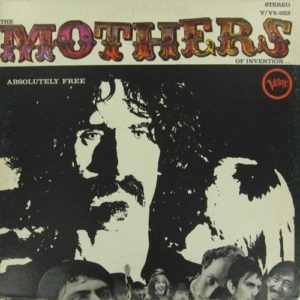
The Mothers of Invention – Absolutely Free

Absolutely Free

The Mothers of InventionAbsolutely Free Verve V6-5013 (1967)


Absolutely Free is sort of the quintessential Mothers of Invention album.  It highlights all the problems with the band’s musical approach.  They were arch cynics, which is to say that their zany fart joke songs give the impression that they are mocking the “system” but that is really just a front for what are ultimately merely attacks on personalities in an — ultimately hypocritical — bid to supplant the personalities being mocked in some kind of upper ranks of that “system” they pretend to mock.  Sound complicated?  Well, it is.  The ultimate problem is the hypocrisy.  Rather than holding up the ridiculous claims of those in power for the moronic and stupid things that they are on their face, The Mothers opt to take a superior attitude, getting mired in a kind of “beautiful soul” problem in which they claim to stand apart from the fantasies of those of dominant society and mock in from afar.  This is the epitome of the criticism that “a cynical distance does not amount to ‘traversing the fantasy’, since it implicitly reduces fantasy to the veil of illusions distorting our access to reality ‘as it really is'[, and so] . . . the cynical subject is [that] who is least delivered from the hold of fantasy.”  But against the odds, The Mothers accidentally addressed this very problem on their next (and best) album, We’re Only In It for the Money, which was unintentionally a self-criticism.
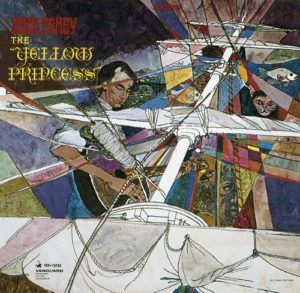
John Fahey – The Yellow Princess

The Yellow Princess

John FaheyThe Yellow Princess Vanguard VSD-79293 (1968)


There may not be any simple way to characterize all of John Fahey’s recordings, given the vast amount of territory they cover.  But even as it feels more modern than his earliest records (read: his first three albums), The Yellow Princess still falls toward the more conservative, straightforward end of the spectrum.  That fact leads to a few rather obvious characterizations.  The material is rather accessible, and focuses on technical mastery of the steel-string acoustic guitar in a relatively traditional folk song setting more than on improvised stylistic explorations.  That is to say that unlike his early attempts to play folk and blues tunes like symphonies solo on a steel stringed acoustic guitar, full of noisy artifacts, or experimental sound collages, he is now playing more conventionally pretty and technically impressive folk music.  Prime examples of this are the title track and “Lion”.  Even though he does include some sound collages, there aren’t the inevitable missteps of experimental music that characterize some other Fahey albums, giving The Yellow Princess a more even feel.  A durable and enjoyable album, but also probably not the most impressive in the Fahey catalog — for which I would probably lean toward things like the more enigmatic and mystical Volume 6: Days Have Gone By.  Nonetheless, this is a versatile album well suited for listening in mixed company.

Worth recommending is a CD reissue that adds three lengthy bonus tracks, the best of which is “The John Fahey Sampler, Themes and Variations”.

Josephine Foster – Blood Rushing

Blood Rushing

Josephine FosterBlood Rushing Fire (2012)


After listening to Josephine Foster off and on for years, I have come to the conclusion that I don’t care much for her singing.  It is simply too much.  The affected mannerisms are too imposing, the delivery too forceful, and, in general, the emphasis too heavy on the vocals.  In short, she tries too hard to make her singing out of character for the kind of folky music she makes.  What I do like about Blood Rushing is everything else.  These are wonderful songs, with an effortless blend of shambolic eccentricities and virtuous melodies.  It’s actually a pretty endearing album.

Yarden Katz – Cheerleading With an Agenda

Link to an article by Yarden Katz:

“Cheerleading With an Agenda: How the Press Covers Science”

Bonus links: Stanisław Lem, Solaris and “Economics as Ideology: Challenging Expert Political Power” and Thorstein Veblen, The Higher Learning in America: A Memorandum on the Conduct of Universities by Business Men and Universities and the Capitalist State

Reviews of Anwar Shaikh’s “Capitalism”

Links to reviews of reviews of Anwar Shaikh‘s Capitalism: Competition, Conflict, Crises (2016):

Bonus links: Video lectures by Shaikh and “Innocuous Proclaimations” (this short interview probably renders reading Shaikh’s book unnecessary)

Bias in Favor of Reckless Drivers

Another example of misguided priorities:

SHAILA DEWAN: Rebecca Horting was a woman who was charged with texting while driving, and reckless endangerment, I believe, was the charge. She hit a girl who was riding her bicycle down the side of the road, causing brain damage and the loss of a leg. And she was offered pretrial diversion. She paid about $1,200, I believe, and is on course to have her case dismissed outright. So, this is a deal that the prosecutor will make with you: “Fulfill these conditions, and we’ll dismiss your case.” And, in general, it’s a pretty good, progressive idea to give defendants a way out of the huge consequences of getting a record.

“The Price of a Second Chance”: NY Times Exposé on How the Rich Pay to Expunge Criminal Records

There is nothing “pretty good” or “progressive” about letting drivers essentially get away with destroying the lives of bicyclists and pedestrians through reckless behavior (easily avoidable texting while driving).  There currently exists a major problem in terms of prosecutors refusing to charge drivers who injure cyclists and pedestrians (aside from more general problems with prosecutorial discretion).  Relatively speaking, such drivers are much more deserving of long prison sentences than most current prison inmates….people should not be able to injure or even kill someone with almost no consequences merely as long as they are driving cars when they do it.  So, aside from the contrast drawn in the linked interview between the reckless driver and a completely different scenario, isn’t it more accurate so say that this is regressive?  At the very least, this is a terrible example to use, because it holds up a terrible problem as some kind of model outcome.

Links to Articles on Liberal Reaction to Trump’s Election

A collection of links to articles critiquing the liberal reaction to the election of Donald Trump as President of the United States, and the related hacking allegations:

Elis Regina & Antônio Carlos Jobim – Elis & Tom

Elis & Tom

Elis Regina & Antônio Carlos JobimElis & Tom Philips 6349 112 (1974)


Tom Jobim was the songwriter of the bossa nova movement.  If the genre was always the bourgie version of samba, then Elis & Tom might be the very finest example of those tendencies.  This is the album that the mediocre Francis Albert Sinatra & Antonio Carlos Jobim should have been.  Elis Regina’s vocals exhibit many of the qualities valued by traditional pop.  So her voice is perfectly suited to these treatments of classic Jobim songs set to decadent, refined and classy orchestration and warm electric keyboards.  She is especially effective on the slower songs with string arrangements (“Modinha” etc.).  And while Jobim’s keyboard playing still has some of the heavy-handed lounge jazz affectations of his past work (Wave, Stone Flower), those qualities are mostly held in check here.  Anyone who doubts the range of the genre should listen to this alongside Dez anos depois, João Gilberto, and any of the slightly, lounge-y bossa nova records of the mid-1960s.  Even as the same songs are re-worked again and again, there are new perspectives offered.  Hardly the stuff of rigid formulas.

Recorded in Los Angeles, this album looks back a bit.  Regina saw working with Jobim on the album as a question of confronting a “sacred cow” of Brazilian music.  This was a period in which Regina, nicknamed “furacão” (“hurricane”) for her mood swings and one of the the most popular Brazilian singers of all time (nearly as well-known as Carmen Miranda), shifted her music to be more political and critical of the Brazilian military junta.  While recording the album, a Brazilian diplomat in L.A. screened Saul Landau & Haskell Wexler‘s documentary (with staged re-enactments) Brazil: A Report on Torture for Regina and Jobim.  Screening the film lead to persecution of the diplomat, Jom Tob Azulay, by the junta.  While nothing about these old songs is overtly political, the way the album looks back and celebrates the music of the pre-military dictatorship period is tacitly political in a very subtle way.