Leo Tolstoy – The Kingdom of God Is Within You

Quote from Chapter XII “Conclusion – Repent Ye, For the Kingdom of Heaven Is at Hand” from The Kingdom of God Is Within You (1894), by Leo Tolstoy:

“the organization of our society rests, not as people interested in maintaining the present order of things like to imagine, on certain principles of jurisprudence, but on simple brute force, on the murder and torture of men.

“People who own great estates or fortunes, or who receive great revenues drawn from the class who are in want even of necessities, the working class, as well as all those who like merchants, doctors, artists, clerks, learned professors, coachmen, cooks, writers, valets, and barristers, make their living about these rich people, like to believe that the privileges they enjoy are not the result of force, but of absolutely free and just interchange of services, and that their advantages, far from being gained by such punishments and murders as took place in Orel and several parts of Russia this year, and are always taking place all over Europe and America, have no kind of connection with these acts of violence. They like to believe that their privileges exist apart and are the result of free contract among people; and that the violent cruelties perpetrated on the people also exist apart and are the result of some general judicial, political, or economical laws. They try not to see that they all enjoy their privileges as a result of the same fact which forces the peasants who have tended the forest, and who are in the direct need of it for fuel, to give it up to a rich landowner who has taken no part in caring for its growth and has no need of it whatever—the fact, that is, that if they don’t give it up they will be flogged or killed.

***

“Simply because torture and murder are not employed in every instance of oppression by force, those who enjoy the exclusive privileges of the ruling classes persuade themselves and others that their privileges are not based on torture and murder, but on some mysterious general causes, abstract laws, and so on. Yet one would think it was perfectly clear that if men, who consider it unjust (and all the working classes do consider it so nowadays), still pay the principal part of the produce of their labor away to the capitalist and the landowner, and pay taxes, though they know to what a bad use these taxes are put, they do so not from recognition of abstract laws of which they have never heard, but only because they know they will be beaten and killed if they don’t do so.

“And if there is no need to imprison, beat, and kill men every time the landlord collects his rents, every time those who are in want of bread have to pay a swindling merchant three times its value, every time the factory hand has to be content with a wage less than half of the profit made by the employer, and every time a poor man pays his last ruble in taxes, it is because so many men have been beaten and killed for trying to resist these demands, that the lesson has now been learnt very thoroughly.

“Just as a trained tiger, who does not eat meat put under his nose, and jumps over a stick at the word of command, does not act thus because he likes it, but because he remembers the red-hot irons or the fast with which he was punished every time he did not obey; so men submitting to what is disadvantageous or even ruinous to them, and considered by them as unjust, act thus because they remember what they suffered for resisting it.

“As for those who profit by the privileges gained by previous acts of violence, they often forget and like to forget how these privileges were obtained. But one need only recall the facts of history, not the history of the exploits of different dynasties of rulers, but real history, the history of the oppression of the majority by a small number of men, to see that all the advantages the rich have over the poor are based on nothing but flogging, imprisonment, and murder.

“One need but reflect on the unceasing, persistent struggle of all to better their material position, which is the guiding motive of men of the present day, to be convinced that the advantages of the rich over the poor could never and can never be maintained by anything but force.

“There may be cases of oppression, of violence, and of punishments, though they are rare, the aim of which is not to secure the privileges of the propertied classes. But one may confidently assert that in any society where, for every man living in ease, there are ten exhausted by labor, envious, covetous, and often suffering with their families from direct privation, all the privileges of the rich, all their luxuries and superfluities, are obtained and maintained only by tortures, imprisonment, and murder.”
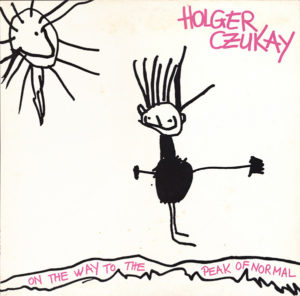
Holger Czukay – On the Way to the Peak of Normal

On the Way to the Peak of Normal

Holger CzukayOn the Way to the Peak of Normal Welt-Rekord 1C 064-46 400 (1981)


Before the advent of samplers and digital audio — with all the concomitant abilities to dice up and recombine sounds — Holger Czukay made On the Way to the Peak of Normal, a highly personal and fully analog set of sound musings.  Drawing on techniques from avant-garde modern classical (think Stockhausen‘s Hymnen, Steve Reich‘s “Come Out” and those sorts of things), plus the spliced-together rock music of his former “krautrock” band CAN, Czukay combines found sounds, bedroom/basement guitar/bass jams, comically unexpected instrumentation, and extended suite-like structures, to form an original and remarkably, infectiously durable album.

“To break up an idea into its ultimate elements means returning upon its moments, which at least do not have the form of the given idea when found, but are the immediate property of the self.  Doubtless this analysis only arrives at thoughts which are themselves familiar elements, fixed inert determinations.  But what is thus separated, and in a sense is unreal, is itself an essential moment; for just because the concrete fact is self-divided, and turns into unreality, it is something self-moving, self-active.  The action of separating the elements is the exercise of the force of Understanding, the most astonishing and greatest of all powers, or rather the absolute power.”  G.W.F. Hegel, Preface (para. 32) to The Phenomenology of Mind.

By sheer coincidence, I first encountered this album at the same time I discovered cLOUDDEAD‘s self-titled collection of 12″ records, and the two albums have a lot of similarities.  Czukay is less precious.  And that is fine.  When I first heard On the Way to the Peak of Normal I was particularly impressed with the way some of the sounds on it were “field recordings” made with a dictaphone — a technology now all but obsolete, but still pointedly in use when I heard this album!  I also really liked (and still do) the way a horn (french horn?) kind of bubbles up unexpectedly in “Ode to Perfume,” a song to that point made mostly with conventional rock instrumentation.  The pace is sometimes slow enough that you can almost hear the wheels turning to inch the magnetic tape along holding these sounds, but that only adds to the overall charm of the album.  This is a heart-warming winner.

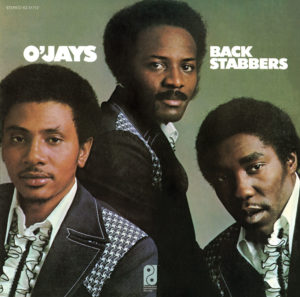
O’Jays – Back Stabbers

Back Stabbers

O’JaysBack Stabbers Philadelphia International Records KZ 31712 (1972)


Soul music underwent a great shift in the early 1970s, from predominantly dance-oriented music with a big beat to a greater emphasis on harmony and layered complexity.  The O’Jays were one of the leading groups of the “Philly Soul” sound.  Back Stabbers basically takes up the socially-conscious approach of the likes of Curtis Mayfield‘s Curtis, Marvin Gaye‘s What’s Going On, and even Isaac HayesHot Buttered Soul and Syl Johnson‘s Is It Because I’m Black.  But, of course, the difference here is the emphasis on a smooth, sophisticated construction with a hint of psychedelia.  So, “Love Train,” which closes the album, is pretty much one of the epic soul cuts.  It is the ideal embodiment of the way christian philosophy — by way of gospel music — lurked behind the end goals of black militancy in the early post-Jim Crow era.  Nothing else here comes close to that song, but, then again, little else in the entire genre does.  If there is a complaint here, and perhaps there should be, it is that The O’Jays lean too heavily on a kind of urban elitism (or should we say “New Age Racism”) that would soon crush the remnants of the soul genre and pave the way for the abomination that is smooth R&B.  This shows in the way some songs seem like safe, mainstream-ready adaptations of There’s a Riot Goin’ On (“When the World’s at Peace”).  And also in the way the string arrangements are a bit lazy and complacent.  So, there is a tension, with elitism being at direct odds with christian universalist values (The O’Jays would further complicate matters on later releases by trying to join christian universalism with its opposite: pre-christian, pagan “family values”).  This one just don’t quite hold up to its reputation, even if “Love Train” surpasses it.  Maybe check out David Ruffin‘s overlooked Me ‘n Rock ‘n Roll Are Here to Stay or Gladys Knight & The Pips‘ criminally under-appreciated Neither One of Us instead, or even The O’Jays’ follow-up Ship Ahoy.

Gustavus Myers – History of the Great American Fortunes & Supreme Court

Links to books by Gustavus Myers:

History of the Great American Fortunes, Vol. I

History of the Great American Fortunes, Vol. II

History of the Great American Fortunes, Vol. III

History of the Supreme Court of the United States

Meyers wrote some confounding things, but he also performed a valuable service by looking critically at things like methods of wealth accumulation, which have tended toward fraud and insider dealing (for instance, the History of the Great American Fortunes “gives the details of [the Yazoo land scandal] and other frauds that have shaped American history. The moral is that great gifts to insiders have effects that will last centuries.”)

João Gilberto – João Gilberto en México

João Gilberto en México

João GilbertoJoão Gilberto en México Orfeón TCI 10.012 (1970)


João Gilberto seemed to always take unexpected paths.  Following his rise to international fame into the mid-1960s, he did not release any studio recordings for five years.  He moved to the United States, then to Mexico for a couple years, then back to the United States.  During those few years in Mexico he recorded the sometimes overlooked João Gilberto en México.  The music is transitional, and while there are some simple performances rooted in his past work, with a focus on just Gilberto singing with his guitar, this was an album that notably embraced lush American pop in a new way.  That new turn is epitomized by a version of “Trolley Song,” made famous by Judy Garland‘s rendition for Meet Me in St. Louis (1944).  The album features orchestration, but it seems like that of a minuscule budget, deployed sparingly.  Gilberto would remove all traces of orchestration on his next album, arguably his best.  But orchestration came back even more prominently on the highly successful Amoroso (1977), which has little of the spark and vitality of João Gilberto en México, and the use of an American pop standard even carried over to the artistically rewarding collaborative effort Brasil (1981).  This is an interesting set of music, revealing Gilberto’s willingness to rethink his music in fairly fundamental ways.  Much of the newer (if still retro) ideas he introduced initially here would only come to complete fruition over two decades later on João (1991).

Steve Keen & Michael Hudson – Keen, Hudson Unpick Historical Path to Global Recovery

Link to a discussion between economists Steve Keen and Michael Hudson:

“Keen, Hudson Unpick Historical Path to Global Recovery”


Selected excerpts:

Michael Hudson: “America did something that has relevance for America for today. After the North won the Civil War, they thought how are we going to teach protectionist, non-Ricardian, non- Malthusian economics. And they say, most of the economic courses were taught at prestige universities, and most universities in America were founded by religious orders to train the priesthood. And the political economy course was taught in the seniorly years, you know, the final one, and it’s all, markets are great.

“So the solution was that you can’t reform these academics. They’re hopelessly tunnel visioned. So America founded state colleges with a different faculty, new people teaching rational, protectionist economics, and the business schools. And the first business school professor was Simon Patten at the University of Pennsylvania, the Wharton School, which was funded by industrial protectionists. And so you had in America this whole body of theory that now has been whitewashed out of textbooks into a kind of Orwellian memory hole.”

***

Steve Keen: “Whereas the top universities are reproducing the religion [neo-classical economics]. And the thing is this is quite a successful strategy when you’re fighting an ideological war. But it’s not a successful strategy when you’re trying to manage a capitalist economy. And, unfortunately, they’re trying to do both at once. And, of course, what that leads to is the debt deflation episode we’re seeing now. Because according to the theories of this high priesthood, such things can’t happen.

***

Michael Hudson: “When the graduates, who learn what you and I are talking about money, graduate, they can’t get jobs, because jobs are conditional upon being able to publish in prestigious economic reviews, and they’re all controlled by University of Chicago and by neoliberals.

“And the genius of Chicago free market theory is you can’t have a free market Chicago style unless you have a totalitarian state that will prevent any alternative to the theory. When they went to Chile, Harberger is said to have sat in a hotel room saying, here are the professors you have to kill. Pinochet and the American embassy said, here are the labor leaders you have to kill. And here are the intellectuals you have to kill.

“You cannot have a free market neoliberal style unless you are willing to either kill or exile or suppress or censor any alternative to your theory, because the theory doesn’t work. It’s fiction. It’s junk economics.”

***

Steve Keen: “So what they’ve had by the purge they’ve managed to achieve – not quite as drastically as Chile, thank god – but the purge they managed to achieve in intellectual economics to make them just that the sole mainstream and knock out any alternative arguments meant that they took over economic policy as well as economic theory. And pushing it forward led them to the financial crisis that they could not see coming, because they didn’t even include the variables that cause the financial system in their models.

***

“Now what you’re seeing 10 years after the crisis is, finally, some awareness coming through that our models are completely at variance with the real world.


Missing from this discussion, which labels Keen and Hudson’s opponents as ideologues, is that Keen and Hudson are also ideologues.  Philosophy tells us that there is no “reality” free from ideology.  What these two should be saying is that their ideology is more scientific, and it benefits a wide proportion of the population.  Hudson says, “You know, every economic theory begins with a conclusion and they work back from the conclusion is what kind of logic is going to lead to this.”  But that is nearly a definition of “legal realism” in jurisprudence — in other words, it is not some special method that applies to certain (neo-classical) economists, it is the way most people work in any situation, including Keen and Hudson!  There is a partial acknowledgement of this when Hudson says, “And all of the reformers, including you and me, look at the – we have a picture of the overall economy, because we’re showing how something whether it’s bad or good will affect the overall economy. The anti-reformers have something in common – a methodology.”

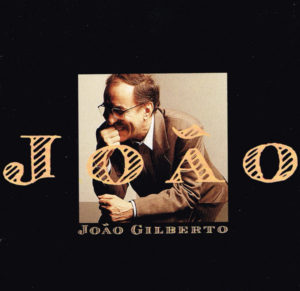
João Gilberto – João

João

João GilbertoJoão Polydor 848-507 (1991)


More than thirty years into his recording career, João Gilberto released 1991’s João.  The master sounds as cool and relaxed as ever, but here he is backed by orchestration.  It is somewhat hard to understand why Amoroso (1977), with its treacly, Sinatra-aping, cookie-cutter arrangements, gets praised as one of Gilberto’s best while this stunning, superior effort is somewhat overlooked.  While he often was at his best in minimalist settings, with little else but his voice and acoustic guitar (João Gilberto, Chega de saudade), João might be the consummate realization of his music in a more elaborate and ornate setting.  The orchestration (by Clare Fischer) features strings plus wind instruments, sounding mostly like woodwinds.  The recording is detailed enough that the woodiness of the oboes comes through, and the flutes are smoothed over to eliminate sharp angles.  And the arrangements are superb — voicings move independent of one another and add melodic detail, always perfectly complementary to the overall mood (reminiscent, perhaps, of Richard Carpenter in his prime).  The orchestration is not so much underneath Gilberto’s playing as interspersed and traded back and forth against his singing, sometimes augmenting it with crescendo-ed washes of strings.  This is not a return to a style of his earlier career as much as a new facet that retains a connection to all of his strengths while also standing somewhat distinctly apart form other trends and undercurrents of his past career.

From the beginning, everything about Gilberto’s craft was suited to last into his autumn years.  He is singing here at such a slow tempo, maybe that is a sign of age, but it also encapsulates the reclusive, deliberate, insouciant, persevering, and, above all, incorruptible qualities that make his music so appealing.  This was one of the first of his albums in a very long stretch to feature new songs.  Released decades after the bossa nova fad had passed, this is, surprisingly, yet another Gilberto album that is among the best the entire genre has to offer.  Pure class.  Superb.

Weezer – Weezer [White Album]

Weezer (White Album)

WeezerWeezer [White Album] Atlantic 554625-2 (2016)


Weezer’s “white album” is about as good as anything they have ever done, which, admittedly, isn’t saying a whole lot.  This is pretty superficial stuff, lyrically especially, and the music is mostly just a reenactment of well-worn pop-punk riffs.  No highlights, and forgettable for the most part, but still fairly consistent from start to finish.