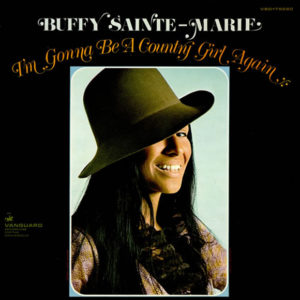
Buffy Sainte-Marie – I’m Gonna Be a Country Girl Again

I'm Gonna Be a Country Girl Again

Buffy Sainte-MarieI’m Gonna Be a Country Girl Again Vanguard VSD-79280 (1968)


Lots of musicians “went country” in the late 1960s — think about country-rock outfits like Rising Sons and Bob Dylan going to record in Nashville.  Buffy Sainte-Marie was at the front end of that curve with her 1968 album I’m Gonna Be a Country Girl Again (released shortly before Sweetheart of the Rodeo and Joan Baez‘s incursions into country). While other artists sometimes created hybrid music, Sainte-Marie for the most part made an authentic Nashville album, complete with A-list Nashville session players (Grady Martin, The Jordanaires, Floyd Cramer, etc.).  This compares favorably to any late 1960s Loretta Lynn album, for example.  Sainte-Marie tried all sorts of different things on her late 1960s and early 70s albums.  She was remarkably versatile, and willing to venture outside folk music.  Other other hand, while side one of the album is great, side two suffers from having a few songs (“Tall Trees in Georgia” and a re-recording of “Now That the Buffalo’s Gone”) that return to the folk sounds of her early career.  Sticking with the Nashville sound throughout would have been more effective.  Still, that is a small issue on an otherwise great album — the folk songs are fine, just out of place.  For what it’s worth, it is kind of great that Sainte-Marie’s foray into country music is immune to criticisms of cultural appropriation.  Would anyone really accuse a musician with native Cree heritage of that?

The album was a flop.  There are numerous explanations.  But among the more unusual ones was that President Lyndon Johnson sent letters to radio stations on White House stationary to convince them to blacklist her in response to her anti-war song “Universal Soldier” becoming a hit (for Donovan).  Despite its lack of success at the time, this is an album worthy of reappraisal.  For that matter, Buffy Sainte-Marie’s entire career deserves more attention.

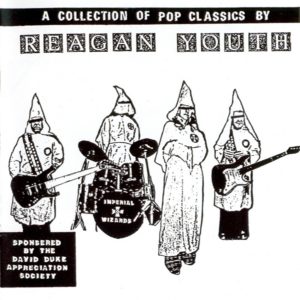
Reagan Youth – A Collection of Pop Classics

A Collection of Pop Classics

Reagan YouthA Collection of Pop Classics New Red Archives NRA13CD (1994)


Reagan Youth formed in the early 1980s as part of the hardcore punk scene in New York.  They were named “Reagan Youth” to criticize President Ronald Reagan (then just a candidate) by associating him with the Nazi Party organization the Hitler Youth.  The band satirically appeared in concert in KKK hoods — bear in mind that they also played “Rock Against Racism” concerts and were staunchly anti-racist.  The imagery was invoked for the purpose of critique.  Their first album was an EP entitled Youth Anthems for the New Order, originally on R Radical Records (founded by MDC).  That EP was later released in expanded form as Vol. 1 (AKA Come Now Jim, It Could Never Happen Here) — the added songs “No Class” and “In Dog We Trust” are better than most on the original EP.  All of the original songs are classic hardcore.  In 1990 they released a second album, Volume Two (AKA For God….and Country).  Both of the albums are collected on A Collection of Pop Classics (and also Punk Rock New York, minus “Degenerate” for some reason).

The band’s first album is a nice slab of satirical DIY hardcore, in the vein of early Black Flag (Jealous Again).  What really makes it nice is the songwriting.  I sing the line ” ‘scuse me I’m not a category” from “No Class” to tease my wife all the time.  I really like that song.  Other songs like “(You’re A) Gonowhere” and “In Dog We Trust” are well written and performed too.

As for Volume Two, call me crazy, but some of this sounds a lot like later period Royal Trux mixed with early Rollins Band, and maybe even some Iron Maiden-type metal leanings.  It was an album that could (and did) alienate fans of Reagan Youth’s pure DIY sounds on their debut, but it is just about as good as their debut.  The stylistic shift in some ways mirrored one made by Black Flag in their later years.  Most of the songs for Volume Two were actually old ones that the band had played around the time of the first album, but they didn’t feel were developed enough to record back then.  In an e-mail, guitarist Paul Cripple (Paul Bakija) said, “it alienated a lot of the punx that only liked Volume I . . . .”  He adds, “A lot of people don’t grow, especially musically and to think Reagan Youth was going to release an album, practically eight years later, that sounds just like their first…..well, those people are pieces of shit.”

The MDC song “Born to Die” was revived by Green Day at the 2016 American Music Awards, following the 2016 U.S. presidential election, with the lyrics changed to: “No Trump! / No KKK! / No fascist USA!”  Reagan Youth re-formed in 2006, after the tragic death of lead singer Dave Insurgent (David Rubenstein), and seem to still be active.  Will they now change their name to “Trump Youth”?

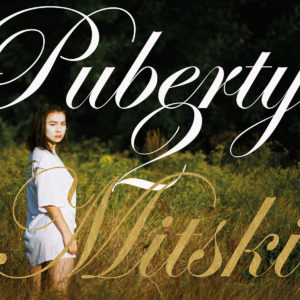
Mitski – Puberty 2

Puberty 2

MitskiPuberty 2 Dead Oceans DOC123 (2016)


A really good pop album.  Mitski’s Puberty 2 takes a bit of introspective singer/songwriter electronic pop (reminiscent of The The‘s Soul Mining) and some noisy, punky retro-pop sensibilities (like The Raveonettes) and puts them forward with a voice that recalls ubiquitous recorded announcements from automatic call centers and elevators (“Doors opening at the third floor.”).  What carries the album, though, is the songwriting.  There are lots of great melodies.  This is thankfully a short album.  Anything more probably would have been filler anyway.

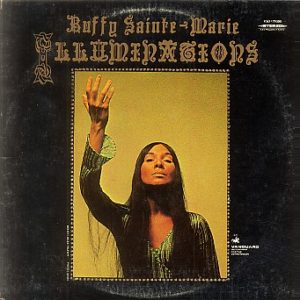
Buffy Sainte-Marie – Illuminations

Illuminations

Buffy Sainte-MarieIlluminations Vanguard VSD-79300 (1969)


Here is a forward-thinking recording that combines three semi-disparate styles.  There is protest folk, akin to Joan Baez.  There is also psychedelic rock, like Jefferson Airplane.  Lastly, and most unusually, there are experimental electronics, comparable to The United States of America, some efforts by The Grateful Dead, or maybe even Silver Apples.  The songwriting talents are undeniable — Sainte-Marie’s versatility is demonstrated by how she later co-wrote the mega-hit “Up Where We Belong” for the film An Officer and a Gentleman.  The musicianship here is a bit raw much of the time.  But this music places more emphasis on innovation than finesse.  Buffy goes so far as to modulate her voice with electronic equipment.  Not surprisingly, this was a commercial flop upon release, but it has nonetheless held on to a doggedly devoted cult following.  It is unmistakably an album of the late-1960s, and perhaps one representative of the fundamentally new possibilities opened up in that era, even if only at the fringes.  Worthwhile for adventurers in modern music.

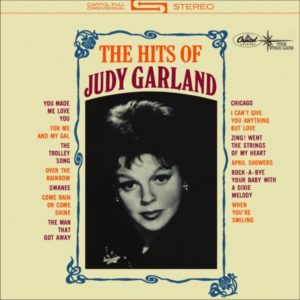
Judy Garland – The Hits of Judy Garland

The Hits of Judy Garland

Judy GarlandThe Hits of Judy Garland Capitol ST 1999 (1963)


Watch That’s Entertainment! and listen to The Golden Age of Movie Musicals, and by comparison Judy Garland’s talents will be immediately apparent.  She had energy and character.  She never shied away from her slightly swallowed midwestern accent.  In concerts she recognized her star status but made overt efforts to connect with her audience without condescension or pretension.  She avoided overt pandering too.  In an era of when everything from racism to cronyism to plain stupidity kept plenty of under-qualified entertainers in the limelight, Judy seemed to actually earn her time there — even if that dedication contributed to her well-documented personal issues and substance abuse.  She became a camp icon for good reason.  This particular compilation isn’t definitive.  While these songs may be Garland’s hits, these recorded versions generally aren’t canonical ones.  Many — if not all — are live and probably from Garland’s many concert performances from the 1950s, though the album sleeve gives no indication of the origins of the recordings. She is still backed by talented orchestras, finely-crafted arrangements, and the sound fidelity loses nothing despite being live.  Here’s to Judy.