
Links to selected works by Joan Miró:
James Kwak – Economism: Bad Economics and the Rise of Inequality
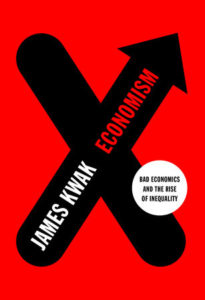
James Kwak – Economism: Bad Economics and the Rise of Inequality (2017)
Probably everything readers need to know about James Kwak’s book Economism comes from this quote by Richard Wolff (which, incidentally, pre-dates the writing of Kwak’s book):
“over the last 50 years, the major debate in mainstream economics has been between neoclassical devotees of laissez-faire and Keynesian devotees of government economic interventions. From the Great Depression through the 1960s, Keynesian economics prevailed and neoclassicals were marginalized. Since then the reverse situation has obtained. The crisis since 2007 shifted some influence back to the Keynesians, but the old debates continue. While both sides disagree on much, they do both endorse capitalism as ‘the best’ economic system and they do both cooperate to exclude Marxian economists from their debates, discussions, journals, and campuses.”
Kwak is kind of a “new Keynesian”, so naturally he fights against neoclassical monetarist economic theocracy, at a time when Keynesians have regained some prestige, while subtly joining with them to declare “there is no alternative” to their shared capitalist assumptions — a form of “university discourse”. What is most embarrassing about his book is that the title, “Economism,” is a term coined by Marxists like Lenin to describe bourgeois economists who sought to exclude class struggle from discourse and pursue trivial reformist trends. In other words, Lenin would have excoriated Kwak as guilty of “economism”! Then again, like all Keynesians, Kwak is quite explicit that he would consider a democratic, Bolshevik-style revolution to be terrible — an outcome to avoid at all costs. He makes a concerted effort to signal that he is an anti-communist cold warrior. This is part of a larger trend of substituting “inequality” for class-based study of capitalism against alternatives in economics. Anyway, Kwak’s book is pretty superfluous. There are many, many books like this already in print. Kwak’s is very readable, maybe more so than some others. Yet the way it tries to paint neoclassical economists as ideologues while implying that its new Keynesian perspective is non-ideological is a joke — Kwak can fairly be accused of promoting ideology masquerading as a critique of ideology.
John Kenneth Galbraith Quote
“The modern conservative is not even especially modern. He is engaged, on the contrary, in one of man’s oldest, best financed, most applauded, and, on the whole, least successful exercises in moral philosophy. That is the search for a superior moral justification for selfishness.”
Cliff Weathers – Your HR Department Hates You
Link to an article by Cliff Weathers:
“Your HR Department Hates You: How Corporate Overseers Exploit Workers”
Stephen Resnick & Richard Wolff – The Economic Crisis
Link to an article by Stephen Resnick & Richard Wolff:
Walden Bello – Europe’s Faustian Bargain with Big Finance
Link to an interview of Walden Bello:
Shin Godzilla

シン・ゴジラ [Shin Godzilla] (2016)
Toho Pictures
Directors: Hideaki Anno, Shinji Higuchi
Main Cast: Hiroki Hasegawa, Satomi Ishihara, Yutaka Takenouchi
A reboot of the Gojira/Godzilla franchise, this is really an excellent monster film. The best parts are about political symbolism. Having watched a number of dumb big-budget Hollywood superhero films recently, I was troubled by how many relied on a frame of a “post-political” society, where all important political decisions are just handed out (down) by unseen technocrats. I thought it would be more interesting to show the deliberations of politicians. Well, Shin Godzilla does exactly that!
The Gojira/Godzilla franchise has shown many different sides of the monster, from an uncontrollable force of destruction, to a helper of humanity, to an object of scientific study. Aspects of this film draw upon some of the ways scientific inquiry was vaunted in the 1990s films. But there is a much more political and serious tone to this film. Here, the monster is finally defeated by a mostly self-organized team of nerds that works together in parallel with the military to defeat the monster, following much destruction.
The political commentary in the film ranges from traditional franchise concerns about nuclear energy and weapons (Gojira/Godzilla in this film is a sea creature that self-mutates after eating nuclear waste, and is powered by nuclear fission), including the 2011 Fukushima Daiichi reactor meltdown, to post WWII pacifism (including Shinzō Abe‘s plan to re-write the Japanese constitution to step away from pacifism), the (real or perceived) subordinate relationship of Japan to U.S. political interests, corporatization and putting profits over people, and more. While the film is sometimes a bit ridiculous — often in a good, campy way, like the wonderfully unrealistic depiction of the monster with bulging eyes and a bulk that still resembles an actor in a rubber monster suit — mostly, this film is expertly delivered. Central to the story is the way it presents existing political institutions as being unable or unwilling to confront current circumstances. The monster is a symbol of the internal contradictions of Japanese society (and capitalism). It would not be too much to say that this is one of the most Leninist films of its day!
The Purge: Election Year

The Purge: Election Year (2016)
Universal Pictures
Director: James DeMonaco
Main Cast: Frank Grillo, Elizabeth Mitchell, Mykelti Williamson, Joseph Julian Soria, Betty Gabriel
The Purge series falls into the tradition of relatively low-budget horror films with dodgy technique that use the “lowbrow” appeal of the film as an opportunity to critique the upper classes. The first film in the series is rather poor, caught up in empty suspense for its own sake (and presumably, due to budget constraints too). But the second film, The Purge: Anarchy, is actually quite good — even going so far as to feature a Black Panther-like group presented sympathetically. The third film, Election Year, is pretty raw and blunt with its message. There is no nuance. And yet, the bad guys are bad guys and the good guys are worth rooting for. The good guys are never saintly. They all face moral challenges, and most are presented as having overcome mistakes of their past. The bad guys are truly monstrous, employing self-serving religious dogmatism and the fascist concept of redemptive violence to further a thinly-veiled class war against the poor — notably along racist lines. The script seems flawed, in that the characters are slow to pick up on plot points that are quickly apparent to the audience. There is also a group of annoying teenager characters who all seem entirely superfluous to the main plotline. So, while falling short of the previous film, this one is still better than the first Purge film. It may be simplistic, but, unlike most commercial films, it actually has a moral center that isn’t stupid.
Doctor Strange

Doctor Strange (2016)
Walt Disney Pictures
Director: Scott Derrickson
Main Cast: Benedict Cumberbatch, Tilda Swinton, Chiwetel Ejiofor, Rachel McAdams, Mads Mikkelsen
Another superhero film. Much of the plot is an ersatz version of anarchist writer Ursula K. Le Guin‘s fantasy classic A Wizard of Earthsea (1968). But there is plenty of good humor here. Tilda Swinton proves yet again that she is one of the best actors in mainstream cinema. While her character, and others, at first seem to be yet another example of the dubious practice of casting white people in “Asian” roles, the film actually addresses that concern in a satisfactory way. In the end, this film is quite average, maybe *slightly* above-average in a relative sense. There are certainly worse big-budget superhero movies out there.
M.G. Piety – Academic Bullying: the Vacuum of Moral Leadership in the Academy
Link to an article by M.G. Piety:
“Academic Bullying: the Vacuum of Moral Leadership in the Academy”
Most of this is general enough to apply outside academia. Interesting that she cited Plato in one place about just behavior, but, rather than another philosopher like Rousseau, cites cognitivist scientists regarding trusting human nature.