Paul Street – Obama: a Hollow Man Filled With Ruling Class Ideas

Link to a book review by Paul Street of David Garrow‘s Rising Star: The Making of Barack Obama (2017):

“Obama: a Hollow Man Filled With Ruling Class Ideas”

The bits about not citing Street’s own books sound a bit like “sour grapes”.  Anyway, by way of contrast, try liberal historian Christopher Read‘s biography Lenin!

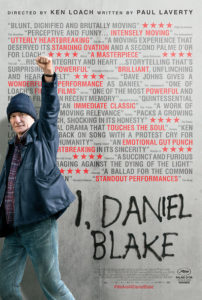
I, Daniel Blake

I, Daniel Blake

I, Daniel Blake (2016)

Canal+

Director: Ken Loach

Main Cast: Dave Johns, Hayley Squires


One of the best “straight narrative” films I’ve seen in a while — reminiscent in some ways of Mathieu Kassovitz‘s La Haine [Hate] (1995). Basically, the premise of the film comes from Frances Fox Piven and Richard Cloward‘s theory about social welfare programs being about politically “regulating the poor” rather than solving the problems that create poverty.  (It is a modern twist on something that people have written about for a long time). In that respect, the film is meant to convey how the politicians who intentionally — though never explicitly, that is, they never openly admit as much — seek to implement policies that are ultimately cruel to the poor and trap them in extreme poverty have “blood on their hands”. At the extreme end of that spectrum, historically, would be the imperialist British policies in India during the late Victorian era, in which British support for native Indians was at levels less than what the Nazis gave to concentration camp prisoners during WWII (!).  While the film’s narrative is pared back from all the complexities of the real world, notably racial animosities used to prevent the kinds of solidarity repeatedly shown in the film, there is nothing far-fetched in the story.  The concision is understandable for a film meant to be accessible.

The most blunt premise of the film is unabashedly political: “Does the masses’ struggle for emancipation pose a threat to civilization as such, since civilization can thrive only in a hierarchical social order? Or is it that the ruling class is a parasite threatening to drag society into self-destruction, so that the only alternative to socialism is barbarism?” Slavoj Žižek, Afterword to Revolution at the Gates: Selected Writings of Lenin From 1917 (p. 210). This film argues the latter. And the way it does so is to magnificently depict the so-called “banality of evil”, the way the Kafkaesque bureaucracy mostly turns a blind eye to the callousness of its action in exchange for a (semi) privileged position above those who bear the burdens.  It also bears mentioning that I, Daniel Blake makes very modest demands.  For instance, the film goes to great lengths to depict the protagonist as someone who has skills (he is a carpenter) who simply can’t work because of a health condition (he recently had a major heart attack), as opposed to defending, say, someone who has no skills but still deserves to be treated with dignity.  In other words, the film goes out of its way to make clear it is not endorsing the notion of “to each according to her needs, from each according to her abilities.”  It might well have.

A few words for non-British viewers are in order.  The plot involves the protagonist seeking social welfare benefits after his doctor says his recent heart attack means that he cannot safely work.  In England, there is a national health service (i.e., socialized medicine), meaning that the (unseen) doctor who gives that diagnosis is a government doctor.  The welfare officials who deny him benefits constitute a vying faction of the government.  What isn’t made explicit in the film is that the Tory (conservative) government of David Cameron had gone to great lengths around the time of the film to purposefully undermine social welfare benefits, for ideological reasons.  Those sorts of cruel efforts continued in various arenas under the Theresa May government.

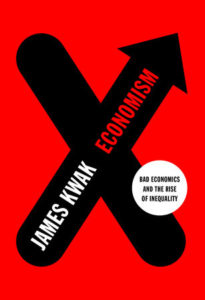
James Kwak – Economism: Bad Economics and the Rise of Inequality

Economism

James KwakEconomism: Bad Economics and the Rise of Inequality (2017)


Probably everything readers need to know about James Kwak’s book Economism comes from this quote by Richard Wolff (which, incidentally, pre-dates the writing of Kwak’s book):

“over the last 50 years, the major debate in mainstream economics has been between neoclassical devotees of laissez-faire and Keynesian devotees of government economic interventions. From the Great Depression through the 1960s, Keynesian economics prevailed and neoclassicals were marginalized. Since then the reverse situation has obtained. The crisis since 2007 shifted some influence back to the Keynesians, but the old debates continue. While both sides disagree on much, they do both endorse capitalism as ‘the best’ economic system and they do both cooperate to exclude Marxian economists from their debates, discussions, journals, and campuses.”

Kwak is kind of a “new Keynesian”, so naturally he fights against neoclassical monetarist economic theocracy, at a time when Keynesians have regained some prestige, while subtly joining with them to declare “there is no alternative” to their shared capitalist assumptions — a form of “university discourse”.  What is most embarrassing about his book is that the title, “Economism,” is a term coined by Marxists like Lenin to describe bourgeois economists who sought to exclude class struggle from discourse and pursue trivial reformist trends.  In other words, Lenin would have excoriated Kwak as guilty of “economism”!  Then again, like all Keynesians, Kwak is quite explicit that he would consider a democratic, Bolshevik-style revolution to be terrible — an outcome to avoid at all costs.  He makes a concerted effort to signal that he is an anti-communist cold warrior.  This is part of a larger trend of substituting “inequality” for class-based study of capitalism against alternatives in economics.  Anyway, Kwak’s book is pretty superfluous.  There are many, many books like this already in print.  Kwak’s is very readable, maybe more so than some others.  Yet the way it tries to paint neoclassical economists as ideologues while implying that its new Keynesian perspective is non-ideological is a joke — Kwak can fairly be accused of promoting ideology masquerading as a critique of ideology.

John Kenneth Galbraith Quote

“The modern conservative is not even especially modern. He is engaged, on the contrary, in one of man’s oldest, best financed, most applauded, and, on the whole, least successful exercises in moral philosophy. That is the search for a superior moral justification for selfishness.”

John Kenneth Galbraith, Dec. 18, 1963.

Shin Godzilla

Shin Godzilla

シン・ゴジラ [Shin Godzilla] (2016)

Toho Pictures

Directors: Hideaki Anno, Shinji Higuchi

Main Cast: Hiroki Hasegawa, Satomi Ishihara, Yutaka Takenouchi


A reboot of the Gojira/Godzilla franchise, this is really an excellent monster film.  The best parts are about political symbolism. Having watched a number of dumb big-budget Hollywood superhero films recently, I was troubled by how many relied on a frame of a “post-political” society, where all important political decisions are just handed out (down) by unseen technocrats. I thought it would be more interesting to show the deliberations of politicians. Well, Shin Godzilla does exactly that!

The Gojira/Godzilla franchise has shown many different sides of the monster, from an uncontrollable force of destruction, to a helper of humanity, to an object of scientific study. Aspects of this film draw upon some of the ways scientific inquiry was vaunted in the 1990s films. But there is a much more political and serious tone to this film.  Here, the monster is finally defeated by a mostly self-organized team of nerds that works together in parallel with the military to defeat the monster, following much destruction.

The political commentary in the film ranges from traditional franchise concerns about nuclear energy and weapons (Gojira/Godzilla in this film is a sea creature that self-mutates after eating nuclear waste, and is powered by nuclear fission), including the 2011 Fukushima Daiichi reactor meltdown, to post WWII pacifism (including Shinzō Abe‘s plan to re-write the Japanese constitution to step away from pacifism), the (real or perceived) subordinate relationship of Japan to U.S. political interests, corporatization and putting profits over people, and more. While the film is sometimes a bit ridiculous — often in a good, campy way, like the wonderfully unrealistic depiction of the monster with bulging eyes and a bulk that still resembles an actor in a rubber monster suit — mostly, this film is expertly delivered. Central to the story is the way it presents existing political institutions as being unable or unwilling to confront current circumstances.  The monster is a symbol of the internal contradictions of Japanese society (and capitalism). It would not be too much to say that this is one of the most Leninist films of its day!

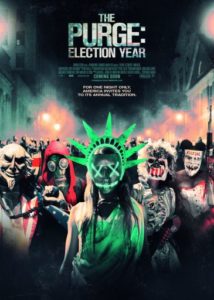
The Purge: Election Year

The Purge: Election Year

The Purge: Election Year (2016)

Universal Pictures

Director: James DeMonaco

Main Cast: Frank Grillo, Elizabeth Mitchell, Mykelti Williamson, Joseph Julian Soria, Betty Gabriel


The Purge series falls into the tradition of relatively low-budget horror films with dodgy technique that use the “lowbrow” appeal of the film as an opportunity to critique the upper classes.  The first film in the series is rather poor, caught up in empty suspense for its own sake (and presumably, due to budget constraints too).  But the second film, The Purge: Anarchy, is actually quite good — even going so far as to feature a Black Panther-like group presented sympathetically.  The third film, Election Year, is pretty raw and blunt with its message.  There is no nuance.  And yet, the bad guys are bad guys and the good guys are worth rooting for.  The good guys are never saintly.  They all face moral challenges, and most are presented as having overcome mistakes of their past.  The bad guys are truly monstrous, employing self-serving religious dogmatism and the fascist concept of redemptive violence to further a thinly-veiled class war against the poor — notably along racist lines.  The script seems flawed, in that the characters are slow to pick up on plot points that are quickly apparent to the audience.  There is also a group of annoying teenager characters who all seem entirely superfluous to the main plotline.  So, while falling short of the previous film, this one is still better than the first Purge film.  It may be simplistic, but, unlike most commercial films, it actually has a moral center that isn’t stupid.