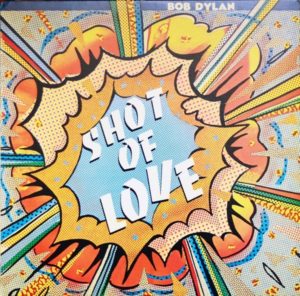
Bob Dylan – Shot of Love

Shot of Love

Bob DylanShot of Love Columbia TC 37496 and PC 37496 (1981)


Flawed, yes, but Shot of Love is one of the more compelling Bob Dylan albums for quite a stretch both before and after.  It has a sound resembling a lot of commercial rock of the day, like Pete Townshend‘s Empty Glass.  It is music recorded in high contrast, stripped of subtle shadings and grainy texture.  The major problem, as with Dylan’s next album Infidels, is what was left off the album.  “Property of Jesus,” “Lenny Bruce” and “Dead Man, Dead Man” all should have been dropped in favor of the much superior tracks “Angelina,” “Need a Woman,” “Caribbean Wind,” and, especially, “You Changed My Life” all left in the vault (but later released on Biograph and The Bootleg Series Volumes 1-3: (Rare & Unreleased) 1961-1991) — a demo version of “Every Grain of Sand” with Jennifer Warnes adding vocals rivals the official version and might justify a swap too.  Also, the single B-side “The Groom’s Still Waiting at the Altar” tacked on to later versions of Shot of Love bolsters the album.  With those changes, this one would be secular enough, more emotionally bare and open, and would maintain an immediacy throughout.  Dylan is engaged on just about everything here, and his vocals reflect considerably more effort than fans would find in most of his albums for at least a decade or so to come.  This one may not be essential, but if the final tracklist had been done properly it very well could have come close.

Bob Dylan – Saved

Saved

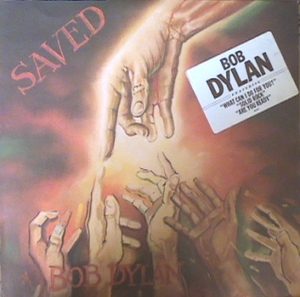
Bob Dylan Saved Columbia PC 36553 (1980)


Dylan’s albums from his “christian” period have aged surprisingly well, considering how frequently they are overlooked entirely or dismissed as unworthy.  Saved is definitely the most dogmatic and preachy of the batch, and probably the least regarded.  For sure, the religious content is rather drab.  It doesn’t offer much.  But taken in the context of where gospel music was around 1980, this is actually a very fine example of it.  The highlights are “Satisfied Mind” and the title track.  Dylan evokes some of the choir style (reference the “crown prince of gospel” Reverend James Cleveland, The Edwin Hawkins Singers, etc.), which was still one of the most popular styles in gospel, while at the same time giving this a more contemporary rock sound.  [But who would have thought that Dylan would use the riff from The Allman Brothers Band‘s “Midnight Rider” for “Solid Rock,” on a gospel album?]  It works fairly well.

Keith Richards quipped that Dylan only cynically got into his “christian” phase to sell records.  But compared to what Dylan was doing just prior to and just after this period, it’s hard to deny that he was quite enthusiastic about this music.  Not even in his later career critical resurgence did his music have the kind of energy it had at this time.

This one certainly is NOT the most compelling offering Dylan has put forth.  But it’s a respectable album, and far superior to some of the dross the man would dump on the world a few years down the road.

Jeff Buckley – Live at Sin-é: Legacy Edition

Live at Sin-é: Legacy Edition

Jeff BuckleyLive at Sin-é: Legacy Edition Legacy C2K 89202 (2003)


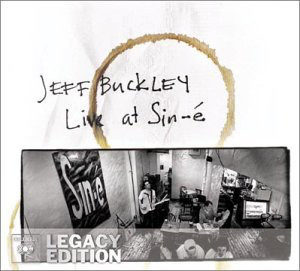
Before landing a major-label record deal, Jeff Buckley spent time doing gigs at coffee shops and other mostly small venues in New York’s lower east side.  He referred to these as his “cafe days”.  After inking that contract, the label recorded him (in hi fidelity) live in July and August 1993 at one of his favorite “cafe days” venues: Sin-é (a Gaelic phrase pronounced “shin-aye”).  The venue was tiny.  As pictured on the album cover, Buckley was basically set up in a corner, without any kind of stage riser, so close to the audience that he might hit somebody with his guitar neck if not careful.  Originally released as a four-song EP in late 1993, a little less than a year before his full-length studio debut album Grace, this was kind of a tribute document to an important phase of Buckley’s career that was coming to an end, as well as a teaser to drum up interest in what was to come.  In 2003, an expanded “Legacy Edition” was posthumously released, featuring two full CDs and a short DVD (only some of the DVD content is from Sin-é, though, recorded in 1996).

The performances are as intimate as the venue.  This is just Buckley, alone, playing electric guitar and singing.  His performances have all the wistful romanticism that would make him a cult star in the coming years — before his untimely death by drowning at age 30.  In the Legacy Edition liner notes (all quite well-composed and informative, incidentally), Mitchell Cohen calls Buckley’s approach a “daredevil’s cabaret”.  It is precisely the right term.  Buckley has a very earnest — almost naïve — ambition that totally undermines what would otherwise be called pretension.  Yet he still puts himself in the spotlight and strives for recognition.  He is going for a kind of intuitive and personal bohemian ethos that, above all, is driven by emotion.  But he relies on a curious kind of pensive and introverted feeling, looking as much to the future and its possibilities as it does the vagaries of the immediate present.  It may not be the sort of thing that appeals to everyone, but Buckley’s fans tend to find his style uniquely appealing.

Buckley’s music cut against the commercial trends of the day.  At a time when morose and almost nihilistic rock, with “raw” vocals, was dominant — think “Grunge” rock acts like Nirvana — Buckley was instead developing a repertoire that looked backwards to pop, folk, blues and religious music of the by-gone past, combined with his own songs that leaned on urbanized, mystical pop blues.  He also sang with a decidedly “traditional pop” style of vibrato, like old time bel canto singing derived from opera (epitomized by Édith Piaf, etc.).  While there are a few popular singers who have used substantial vibrato in the rock era, like Bryan Ferry of Roxy Music, Joan Baez, and Jeff’s biological father Tim Buckley, it was increasingly rare.  It gives the music its own incongruous sophistication.

All of the best songs from Grace are here.  That includes a performance of John Cale‘s compact arrangement of Leonard Cohen‘s “Hallelujah,” which became Buckley’s signature song.  Quite surprisingly, even as solo performances the arrangements are basically the same as on the later studio recordings.  But in place of the slightly ill-fitting clinical professionalism of the studio band, there is the more immediate charm in Buckley’s do-it-yourself one man performance.  As another reviewer astutely put it, “The performances range from amazing to alright and everything in between. The flaws only make it more endearing, though.”

As to the Legacy Edition, disc one is the better of the two.  Though both have much to offer.  Buckley wears his influences on his sleeve.  There are choice covers.  The second disc slows a bit, due to between-song narratives that seem to go on longer, and a few of the less successful performances are more grating.  Buckley declares himself an unabashed Nusrat Fateh Ali Khan superfan, but his performance of “Yeh jo halka halka saroor hai” induces cringes.  It proves — should such proof be necessary — that Buckley knew Kahn songs by heart, but his voice just isn’t up to the task of qawwali devotional singing.  But for every moment like that, there are two or three like “I Shall Be Released” and “Be My Husband,” where Buckley gives his own memorable take on an iconic song.

In an interview on the DVD, Buckley suggests that he has much more and better things on the way.  Yet, really, Live at Sin-é: Legacy Edition is already Buckley at his best — not his most polished, but his best.  Here he is willing to try things that he is not certain will work.  There is a tentative — and, if you will, “contingent” — quality to this that is absent on his studio recordings.  Those qualities end up being bigger assets than the polish and precision of the later studio recordings (even if Gary Lucas does add intriguing guitar work in places on Grace).

There is much to like about Live at Sin-é: Legacy Edition.  Listeners can admire Buckley’s efforts to succeed through hard work and determination.  They can appreciate his efforts to find continuity with the past while also looking to grow and evolve.  There is also his impish charm and  convincing emoting.  And the song selection is hard to argue with.  Any which way, this collection remains a valuable document of some of the best of what was musically possible in one particular place and time.

Arrival

Arrival

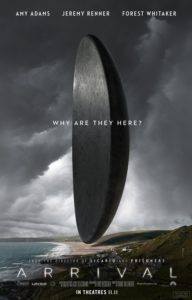
Arrival (2016)

Paramount Pictures

Director: Denis Villeneuve

Main Cast: Amy Adams, Jeremy Renner, Forest Whitaker


This sci-fi film has roughly the feel of Contact (1997), with a bit of The Tree of Life (2011) thrown in for good measure. Credit goes to the many members of the crew who make this a marvel of technical skill. But the script falls apart in confusion as the film goes on. The central story line involves the arrival of extra-terrestrials to Earth, and the attempts of humans to communicate with the aliens. The protagonist is Dr. Louise Banks (Adams), a linguist brought in by the U.S. military. A central plot point involves invocation of the Sapir-Whorf hypothesis, a real-life theory that is stretched to absurd lengths in the film. This is precisely where the film fails.  Rather than the grand tradition of using sci-fi scenarios to open space to discuss wholly realistic human social concerns otherwise barred from “respectable” discourse, Arrival reverts to empty deployment of “magical” actions. Actually, from the beginning to roughly the middle of the film, it seems almost that it will be about something that was in Stanisław Lem’s classic sci-fi novel Solaris that was excised from every film version — that humans are unable to comprehend “otherness” (explicitly that of aliens, but implicitly of other humans). But that would seem to be beyond what Hollywood permits, so by the end the plot gets dumbed down to pointless time-travel drivel.

Prince & The New Power Generation – Diamonds and Pearls

Diamonds and Pearls

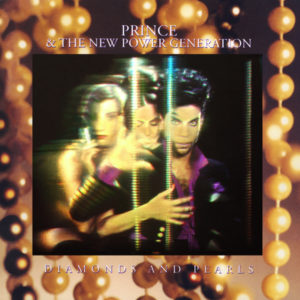
Prince & The New Power GenerationDiamonds and Pearls Paisley Park 9 25379-2 (1991)


While Prince had already demonstrated in the 1980s that his music could be self-indulgent, in the 1990s he also demonstrated an unfortunate willingness to pander.  Diamonds and Pearls is one of the biggest duds in Prince’s catalog.  It opens with a few faux-street-tough songs in the same mold as Michael Jackson‘s Dangerous (released a couple months later).  While not particularly memorable, they are at least listenable.  Then there is the hit title track, a sappy ballad that is quite mediocre.  But then, a bright spot.  “Cream” is Prince in his prime, a sleek: funky R&B song with all the ribald themes listeners expect from the man.  But from there the album drops off considerably.  The rest ranges from the bad to the cringe-worthy.  Prince is trying to fit himself (and his band) into some kind of mold of appearing tough yet vulnerable, seemingly aiming for praise for “triangulating” what the public wants. In hindsight, it comes across as an unconvincing and contrived act.  In the late 1990s Prince famously said in an interview (in which he talked about jumping off pianos) that his career was about the music not about money or the trappings of fame.  Listeners might well question whether that statement held true around 1991 though — or at other times in his career too.  For instance, Prince’s first producer Chris Moon later claimed that Prince was mostly interested in fame when he first entered the music business.

Listeners can safely pass on Diamonds and Pearls and merely pick up “Cream” on a compilation.