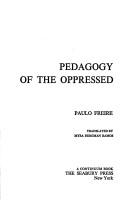
Paulo Freire – Pedagogia do Oprimido [Pedagogy of the Oppressed] (Myra Bergen Ramos, trans., Seabury Press, 1970)
Pedagogy of the Oppressed by Paulo Freire is a founding document of the the “critical pedagogy” school of educational theory. In a nutshell, this school of thought takes Marxist–Leninist politics and combines it with the classic Socratic method. Along the way, it adds post-Leninist insights drawn from Fromm, Mao, Guevara, Fanon, and more. Freire doesn’t really ever mention it, but his approach is founded on the real Socratic method, not the bastardized anti-socratic thing called “The Socratic Method” in schools, especially western law schools. He also remains consistent with Leninist aims, citing What Is to Be Done? extensively, but really drawing from The State and Revolution principally. The most basic insights of “critical pedagogy” is this:
“Cultural action either serves domination (consciously or unconsciously) or it serves the liberation of men and women.”
This flows directly from the Leninist view that everything is political.
“Lenin’s famous statement: ‘Without a revolutionary theory there can be no revolutionary movement’ [What Is to Be Done?] means that a revolution is achieved with neither verbalism nor activism, but rather with praxis, that is, with reflection and action directed at the structures to be transformed. The revolutionary effort to transform these structures radically cannot designate its leaders as its thinkers and the oppressed as mere doers.”
Freire is immanently practical. And just as Lenin routinely denounces “reformists” and “opportunists”, Freire picks apart the flaws of accommodations to elites and minor reforms.
“It would be naïve to expect oppressor elites to denounce the myth which absolutizes the ignorance of the people; it would be a contradiction in terms if revolutionary leaders were not to do so, and more contradictory still were they to act in accordance with that myth.”
But he also is great at pointing out common tactical errors of the political left:
“the Left is almost always tempted by a ‘quick return to power,’ forgets the necessity of joining with the oppressed to forge an organization, and strays into an impossible ‘dialogue’ with the dominant elites. It ends by being manipulated by these elites, and not infrequently itself falls into an elitist game, which it calls ‘realism.'”
Sound like Alexis Tsipras and Syriza in Greece, no? (see also Jodi Dean, Crowds and Party).
This is an excellent book, just as relevant today as when it was written. It is meant to be readable by general audiences. One flaw, however, is Freire’s repeated argument that humans are different from animals. This is basically hypocritical, in that he repeatedly argues that all humans are equal, but tries to convince readers of that point by arguing that humans are superior to other animals. Aside from the flimsiness of Freire’s argument here, which merely attempts to shift an antagonism among humans to one between humans and other animals, it is an argument that ecological crisis has conclusively rendered untenable. As one latter-day Leninist put it, alluding to R. Buckminster Fuller‘s “Spaceship Earth” metaphor:
“We have to accept that we live on a ‘Spaceship Earth’, responsible and accountable for its conditions. At the very moment when we become powerful enough to affect the most basic conditions of our life, we have to accept that we are just another animal species on a small planet.”
Still, that unfortunate argument can be largely ignored. (If you must, read instead something like V. Gordon Childe’s more nuanced explanations). Given the importance of education to Leninist political philosophy (through the October revolution, Lenin was finally able to institute educational programs that his parents had been blocked from doing under the tsarist autocracy, this being one of his most lasting concrete political achievements), Freire’s views are crucial in expanding upon the the overall organization of education, primarily at a more adult level.