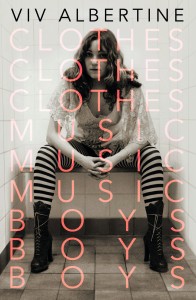
Viv Albertine – Clothes, Clothes, Clothes. Music, Music, Music. Boys, Boys, Boys. (Faber and Faber, 2014)
There have been many memoirs published from surviving punk rock personalities. These include a recent spate of books from women involved in the scene, and its offshoots, from Patti Smith‘s lauded Just Kids to Kim Gordon‘s Girl in a Band: A Memoir. Viv Albertine, who was the guitarist for the iconoclastic (even by liberal standards) UK punk band The Slits, contributes her own memoir with Clothes Clothes Clothes Music Music Music Boys Boys Boys. Albertine is not a trained writer and so, like her music, her book is direct and from the gut. It is made up of mostly short chapters, arranged chronologically. Each has a punchy theme and tries to grab the reader with its candidness and revealing, even lurid, tidbits. It wouldn’t convey as much about the punk ethos if it was written any other way. It is a book refreshingly light on grandstanding and self-mythologizing — the bane of many memoirs — as well as fake humility and fabricated adversities (at least, taking much of this at face value).
The book is in two parts, named “Sides” (like an LP). The first covers her childhood up through the early 1980s dissolution of her band The Slits. Most readers came for this part of the book, with its gossip about the punk scene and first hand account of what it was like to be a part of the now-legendary Slits. The second part of the book is the rest of her life, one filled with more “typical girl” issues like making a living and having a family. Much of side two would fit comfortably on a daytime talk show for middle class viewers. But throughout, Albertine comes across as remarkably candid, and for all the lurid gossip and confessional tracts, she tries to stick with a tone that is questioning and humble.
The book’s title is drawn from what her mother complained were the only things she talked about growing up. Clothes come first. Chapters include photos and many descriptions of outfits. This was clearly a big part of what she spent time thinking about all her life. Some scenes in the book seem to revolve around how certain clothing was selected, and often the mention of certain brand names stands in for more detailed description of the appearance of that clothing. What is revealing though, is how these descriptions of clothing labels, cut, color, modification, purchase location and such actually fade in and out of the story. It is when Albertine sees potential and promise in her life that clothing takes on a prominent role, at least a sufficient enough role to merit mention in the book. She studied textiles for a time at an art school, so she knew clothing from that perspective. But fashion was part of how punks set themselves apart and brought out instant confrontation with those around them. When she is married and struggles with cancer and in vitro fertilization (IVF) treatment, and when she is depressed and without a career or child, there is almost no mention of clothing. It appears barely in passing. A compendium of eras of her life at the end of the book, with friends, musical interests and key clothing compiled for each era, lists clothing for one time period simply as “boring”. It would have been a bit daring to relentlessly describe clothing across the entire book, even the boring stuff. Not doing so has a way of revealing how clothing was a tool for ambitious and aspirational ends in Albertine’s life. When she omits descriptions of them, it conveys a sense of finality and stasis to those periods of her life. Some readers may find nothing in the details of the clothing descriptions, though it seems worthwhile to at least take in the context for how Albertine’s nostalgia for fashion frames her whole life’s perspective as one seeking mechanisms not just to be herself freed from intrusion but to actively engage in society in her own way. Viewed through the lens of the old debate between positive and negative freedoms, her fashion sense stands for positive freedom to shape your social trajectory. When her trajectory was fixed (or seemed fixed) at times of her life, that positive freedom was missing and so clothing doesn’t play a role worthy of mention in her memoir. Maybe she had (negative) freedom from demands and impositions as a stay-at-home mother, but for her that wasn’t enough, and the clothing that accompanies such negative freedom doesn’t interest her enough to write about.
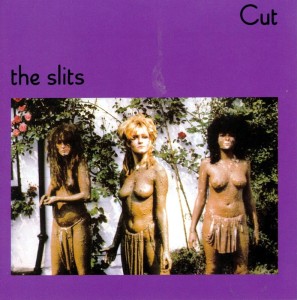
Music is the reason people know Viv Albertine’s name. Her band The Slits are cult legends, and their debut album Cut is considered a lost classic. It is hard to imagine many later feminist rock bands like Bikini Kill without the historical precedent of The Slits. Albertine describes her early influences, how she navigated the London punk rock scene, and, eventually, how she returned to music later in life after a long hiatus. She had no formal musical training. Mostly, she taught herself to play guitar. The book is filled with plenty of descriptions of the tribulations of being an autodidact musician, playing concerts, writing songs, and recording music commercially. Yet the book’s treatment of music as often as not is a platform to write about the people involved in her life. Albertine somewhat takes for granted that readers have heard of some of the bands and other musical personalities she mentions, but, rest assured, those unfamiliar should still be able to navigate those chapters.
“Boys” is the last part of the book’s title. No doubt, boys and romantic entanglements and exploits with them make up a substantial amount of the book. Albertine is fairly frank. It might be tempting to cite these things as just prurient gossip. Yet, remember, this writer considers herself a feminist. There seems to be something of a point being made here against “slut shaming” and an exploration, of sorts, of what the punk ethos has to say about sexuality, both during its heyday and in its aftermath. Albertine is quick to note how the punk scene could, in actual practice, be misogynistic and more limited for women than its inclusive attitude suggested. The only way to meaningfully examine these things and move beyond them is for people to openly talk about them. Kudos to Albertine for that.
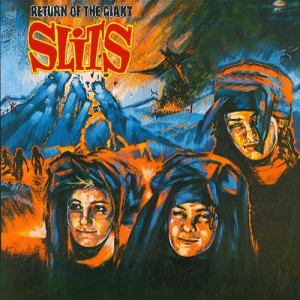
“Side One” is a fast-paced read. The chapters are short. There is no attempt to comprehensively chronicle the days of The Slits here. This remains a book about about Albertine, not her one-time band. Some of the descriptions match almost verbatim things she (and former bandmates) have said in interviews. The ways in which she saw feminism work for (and against) The Slits (and then in the post-Slits years) remains one of the more unique contributions of this book. There are plenty of little vignettes and anecdotes about things like starting a band (The Flowers of Romance) with Sid Vicious, navigating the mean streets of London as a young girl, and acting on the do-it-yourself (DIY) mentality of punk against a backdrop of institutions set up to prevent that from happening or succeeding.
She relied on opportunities that haven’t been so plentiful in the years that followed (there are allusions to the Thatcher government withdrawing some opportunities). Looking back over thirty years later, she writes, “‘Punk’ was the only time I fitted in. Just one tiny sliver of time where it was acceptable to say what you thought. Perhaps I was lucky to have that.” When The Slits disband, she sinks into depression and doesn’t know what to do with herself. Many musicians start other bands, or move into producing or other ancillary roles. But for Albertine, there was something singular about the punk scene, and her outsider status as an untrained musician didn’t really equip her to deal with a music industry that is quick to discard bands and genres. She also came from a poor family, raised much of her childhood by a single mother, and wasn’t exactly made wealthy from her work with The Slits. She didn’t exactly have a vacation home or ample reserve funds to support new endeavors. The abruptness of how her musical life fell apart is interesting, because for many listeners it is easy to never give a thought to what band members do after there albums are out and the tours complete. On top of all this, the militantly confrontational nature of The Slits’ music took a heavy toll. From Albertine’s description, it seems perfectly natural that someone fighting on the front lines to change the world through music might be a bit worn out by that effort a few years later.
“Side two” of the book begins with the immediate aftermath of The Slits dissolving. She becomes an aerobics instructor, then goes to film school, tries to date, eventually marries, tries to have a child and eventually does, has cancer and lives through it. Her husband is identified only as “Husband” or “the Biker”. Then she divorces and renews a musical career. The pacing of the book shifts markedly here.
The trying times of life, especially dealing with cancer, are by no means new topics to this memoir. Albertine treats these as well as she can. Though much of her writing in those stretches seems to echo Denton Welch‘s brilliant unfinished autobiographical novel A Voice Through a Cloud, concerning his strained recovery and difficult readjustment to life after being hit by a car while riding his bicycle (if you have not read Welch’s book, please do so now!).
Her views of romance and love jump around through her life. She stands by a rather unsentimental vision of it, which recalls what philosopher Alain Badiou calls the “two scene” (see In Praise of Love). Yet she also wavers between wanting to see the world from the decentered point of view of two or to reaffirm her own singular identity. She fights off the worst temptations of identity politics. She doesn’t simply categorize herself as a feminist or a punk or a mother, and presume that those labels have a force of their own. For that, she struggles to find meaning and purpose at times.
The themes that emerge from the later half of the book wouldn’t be nearly as interesting if not bracketed by both the entire first half and the final few chapters. Albertine doesn’t talk much about politics or big agendas, only that she has always considered herself a feminist (which is the radical notion that woman are equal to men). But everything in her life is political. Consciously or not, she was always working from ideals that are staples of the political left, mostly involving radical egalitarianism. She mentions struggling with these things in the second part of the book. She describes the punk ethos as “‘nobody’s better than anyone else’ — we didn’t encourage fandom and that’s still with me[,]” and so doesn’t want to glorify The Slits or claim to be some sort of punk legend and spokesperson for a generation (though she does rely on that fandom to auction much of her punk memorabilia to pay for expensive IFV treatments; something hardly worth criticizing her for). Ultimately, she concludes that she doesn’t have the (positive) freedom to do as she wishes in her marriage, so after almost 20 years gets a divorce and commits herself to a renewed music career — spurred on by a strange contact, completely out of the blue, from the actor/director Vincent Gallo.
A long period of Albertine’s life was spent as what people in the States call a “soccer mom”. But there aren’t many soccer moms who were once in a radical punk band and best friends with Sid Vicious! How did she adapt to being a wife and mother? What spurred her to go back to music and arts? What is it like for a woman “of a certain age” (with a punk legacy on top of that) to start up a music career on the “open mic” circuit? Lots of questions like “how does a person cope with having cancer?” are commonplace, unfortunately, in melodrama and (auto)biography. But Albertine’s history as a kind of iconoclast gives those same questions a peculiar import. She does reveal enough about her material circumstances to give a sense of why she chose to buy a bigger house and let it define who she was for a time, and her time as a guitarist for The Slits forces her to confront those questions in a different way than women who dream from childhood about nothing more than marriage and children and a suburban, consumerist lifestyle.
Most musical memoirs are from people who worked in music continuously their entire lives (Patti Smith semi-retired from music for less than eight years). Clothes… is somewhat unique in adding the perspective of someone who walked away from it completely (and then came back). And what do punk stalwarts think of all this? Albertine’s friend Don Letts made a documentary Punk: Attitude in which Henry Rollins (once of Black Flag) comments about how everyone thought of punks as being open-minded, but it turned out that most were just as closed-minded as everyone else, maybe just close-minded in a slightly different way. While it is somewhat obvious by this point to ask about how some first-wave punks — and plenty of others who followed — were sexist and didn’t think women/girls could make legitimate music on their own terms, what has been less explored is to ask what people once associated with punk think about “ordinary” domestic life outside that milieu. Are punks, now at least, open-minded enough to listen to somebody who settled down into suburban life after an underground music career?
Albertine writes about how the punks were “the children of the first wave of divorced parents from the 1950s[.]” Yet much of “Side Two” is about a long, slow reconciliation with that viewpoint, as she tries, for a time, to succeed with a “domestic dream” that she at one point thought “was impossible to live up to.” This is completely in the spirit of her description of her leap into performing in the punk scene back in the 1970s: “Time to try, and maybe fail again, but better that than never try at all.” Go Viv! If only that sort of fearlessness caught on a bit more, what might the world be?
For more on this book, check out the many other reviews and interviews with the author.