
Link to an article by Michael Hudson:
Courtney Barnett – Sometimes I Sit and Think, and Sometimes I Just Sit
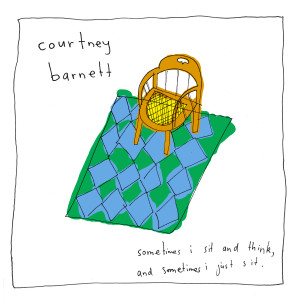
Courtney Barnett – Sometimes I Sit and Think, and Sometimes I Just Sit Mom + Pop MP221-2 (2015)
Courtney Barnett’s first full-length album trades in some of the dense yet laconic wordplay of her first two EPs for more refined guitar sounds. This is definitely a fuller, more developed production than here earliest recordings. The rhythms are crisp and everything is in tune. The trade may take away some of the quirky charm, but it makes up most of that ground with assured rock textures.
Barnett has long worked with a kind of pastiche of old alt rock styles, everything from underground rock of the early 1970s (The Velvet Underground‘s Loaded), to witty underclass poetry with almost incongruously contemporary pop-rock backing (Ian Dury & the Blockheads’ New Boots & Panties!!), to slacker punk (her song “Avant Gardener” from How to Carve a Carrot Into a Rose, with its deadpan vocals, is a dead ringer for “You’re Gonna Watch Me” by the short-live Cleveland punk band Pressler-Morgan One Plus One). This album, though, is less a grab bag of influences worn on her sleeve than an integration of influences into a more streamlined package. Take that as you will. She’s consolidating what has been done before, expanding it to fit her purposes. Is it wrong to say she’s domesticating this stuff? Probably! Anyway, she takes the counter-culture and kind of makes it seem lived-in, and roomy enough to accommodate just about anyone, in a low-pressure kind of way — the sonic equivalent of going to a friend’s place (but not your best friend’s place) and “crashing on the couch.” This probably won’t knock anyone over, but it may just grow on you if it doesn’t seem immediately appealing.
The Crowd
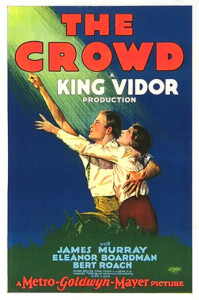
The Crowd (1928)
Metro-Goldwyn-Mayer
Director: King Vidor
Main Cast: James Murray, Eleanor Boardman
King Vidor’s silent film “The Crowd” was the most acclaimed early feature to use a melancholy, existential ending where a character with great aspirations learns to accept a life short of that, in this case as an anonymous failure. This would become a sort of film staple, especially in “art house” cinema, with similar examples ranging from Yasujirō Ozu‘s Otona no miru ehon – Umarete wa mita keredo [I Was Born, But…] (1932), Ingmar Bergman‘s Sommarlek [Summer Interlude] (1951), and Satyajit Ray‘s Apur Sansar [World of Apu] (1959), to name a few. This is one of Vidor’s very finest films — up there with Our Daily Bread (1934). The pacing is meticulous and graceful, the humor well-placed, and, of course, the acting superb. Large parts of the film are shot on location — a rarity for Hollywood films of the era — and the sense of realism that the bustling city shots provide is really a useful counterpoint to the ambitions of the protagonist John Sims (James Murray). But what separates The Crowd from much of what simply has a similar ending is that this is a film that from beginning to end is about ordinary people. It is not an epic. There is no hero.
Adam Kotsko – How to Read Žižek
Link to an article by Adam Kotsko:
Bonus link: “How to Read Žižek on the Refugee Crisis”
Slavoj Žižek on NFL
https://twitter.com/ZizekOnNFL
Made me laugh, and reminded me of the Monty Python bit “World Forum” with Karl Marx, V.I. Lenin and Che Guevara on a quiz show answering questions about soccer (football).
John Fahey – Womblife
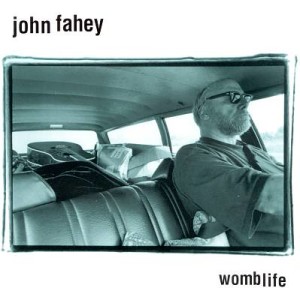
John Fahey – Womblife Table of the Elements TOE-CD-37 (1997)
John Fahey’s 1990s renaissance was not unlike Scott Walker‘s in leading down a very stark and abrasive path. Womblife is intriguing even if not essential like his early classics. His guitar style was starting to resemble Loren MazzaCane Connors in many ways.
Dropkick Murphys – The Warrior’s Code

Dropkick Murphys – The Warrior’s Code Hellcat 80472-2 (2005)
Seems like the worst possible combination of The Mighty Mighty Bosstones and The Pogues.
Diana Ross + The Supremes – The Ultimate Collection
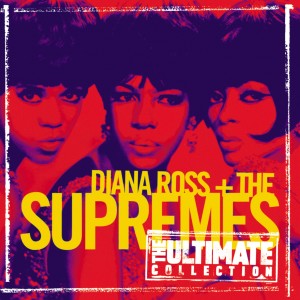
Diana Ross + The Supremes – The Ultimate Collection Motown 314530827-2 (1997)
This is definitely the “ultimate” Supremes collection. However, it’s funny that despite The Supremes’ popular recognition, they really don’t have 25 great songs to fill out this whole disc.
L. Ali Khan – Debt Serfdom in America
Link to an article by L. Ali Khan: