
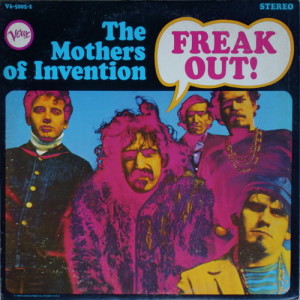
The Mothers of Invention – Freak Out!

Freak Out!

The Mothers of InventionFreak Out! Verve V6-5005-2 (1966)


There is something really curious about Mothers of Invention records.  They rely on a kind of double irony.  That is to say that there are songs like “Go Cry on Somebody Else’s Shoulder” and “Any Way the Wind Blows” that look back to 1950s doo-wop and pop/rock with a dose of sarcasm, or “Wowie Zowie” with a melody near the end cribbed from The 4 Seasons‘ 1962 sunshine pop hit “Sherry,” but the sarcasm is itself ironic and sarcastic.  It’s like this: given the wave of counterculture that was underway in the late 1960s (a year after the release of Freak Out! was the “summer of love”), the only way for the Mothers to hold fast to the pre-countercultural norms was to do those things ironically.  So when someone hears a song like “Go Cry on Somebody Else’s Shoulder” the listener hears sarcastic, mocking vocals, she is really supposed to like the song and not sarcastically dismiss it.  In the liner notes there is a comment about “Any Way the Wind Blows” that says, “It is included in this collection because, in a nutshell, kids, it is…how shall I say it?…it is intellectually and emotionally accessible for you.  Hah!  Maybe it is even right down your alley!”  But why put a song like this on the album at all — or write it in the first place — if it is only for squares?  And why go on to do Cruising With Reuben & The Jets, an entire album of doo-wop?  Again, this is why the real intent is to like the song for its retro qualities.  Really, what is wrong with that though?  Probably the best career move bandleader Frank Zappa ever made was to sign the Philadelphia doo-wop group The Persuasions to his record label!  In some ways, the doo-wop tracks are some of the very best cuts on the entire double album.

One of the most successful rockers is “Trouble Every Day.”  This song, commenting on the Watts Riots and race relations generally, turns out to have less of an Abbie Hoffman “militant activist” vibe than a Hubert H. Humphrey “compassionate liberal” vibe!

All this positions The Mothers not as a faithful part of the counter-culture, but as part of the counter-counterculture. The band’s labelmates (sometimes appearing together on tour) The Velvet Underground represented a real musical revolution.  But Zappa would mock them on stage.  Zappa, and by extension The Mothers, were basically crypto-conservatives (of the liberal-libertarian-conservative strain).  If that seems like an odd characterization, it is in the sense of adapting to and blunting revolutionary impulses to avoid a real revolution — think Igor Stravinsky instead of Arnold Schönberg or The New Deal instead of the Bolsheviks.

Challenging that view, however, are songs like “I Ain’t Got No Heart,” “How Could I Be Such a Fool,” “You Didn’t Try to Call Me,” and “I’m Not Satisfied” that appropriate easy listening, marching band and plaid suit old boys club horn section atmospherics, and place them alongside rock guitar riffs.  According to one source (not verifiable by any other online source), Zappa attended musical training by Pierre Boulez and Karlheinz Stockhausen, and the use of wildly disparate musical styles was an approach that showed up in the work of many such students — Zappa’s fellow student Rogério Duprat from Brazil employed that effect with more startling originality and subversive power on records for Gilberto Gil and others in the tropicália movement.  Zappa’s use of this technique is the most rudimentary.  It seeks to provide a contrast, but never really succeeds in mocking the underlying premises of the horn section music.  It just shows up like a fart joke (and those kinds of jokes were mainstays of The Mothers’ repertoire).  The lengthy closer “The Return of the Son of Monster Magnet” was an unfinished track that Zappa and the band did not want included.  The the abstractions of “Help, I’m a Rock (Suite in Three Movements),” “It’s Can’t Happen Here,” and “Who Are the Brain Police?” add other layers and music elements to the mix — only the first part of “Help I’m a Rock” really succeeds though.

This album is decent.  It is worth giving a listen every once and while, but doesn’t quite come together enough to likely be a perennial favorite.  As my friend Brian put it, “Freak Out! is a more important release than it is necessarily a great album.”  The Mothers did better with We’re Only In It for the Money.  And other artists later improved on many of the ideas here: The Grateful Dead on Anthem of the Sun and CAN on Tago Mago with a hybrid of rock and modern classical; Brazilian tropicalismo with juxtaposition of seemingly opposing elements; and The Red Krayola with absurdist humor on the likes of God Bless The Red Krayola and All Who Sail With It.  But Freak Out! still deserves credit for attempting a unique blend of countercultural rock, retro pop, and avant garde modern classical musics.  It clearly tries to normalize the weirder elements — to prove that the weird stuff isn’t really weird at all.  Yet it was making these attempts and making its experiments sooner than most.  The floodgates of truly revolutionary music would only really open in 1967 and 68.  Legendary producer Tom Wilson deserves special credit for the album’s best elements.  He summoned a lot of resources to help make an album of base humor with the finest studio recording techniques and equipment of the day.
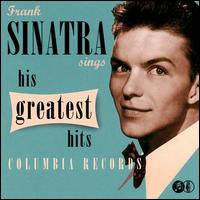
Frank Sinatra – Sings His Greatest Hits

Sings His Greatest Hits

Frank SinatraSings His Greatest Hits Legacy CK-65240 (1997)


This album makes an excellent introduction to Frank Sinatra’s music.  It’s not a perfect collection, but it features some great songs from the 1940s and early 1950s.  There are a few alternate versions and previously unreleased tracks included. I would recommend this album over the more popular Sinatra Reprise: The Very Good Years if you only want a single disc Sinatra collection, and also over the bloated box set The Best of the Columbia Years 1943-1952.  However, The Capitol Collectors Series and Frank Sinatra’s Greatest Hits are also good collections for later time periods (picking up both of those along with Sings His Greatest Hits would provide a fairly complete overview of his entire career — they cover basically non-overlapping periods).

Interesting aside:  did you know that “The House I Live In” was the title song to short film Sinatra starred in that was organized by the communist party?  Or that as a consequence of those sorts of activities he was barred from performing for troops during the Korean War?

A Critique of Michael Schwalbe’s “Brief for Equality”

Professor Michael Schwalbe wrote an essay entitled “A Brief for Equality.”  The basic thrust of his argument is a good one: liberal insistence that egalitarianism is too extreme is really about maintaining certain inequalities, which are not morally justified.  However, there is a curious flaw in his argument.  He writes:

“equality would produce a flourishing of creativity and constructive diversity. The cultivation of talent that is possible now for only the privileged few would be possible for all. What’s more, an equal sharing of resources would by no means hinder the appreciation of virtuosity. There would in fact be more virtuosity and accomplishment to appreciate.”

Why is this a logical flaw?  Well, there are different types of capital (as a sociologist, Schwalbe should be well aware of these concepts; though they appear in fiction too).  Yet his brief is written only in regard to economic capital.  He asserts that a better society flows from equality of economic capital.  But he then praises an inequality of cultural capital (virtuosity, accomplishment).  Why is it that the liberal position that relies on a core of (economic) inequality is wrong but Schwalbe’s reliance on a core of (cultural) inequality is better?  He does not address this point about second level (cultural) hierarchies.  This seems to be a flaw in his underlying theory — by failing to account for different types of capital, and associated hierarchies, his argument lacks persuasiveness.  Really, this is perhaps a pure expression of ideology, revealing the disavowed assumptions behind his argument.  It is somewhat customary for academics to have more cultural capital than economic capital.  So does Schwalbe’s argument really amount to self-interested promotion of the type of capital that he possesses over that which he does not possess?  And will inequality of cultural capital simply reproduce inequalities of economic capital over time?  These are the lingering doubts clouding his argument, which is far more self-interested than it admits.

Michael Scott Christofferson – May 1968’s Black Sheep

Link to an interview with Michael Scott Christofferson conducted by Daniel Zamora:

“May 1968’s Black Sheep”


Bonus quote:

“The anarchist denunciations of [state power] from Foucault to James Scott are less worried about transnational monopolies than about the (now defunct) Soviet party state or even the social-democratic nanny state. And as for the intellectual and cultural polemics, they always end up denouncing Marx and Marxism. I think these battles on the left are unproductive politically and intellectually . . . .”

Fredric Jameson, “Afterword: On Eurocentric Lacanians”

Mapping Police Violence – 2015 Report

Link to the group Mapping Police Violence‘s report:

“2015 Police Violence Report”

Bonus links: Interview with Sam Sinyangwe, Campaign Zero (mostly good ideas, with some flaws:  the persistently proposed requirement that “community organizations” nominate civil servants/overseers is flawed [would the KKK qualify as a “community organization”?  If not, then which groups?  And who decides which groups?], and the “fair union contracts” aspect includes important points but then goes too far [banning contacts that allow officers to “receive paid leave or remain on desk-duty during an investigation following a police shooting or other use of deadly force” is anti-due process and anti-worker]; lastly, “unconscious bias” research is still in its infancy and relies on many troubling ideological assumptions [the research has its own bias of the cognitivist and/or liberal variety: “PC anti-racism is sustained by the surplus-enjoyment which emerges when the PC-subject triumphantly reveals the hidden racist bias on an apparently neutral statement or gesture“] making it difficult and premature to implement as a mandatory process).

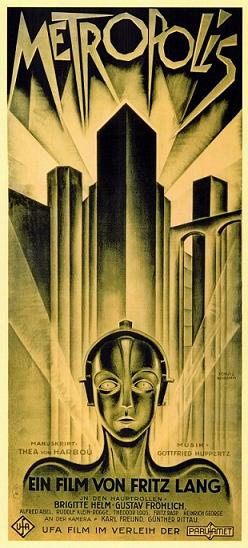
Metropolis

Metropolis

Metropolis (1927)

Universum Film A.G.

Director: Fritz Lang

Main Cast: Gustav Fröhlich, Brigitte Helm, Rudolf Klein-Rogge


A classic of the silent era.  Epic in proportions yet simple in story, this has influenced countless films that followed.  Some (Elysium (2013)) are practically remakes.  The special effects were groundbreaking.  This — along with the likes of Brecht/Weill‘s The Threepenny Opera and Döblin‘s Berlin Alexanderplatz and even Hilferding‘s Finance Capital — represents one of the great achievements of Weimar Germany.