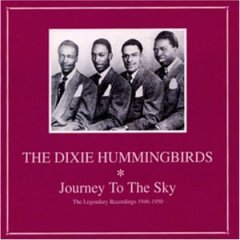
Dixie Hummingbirds – Journey to the Sky: The Legendary Recordings 1946-1950

Journey to the Sky: The Legendary Recordings 1946-1950

Dixie HummingbirdsJourney to the Sky: The Legendary Recordings 1946-1950 P-Vine PCD-5818 (2001)


Legendary vocal quartet music, featuring dynamic lead singer Ira Tucker and bass vocalist William Bobo.  This may be the very best vocal group music of the late 1940s, at a point when the “jubilee” style of gospel singing was being left behind in favor of the new, more daring “hard gospel” style.  Too many classic cuts here to go through them all individually, but hearing just “Move On Up a Little Higher” (either version), “In the Storm Too Long”, or “Search Me Lord” alone would be enough to make the whole set worthwhile even though there isn’t a bad cut to be found.  You don’t need to have any interest in the religious content of this music to enjoy it.  This particular set lacks recording and release information (at least in english), but the sound is great for recordings this old.  There are a few other Dixie Hummingbird collections out there on CD as well, like Complete Recorded Works 1939-1947 in Chronological Order covering a generally earlier period, and Thank You for One More Day: The 70th Anniversary of The Dixie Hummingbirds and The Best of both focusing a bit more on later periods.  But this is probably the place to start.

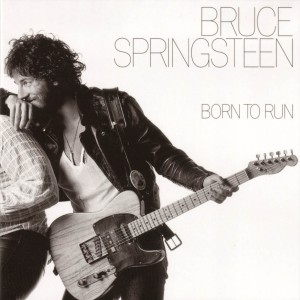
Bruce Springsteen – Born to Run

Born to Run

Bruce SpringsteenBorn to Run Columbia JC 33795 (1975)


It is possible to look at Bruce Springsteen as the ultimate salesman/apologist for capitalism in the 1970s music scene.  Looking at Springsteen’s excellent, and overlooked, debut album Greetings From Asbury Park, N.J., one finds (much like in Van Morrison albums) a dreamy desire for a kind of utopian world outside the confirms of present reality, and much pondering of the obstacles to such dreams. But with Born to Run the ambitions have been narrowed (“focused,” if you must say so) to concentrate all energies on reaching escape velocity, that is to say, all attention is on the act of breaking free. The context of what is being broken away from, or what destination might await anyone who does break free, and other such concerns, are all relegated to a decidedly secondary place.

Historian Jefferson Cowie wrote a book called Stayin’ Alive: The 1970s and the Last Days of the Working Class (2010), which theorized that one of the dominant narratives in American media in the 1970s was that of the individual breaking free of restrictive social bonds.  Is there any more acute statement of that sentiment than the title track of Born to RunErnest “Boom” Carter‘s drums mechanically urge everything onward:  thud, thud, thud, thud, thud, thud, thud, thud, thud, thud, thud, thud! Elsewhere the rhythm on the drums is steady but played in a circular figure.  (The monotonous rhythm of the drums set against the more supple, syncopated rhythms of the other instruments and vocals is one of the most significant features of the recording).  Bruce sings:

“Tramps like us /

Baby, we were born to run”

A rebuttal of sorts might be the Carpenters‘ “I Need to Be in Love” from A Kind of Hush (1976), with the line, “But freedom only helps you say goodbye.”  In that Carpenters song, there is a resigned acceptance of stifling social bonds, without completely internalizing and normalizing the strains those social bonds produce.

Why does all this matter?  Well, there is a theory that politicians in the United States basically offer up constituencies to the highest bidder — they form constituencies in the name of certain interests but then almost always betray those people and interests by accepting money (bribes) in the form of campaign contributions to further the opposing goals of the donors.  This is more or less the “investment theory of politics” by political economist Thomas Ferguson (similar theories have been offered by the likes of G. William Domhoff, etc.).  Recent, well-publicized research by Martin Gilens and Benjamin Page empirically supported these theories, showing that the opinions of ordinary people have close to zero influence on public policy in the United States while those of elites (and their organizations) have substantial influence.

If we look at the Carpenters song as being built on a christian notion of love (as in, “love thy neighbor”), a kind of community-building myth that brings people together despite differences, Springsteen is pushing for an anti-christian attitude of atomistic individuals.  His constant references to automobiles is simultaneously praise for generic materialistic consumption, weird sexualized commodity fetishism, and advocacy for enjoyment of the primary mechanism for an individual to contribute to fossil fuel pollution and waste.  Now, it is possible to say that all this is sheer coincidence.  Or not.  Matthew Modine‘s character Pvt. Joker in the film Full Metal Jacket (1987) is the cynic who actually manages to sustain the Vietnam war effort by maintaining a protective personal distance from the insane logic of the war effort, whereas Vincent D’Onofrio‘s character Pvt. Pyle, who takes the war effort serious, shoots himself, thereby not advancing the effort.  Springsteen always had a sense of irony and cynicism, but it was the sort that worked in favor of the groundswell of neoliberal politics in the mid-1970s.

Neoliberalism, in terms of specific and recognizable policies, is about favoring financial interests over labor, privatization, fiscal austerity, deregulation, free trade, and reductions in government spending to expand the role of the private sector in the economy; but those policies are sustained by a manner of thinking that favors certain groups over others.  Henry A. Giroux: “As an ideology, it construes profit making as the essence of democracy, consuming as the only operable form of citizenship, and upholds the irrational belief that the market cannot only solve all problems but serve as a model for structuring all social relations. It is steeped in the language of self-help, individual responsibility and is purposely blind to inequalities in power, wealth and income and how they bear down on the fate of individuals and groups.”  Erik Olin Wright: “Neoliberal ideology says that the social-democratic solutions are permanently off the table. That’s just self-justification of elite privilege.”  Michael Hudson: neo-liberalism is neo-rentier and perhaps neo-feudal, and attempts a counter-enlightenment.

So, yes, perhaps Springsteen was a useful idiot, unknowingly advancing interests he didn’t consciously wish to advance.  All this does matter, because his public image is that of the “ordinary Joe,” or, perhaps, hero of the “ordinary Joe.”  But is he really helping ordinary people, or selling them out to their class enemies? It seems like the latter more than the former.  Further proof might be how so many people “misunderstand” Springsteen’s Born in the U.S.A.  Some intellectual types state that listeners who use the song for its patriotic content are missing its ironic, cynical critique of patriotism.  But perhaps the intellectuals are overstating the effect of irony/cynicism, and perhaps it really is just a necessary distance.  In this way, maybe Springsteen is akin to Dmitri Shostakovitch, whose very distance from Stalinism was paradoxically really part of the functioning of the Stalinist regime.  Like Pvt. Joker and Shostakovitch, Springsteen actually aided the Carter/Thatcher/Reagan neoliberal counter-revolution to roll back the social welfare programs of the mid-20th Century.  Oh, and also maybe a nickname like “The Boss” aligns Springsteen a bit too close for comfort with the exploiters of labor?

So both at the level of individual psychology, and at the level of the political economy, Springsteen’s music can be seen as supporting the very thing it purports to oppose. Let’s return again to the Carpenters.  “I Need to Be in Love” and albums like A Song for You (1972) are about building something, rather than breaking away from something.  Even a cursory view of the Carpenters’ music reveals a kind of frustration with the world it inhabits.  But, the thrust of the music is about saying working those problems is preferable to trying to cast aside everything and start anew like Springsteen proposes in song.  Rather than simply cast aside institutions that have their problems, the Carpenters made music about recognizing and addressing those problems.  Springsteen, on the other hand, just abandons the difficult tasks.  These seem like cop-outs framed around mitigating symptoms rather than redressing root causes.  This might be summed up by articulating the missing burden: “The difficult lesson . . . is thus that it is not enough to simply give voice to the underdogs the way they are: in order to enact actual emancipation, they have to be educated (by others and by themselves) into their freedom.”

There are, indeed, some really good songs here:  the title track and the opener “Thunder Road.” There is some decent material too: the hearty R&B of “Tenth Avenue Freeze-Out,” etc.  Most of the songs maintain the sense of movement, action, and almost inevitability and achievement.  Piano is used in places to make the music grandiose.  The jazzy ballad “Meeting Across the River” doesn’t do that, and it changes the pace of the album just before the closer “Jungleland.”  Whether it’s the “wall of sound” style of producer Phil Spector, soulful R&B horn breaks, obvious nodes to Bob Dylan, or something else, most of these songs look backwards to old styles, with commonplaces that might be called pastiche — though frequently leaning more heavily on guitar riffs that the sources of inspiration. This looking backward is significant, because it tends to underscore the lack of new demands in the music.  If stereotypical 1960s radicalism was about pressing established institutions with demands intended to undermine those very institutions, then Born to Run kind of relents and says that no new demands will be made.

If contrasted with Springsteen’s excellent debut album, the turn with The Wild, The Innocent & The E Street Shuffle and then Born to Run can be seen as selling out.  According to the standard narrative (pushed in promotional materials for reissues of the album), faced with a commercial crises for lack of album sales, he capitulated to the forces that his debut leaned against.  The transformative idealism of the debut was gone, which suggested asking new questions and creating new attitudes to fit those questions, and it its place a kind of empty idealism that was all about action stripped of context, kind of like running on a treadmill — there is the illusion of movement (breaking free) that really keeps the runner in one place.  This was somewhat similar to what French “new philosophers” of the 1970s (Michel Foucault, Bernard-Henri Lévy, André Glucksmann, etc.) did, when they asserted that the only revolutionary project is that of self-realization.  And yet, this album is quite an effective sellout effort!  This is the sort of album that can be appreciated much like Leni Riefenstahl‘s Nazi propaganda film Triumph des Willens [Triumph of the Will].  If this sort of comparison seems like a stretch (see also “Godwin’s Law”), then consider that alienation and isolation were preconditions for totalitarianism according to Hannah Arendt.

So maybe it is time to rethink Springsteen’s “blue collar” bona fides.  There are few, if any, albums from the 1970s that so succinctly capture and redirect the populist underpinnings of neoliberalism as dynamically and persuasively as Born to Run.

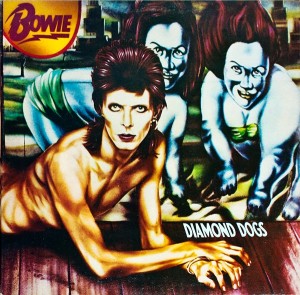
Bowie – Diamond Dogs

Diamond Dogs

BowieDiamond Dogs RCA APL1-0576 (1974)


After the glam hard rock of Aladdin Sane and the nostalgic (and poorly-received) Pin Ups, David Bowie returned, somewhat, to the theatrics of The Rise and Fall of Ziggy Stardust and the Spiders From MarsMick Ronson and The Spiders From Mars are gone, but Bowie’s own guitar playing is sturdy and effective, if more economical and scrappy.

“Rebel Rebel” is one of Bowie’s catchiest guitar riffs.  “Diamond Dogs” is another great one here, with its solid glam beat and gracefully dingy horns.  Of the tracks that aren’t on the radio or best-of collections, “Rock ‘n’ Roll with Me” is perhaps the best, and most instructive.  It (and the soulful “We Are the Dead”) points towards Bowie’s focus on his singing that would lead to the R&B rave-up title track to Young Americans and the excellent cabaret ballad “Wild Is the Wind” on Station to Station.

There is a concept of sorts behind this album, something about a dystopian future like in George Orwell‘s Nineteen Eighty-Four (Bowie was denied rights by the author’s estate to make a direct adaptation of the novel).  The concept helps the album, not in the direct structure of a cohesive overall story line, but in providing a kernel of inspiration that gets individual songs going.  There is more social commentary here than on perhaps any other Bowie album.

Really, Diamond Dogs is one of Bowie’s best.

Death Penalty

The death penalty should apply only to those who claim power in the name of others, like world leaders, military and police commanders, and even (sometimes) business executives.  Serial killers and minor criminals are usually pressed by mental health concerns and poverty in a way that makes prison or commitment more appropriate.

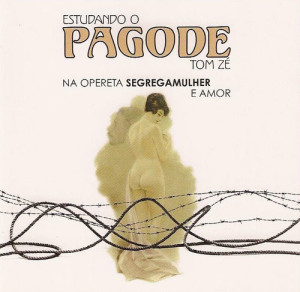
Tom Zé – Estudando o Pagode

Estudando o Pagode (Na Opereta Segregamulher e Amor)

Tom ZéEstudando o Pagode (Na Opereta Segregamulher e Amor) Trama 748-2 (2005)


Often described as a feminist operetta, Zé insists that Estudando o Pagode is not one.  But he is merely explaining things so he can confuse you.  If feminism is defined as the radical theory of the political, economic, and social equality of the sexes, then this is absolutely a feminist work.  The album was dedicated to philosopher Mary Wollstonecraft (author of A Vindication of the Rights of Woman (1792)), Isabella Faro de Oliveira, scientist Charles Darwin, ethologist/zoologist Konrad Lorenz and science journalist (and evolutionary psychology advocate) Robert Wright.  The psychoanalyst Maria Rita Kehl is cited repeatedly in the libretto.  A central concern is how the relationship between men and women is crafted in societies premised on domination and how hierarchies evolve and reproduce themselves, often in disguised and hidden ways.  In an interview, Zé said,

“I would like to clarify a bit the general attitude of this album, an operetta about the woman situation.

“It is not a feminist work. Though it is not a machoist CD, it is, at least, ‘masculinist’: It calls man’s attention to the huge disadvantage he has created in his present relationship with women.

“A woman, nowadays, is slightly suspicious and cannot permit herself the easy-going kind of well-being of companionship that allows going from affection to a caress.

“Women have incorporated a feeling of mistrust towards men. She is always tense, worried, confronted with a potential enemy, an attitude created due to the psychological context of his situation in the society.”

This is a work meant for men, to convince them they have mistreated women throughout history to hold greater power.  It is to convince men to see the world from a point of inclusive difference, not from a perspective of chauvinism.  (Regarding the elimination of racism, Judith H. Katz wrote White Awareness from a similar premise: racism is a problem caused by white people and white people are responsible for ending it, not the victims of racism).

What Zé is really driving at is that this is not music premised on so-called “identity politics“.  What does “identity politics” mean?  In short, it is about building political power by looking at the world through identity, namely, by building groups having a common identity such as the same gender and then exerting the collective power of the group identity to achieve political ends, particularly from the perspective of so-called “minority influence” but also through coalitions.  This is something promoted by the likes of Ernesto Laclau and Chantal Mouffe, and it has become one of the dominant aspects of neoliberalism — manifested through “inclusive” policies like multiculturalism.

French philosopher Alain Badiou is one of the most renowned opponents of “identity politics”.  Badiou has said, “What is the world like when it is experienced, developed and lived from the point of view of difference and not identity?  This is what I believe love to be.”  If there is a way to relay the premise of Estudando o Pagode short of actually hearing it, this would be it.  As acknowledged in the liner notes, following a lengthy quote/summary of Riane Eisler‘s book The Chalice and the Blade: Our History, Our Future (1987), Zé wants to push for utopian (gender) egalitarianism (using the past to break with the Gordian knot of the present with a form of argument that Walter Benjamin advanced: using the past to argue for a different future).

This music is also, thankfully, not really “opera” in terms of the manner of singing — it isn’t even bel canto popular music influenced by operatic forms of singing.  American writer Mark Twain (Samuel Langhorne Clemens) attended a performance of Richard Wagner‘s opera Parsifal and wrote a piece “Mark Twain at Bayreuth” in Chicago’s Daily Tribune newspaper, published December 6, 1891.  He summed up a common reaction to experiencing a Wagner opera:

“The entire overture, long as it was, was played to a dark house with the curtain down. It was exquisite; it was delicious. But straightway thereafter, or course, came the singing, and it does seem to me that nothing can make a Wagner opera absolutely perfect and satisfactory to the untutored but to leave out the vocal parts. I wish I could see a Wagner opera done in pantomime once.  ***  Singing! It does seem the wrong name to apply to it. Strictly described, it is a practicing of difficult and unpleasant intervals, mainly. An ignorant person gets tired of listening to gymnastic intervals in the long run, no matter how pleasant they may be.”

The overriding reason that opera is sung in such an unnatural way is to emphasize distinction among its listeners and partisans.  In other words, the very unnatural way about it, in relation to normal speaking voices, makes it esoteric and not readily appreciated.  It takes time and effort (and resources) to cultivate an understanding of its objectives, and therefore involves a degree of “conspicuous waste” (to use Thorstein Veblen‘s term) that distinguishes the wealthy — who have time and money to cultivate obscure tastes — from the “rabble” — who don’t.  Also, the “great person” aspect of operatic singing emphasizes that the feats of vocalization achieved by trained singers are not possible for everyone.  This promotes inequality, and reinforces a sense that inequality is natural and just.

If the concept of a feminist (or masculinist) operetta still seems unappealing, know that this music is wonderfully quirky and idiosyncratic.  Tom Zé is one of those endearing weirdos who can put a smile on the face of even the most bitter cynics.

This is the second of the (perhaps still-counting) trilogy of Zé’s “studies” (estudandos) of musical forms.  The way he approaches these studies is reminiscent of Conlon Narcarrow, a major musical influence.  Nancarrow composed (and recorded) “Studies for Player Piano,” punching holes in player piano rolls in way that produced music impossible for a single human performer to play.  Sometimes he prepared the player pianos by rigging the piano hammers with leather or metal to produce different timbres, and synchronized multiple player pianos for performances in unison.  Nancarrow’s works are intellectually curious and profound, while also being playful and having an affinity for popular musical forms like boogie-woogie (see his Study No. 3a for example, which, in the best possible way, sounds a bit like four pianists improvising on a James P. Johnson tune, simultaneously, as fast as they can play).

Zé uses a lot of different musical techniques here, drawn from many different quarters.  The opening “Ave Dor Maria” features a processed, computer-like voice, reminiscent of Prince & The Revolution‘s “1999” (“Don’t worry, I won’t hurt you…”).  The song draws on hip-hop and has a sturdy electric guitar-led rhythm.  Many of the songs utilize electronically programmed sounds, for beats or just for noisy effects.  “Teatro (Dom Quixote)” throws in anachronistic horns.

There is melody too.  The Second Act in particular draws on pleasant lyrical statements, on “Eleau,” “Prazer Carnal” and songs around them.

Speaking about his talents — or lack of talent — he said,

“I am a very bad composer, a very bad singer, a very bad instrumentalist, but the text is the most important thing of everything. Because I am so bad, that is the reason I am here. I am always going to the edges where nobody wants to go and try to work it out.”

The studies albums are the most explicit in describing a process of working through problems at the edges of possibility.  Syncretism has always been a part of Zé’s music.  Yet here there are as many — or more — different types of music in one place as anywhere in his back catalog, and the mashups are both as dramatically incongruous and creatively provocative as they can be.  This is also incredibly playful music.  The themes may be intellectual, but the performances are approached almost like stand-up comedy.  Tom Zé has always embraced compositions with disparate elements moving not in unison, but together, independently.  There is much of that here:  staccato guitar riffs and whistles, slowly moving washes of noise, tuneless glissandi caused by blowing on ficus leaves.  There is a pervasive tension between lead and backing voices.  They jostle.  Zé calls these approaches “induced harmony” and likens them to “incipient practices” like he used as a child performing in the Brazilian folk genre of música sertaneja, and like the intuitive sociopolitical life strategies of ordinary people.

The story of the operetta is summarized on the back of the album.  It vaguely resembles another strange psychoanalytic epic, El Topo.  But don’t approach this thinking that following the libretto is crucial.  It isn’t.  The music is worthwhile on its own, even if you do not speak Portuguese.

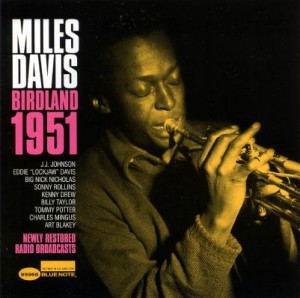
Miles Davis – Birdland 1951

Birdland 1951

Miles DavisBirdland 1951 Blue Note 7243 5 41779 2 7 (2004)


Very good performances from Miles’ bop days, but these were recorded in “primitive” fashion from radio broadcasts.  Casual listeners should avoid this in favor of something with better than bootleg quality sound.  Committed Davis fans will really dig the performances though, and can probably look past the fidelity issues.

Tom Zé – Tropicália lixo lógico

Tropicália lixo lógico

Tom ZéTropicália lixo lógico Passarinho PASSCD0001 (2012)


The late sociologist Pierre Bourdieu said, “I believe that if the sociology I propose differs in any significant way from the other sociologies of the past and of the present, it is above all in that it continually turns back onto itself the weapons it produces.”  A similarly reflexive position is taken in certain psychoanalytic/philosophical discourses (dealing with “permanent self-questioning”).  Tom Zé’s self-released album Tropicália lixo lógico (crude English translation: “Tropicália Logical Waste”) kind of follows a similar approach to music.

Zé is a kind of musical analyst (most likely a logical-intuitive introvert, just like cinema’s Jean-Luc Godard).  This album draws on Zé’s past in the late 1960s Tropicália movement, without being beholden to it.  This is a fairly mellow collection of music, much like his prior studio album Estudando a Bossa: Nordeste Plaza.  He is ironically using bits of popular music, some old, some newer.  What is different here is that unlike recent efforts his appropriations are in a way more crude, less nuanced.  This is kind of the point!  What made Zé’s misadventures in Tropicália decades ago so unique is that they dissolved many of the contradictions of straight-up cynicism.  When he appropriated bits of mass culture he didn’t do so just to cheaply trade on a kind of guilty-pleasure enjoyment in kitsch but to elevate the appropriation in relation to the content, honoring the sources without becoming beholden to them.  That last part was always the key.  When rudimentary cynics like Frank Zappa do things like this, they tend to prove in the end that they are really beholden to the past and can at most recall it to reinforce its underpinnings (and try to show off in the process).  Zé, on the other hand, robs the past of its coercive force, opening up the future to other possibilities.  He’s doing that again here.  But this man is in his late 70s!

Tropicália lixo lógico is an excellently produced album.  Much like Jogos de armar (Faça Você Mesmo), this is as conventional and approachable a production style as you will find anywhere from Zé, while also retaining the man’s essential weirdness and edginess.  There are hints toward indie rock, bossa nova, and so forth, with fewer and softer angular rhythms than on his most experimental recordings.  But he still has tricks up his sleeve.  One of his best devices is to cut off many of the songs.  Rather than fade out, or reach some kind of clear resolution, many of the songs are cut off mid-verse and the next song abruptly begins.  Consider this a litmus test.  If something like that sounds absurd to you, perhaps it is time to move along.  If the idea of cutting off the ends of the songs to refuse any sort of resolution sounds kind of interesting, then buckle in for a lifelong fascination with one of Brazil’s most fascinating musical figures — this probably won’t be your last Zé recording.