
Link to an excerpt from the book It’s Not Over: Learning From the Socialist Experiment (2016) by Pete Dolack:
Jackie-O Motherfucker – Change
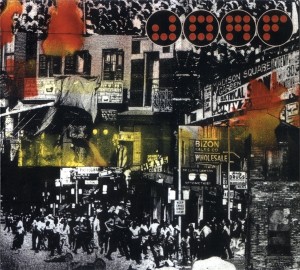
Jackie-O Motherfucker – Change Textile TCD 02 (2002)
Jackie-O Motherfucker’s (JOMF’s) approach to music is syncretic. Percussive elements draw out and expand other sounds lurking in guitars and other noisemakers. The sounds are distantly familiar, but they now seem to slowly rise to a conscious level. Once a part of the music has made itself felt, JOMF move on. The progression is slow. It is also steady. JOMF pull together folk, ragas, turntablism, jazz, blues, rock. Actually, they do a good job summing up their many influences. They look upon those influences as raw material for new combinations and presentations. This is a strange and friendly mélange of urban and rural elements. Part of the so-called “free folk” movement, this is vaguely like psychedelic jam band music but far less prone to showiness and guitar wankery than that label suggests.
Change is a very good album. Part of what makes it so good is that each song elaborates its themes. Solos and impressive technical feats aren’t the attraction; the shifting, almost pastoral musical landscape is. This takes attention away from the individual band members. The album offers the chance experience the concepts through many perspectives. The result is big; you have to step back to take it all in. Change is an opportunity to consider where you are, in relation, then to ask if you are ready for whatever comes next. Because whatever music has in store tomorrow, it will have to be different. JOMF have covered a lot of territory, and for anyone to retrace any of their steps would be too boring. And deep under the guitars that sound like sitars, the mumbled vocals, and the saxophone that makes its humble appearances, JOMF have a positive outlook as to where things are headed. Attention: Now leaving the terrordome.
Morris Berman – The Twilight of American Culture
Morris Berman – The Twilight of American Culture (WW. Norton & Co. 2000)
Disappointing. I ended up just skimming through a lot of this. Berman presents an interesting topic, but this feels like a five page essay spun out to book length. His analysis is pretty superficial. In describing the decline of American culture he seems to be “preaching to the choir” as they say. The best parts are his personal anecdotes about teaching experiences, but those alone don’t support his premise.
Marc J. Soares – 100 Hikes in Yosemite National Park

Marc J. Soares – 100 Hikes in Yosemite National Park (Mountaineers Books 2003)
Lacking in detail, and generally worthless other than as a list of some of the trails and directions to where they begin. The Falcon Guides book on hikes in Yosemite is superior, with elevation maps and in-depth discussions of trail difficulty and conditions.
Vicenç Navarro – What is Meant by “Single-Payer” in the Current Discussion of Health Care Reforms
Sam Gindin – Chasing Utopia
Link to an article by Sam Gindin:
Sole – Selling Live Water
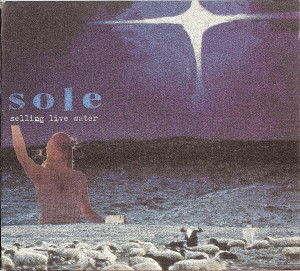
Sole – Selling Live Water anticon. ABR 0026 CD (2003)
Selling Live Water is hip-hop that can’t take for granted that it is hip-hop at all. It is music made to engage an audience and provoke critical thought. Hip-hop is just a convenient form that it adopts. Sole pursues his music with a fervor that concedes nothing but complete, honest commitment to his agenda. The most appealing part of this is the self-reflexive aspect. Hip-hop has been around long enough now that a more complex look at the genre itself is due. Sole contorts traditions with no hesitation.
On “Da Baddest Poet,” Sole admits how he isn’t smart enough for any techniques other than hip-hop. The necessity of his place amidst hip-hop culture means he really is making some sort of contribution to it. Sole is just trying to keep hip-hop as good as it was, and promised to be, in the age of “conscious hip-hop”, just… different. He says, “in the immortal words of Ice-T/ shoulda killed me last year/ but in the mere mortal words of me . . . ” There is humility here that is quite the opposite of the materialistic, misogynistic, violent subject matter promoted most heavily in the genre, combined with an awareness that Sole is tilting toward something else.
“Shoot the Messenger” goes off with “I never learned to kill for oil/ but then again I never learned to sit still/ and probably never will.” “Respect pt. 3” even seems to be a little anarchistic. There are politics all over this album — not in the sense of passing news, but in the sense of a commitment to bottom-up social transformation away from corruption and domination (Sole has noted that material on the album was inspired by Howard Zinn‘s A People’s History of the United States).
Sole is a good lyricist though he has only a passable delivery, something still impressive given what Sole does. His lyrics are very busy, giving him the difficult task of fitting it all in. He is either silent or in vocal bombardment mode. What turns out to make it work is the jokey attitude — full of gags and purposeful contradictions. By some manner of calculation he is aware of precisely how much ferocity separates his mind and his voice. Even though his rhythms don’t stretch and his dynamics are flat, deadly words still ooze from each of Selling Live Water’s cuts. Nonetheless, he steps up for some more impressive vocal rhythms, shifts and drawls on “Salt on Everything.”
The anticon collective producers on board (Alias, Odd Nosdam, Telephone Jim Jesus) cultivate a sort of blurred, hazy melange of oversaturated sounds, while keeping to a sense of syncopated rhythm. The beats contribute to the bleary feeling of being overwhelmed by media and the numbing spectacle of mass culture. This complements Sole’s way of rapping that often seems like shouting out as many words as possible without planning his delivery beforehand.
Sole makes good on the idea of personal hip-hop. He may not have expansive vocal talents to rely on, but he has still made some great music here. To appreciate Selling Live Water, a listener must accept that important statements can be made without access to large resources or authorization by the powerful, without being a supplicant or sycophant, by anybody who puts in the effort. If you reject those premises, then realize that this is an album made against what you believe.
Willie Nelson – Let’s Face the Music and Dance
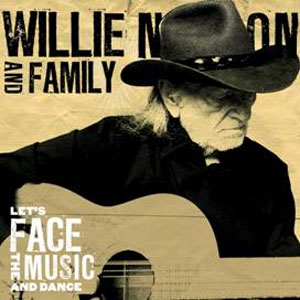
Willie Nelson and Family – Let’s Face the Music and Dance Legacy 88765425852 (2013)
If you have followed Willie Nelson’s later career — and before his surprise hit Band of Brothers you probably haven’t — he has continued to shuffle between styles. The occasional effort sounds a little more contemporary, but plenty look back to old-time western swing and early 20th Century pop, and sometimes jazz. Let’s Face the Music and Dance is a grab bag. The title track is an easy listening version of the sound from arguably Willie’s best late-career album, the austere Tex-Mex album Spirit. “Is the Better Part Over” is yet another re-visitation of one of his old songs (from the late 1980s effort A Horse Called Music). Most of the standards here seem to build on his American Classic, but with his regular touring band providing more country flavor than the jazz combos of that earlier effort. Not surprisingly, the best here is “You’ll Never Know,” with Willie’s not-so-secret weapon his sister Bobbie featured prominently on piano. This one is par for the course for Willie’s august years and hardly a standout, but it is more proof, if any more was needed, that he’s still not finished yet.
Nick Drake – Five Leaves Left
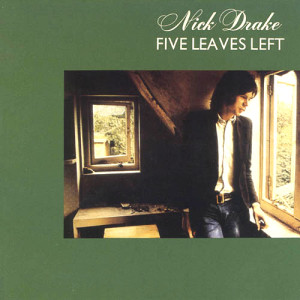
Nick Drake – Five Leaves Left Island ILPS 9105 (1969)
Nick Drake’s debut album Five Leaves Left was a rather unique recording that didn’t seem enmeshed in any sort of widespread movement. Fans often remark that his music seemed to come from “nowhere”. He never achieved much commercial success before his early death, partly due to his limited efforts to tour or promote his recordings. Still, his renown has grown tremendously since his death. Nick Drake is the sort of musician who came along ahead of of more widespread efforts to render a feeling of failed promise, which is to say failure to live up to potential. This is very inward-looking artistry. Extroverts may appreciate Drake from a distance without really warming to him more intimately. His music is somewhat elitist. Its lyrics are informed by the sort of poetry studied in “classics” courses in elite universities, and the orchestral treatments and delicate guitar playing (Drake was an impressive guitarist) pay homage to Euro-classical compositions. Yet these are pop songs, which underscores the way the music has a familiarity with highbrow culture but turns away from it, if only slightly. It is the devastating earnestness of Drake’s songwriting and performances that keeps this from being pretentious. This album leans toward the counterculture, but from a privileged place that manages to satisfy every criterion of dominant culture. More than anything, that was Drake’s real achievement. He managed to hold together seemingly incompatible forms in a way that never for a second seems like a juxtaposition at all. The stark, flawless Pink Moon may well be Drake’s finest album, but Five Leaves Left is great too, and hardly a step back at all (saying so is a matter of splitting hairs).
David Ruffin – Me ‘n Rock ‘n Roll Are Here to Stay
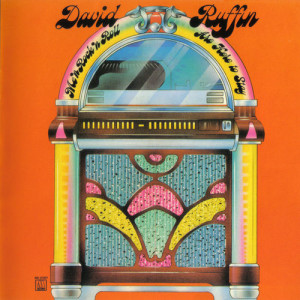
David Ruffin – Me ‘n Rock ‘n Roll Are Here to Stay Motown M6-818S1 (1974)
This one has that pure Norman Whitfield psychedelic soul sound. “I Saw You When You Met Her,” “Smiling Faces Sometimes” and the title track kill. Looping in canned applause on two tracks was a hugely dumb decision. Still one of Ruffin’s best.