Lucio Battisti – Anima latina

Anima latina

Lucio BattistiAnima latina Numero Uno DZSLN 55675 (1974)


Here’s an album that seems to be an unlikely Rosetta Stone for much of European rock and pop of the 1970s.  Anima latina (“Latin Soul”) is perhaps Lucio Battisti’s most acclaimed album.  He was a big pop star in his native Italy, though internationally (especially outside Europe) he was and is less well known.  The music ranges from (symphonic) prog rock to Canterbury Sound psychedelic jazz-rock, with ambitious, arty meanderings, laced through with understated brass horn charts and diffuse synthesizer figures.  Most of the songs are over five minutes in length.  None are structured like catchy pop hits.

The opening “Abbracciala abbracciali abbracciati” sets the album off well.  This is high drama.  The effect is a bit like a darkened theater, a huge one, with an assemblage of musicians in an orchestra pit somewhere out of sight, but a lone singer in a dim spotlight delivers a searching, allusive and almost existential song in halting yet eloquently delivered statements.  There is sparse percussion.  Yet the drums are played with such pauses as to mean there is no real syncopated beat as such — duh(ch), duh, ____du-chashhh___.  Behind the drums, the song opens with a sustained but subdued synthesizer chord and a solitary trumpet (electronically processed most likely) playing long, faint notes that seem to move toward an unfinished statement, without ever realizing a melody.  There isn’t a whole lot of singing.  Battisti begins just by singing wordless sounds.  The singer isn’t so much a protagonist as someone who has stumbled into the song.  At least, every effort is made to make this the appearance.  There is never any doubt that this is a staged performance.  As the song continues, the drums and a bass provide more of a steady rhythm.  If there is a comparison for “Abbracciala abbracciali abbracciati,” it is perhaps Neil Young‘s opening to Tonight’s the Night (recorded before or at the same time but released after Anima latina), or the more frequent comparison of Robert Wyatt‘s Rock Bottom (released the same year).

The rest of the album ranges from spacey, swirling meditations to funkier tunes that get a decent groove going.  The album title alludes to a South American influence.  This is a subtle but important presence throughout the album.  The influence of samba, perhaps even tropicália, in the rhythms (“Due mondi,” “Gli uomini celesti (Ripresa),” “Macchina del tempo”) and some of the horns (“Anonimo,” which flirts with tropicália’s reverent/irreverent use of kitsch), and the burning intensity of Argentinian folk-rock (“Anima latina”), all make themselves felt.  Rather than the clinically calculated shifts in unusual time signatures and other technical feats that make a lot of prog- and jazz-rock kind of distant, even tedious, Anima latina leans on warm and organic rhythms to tie all the experiments and shifting concepts together.  That is crucial.  It lends a suppleness that gives the otherwise very arty aspirations of the album a beating heart.

If prog rock remains the core referent for the style of the album as a whole (and especially toward the end), it is worth noting that most of the guitars are acoustic.  There are no electric guitar heroes here, or flashiness of any kind really.  More than any one dazzling performance — even by Battisti — this is an album that succeeds based on its structure.  The ebb and flow of the songs, the deliberate pacing and wide open spaces emerging from the sonic fabric, anything that is the implication rather than the direct content — these are the things that make Anima latina captivating.  There isn’t one right way to hear this music.  In Criticism and Truth, Roland Barthes wrote that “a work is ‘eternal’ not because it imposes a single meaning on different men, but because it suggests different meanings to one man…”  That provides an apt reason to listen here.

Beyoncé – Beyoncé

Beyoncé

BeyoncéBeyoncé Columbia 88843032522 (2013)


This album is an excellent encapsulation of contemporary pop music.  The first thing that stands out is how capital-intensive this music is.  In other words, it takes a tremendous amount of resources (capital) to make an album this finely layered, refined and varied.  Rather than one producer crafting many of the backing tracks across the whole album, there is an army of producers, songwriters and musicians.  Most singers could never summon the resources to make an album that way (Public Enemy‘s Most of My Heroes Still Don’t Appear on No Stamp is an exception that proves the rule, fueled by artistic credibility — and associated crowdfunding — rather than the largest bank account).  The eclecticism is stunning.  Some songs are in the style of electronic dance music, others like vintage Prince, or more recent D’Angelo.

What this album stands for is the “mogul” mentality, that the world needs big-shot moguls who are better than everyone else.  In a way, this is the ultimate (and most seductive) way of promoting collaboration with or resignation to the demands of the powerful cabal that controls the major institutions of society.  No, that is not meant as some sort of conspiracy theory.  Instead it means that the society in which Beyoncé was released is very polarized and unequal, and the repeated message across the album is that if you accept the dictates of the moguls then maybe you too can become one someday — like winning the lottery, this requires that many, many others lose, and discussions about the hardships of the winners say nothing of the hardships of the losers.  In an interesting way, the repeated interludes (like Beyoncé as a kid on the “Star Search” TV show) and the “it’s hard to live up to expectations to be pretty as a woman” theme make a cynical capitulation.  Rather than reject the social demands to be “pretty”, or reject the system that creates moguls by creating dire poverty and widespread insecurity, this kind of just shrugs that off and declares there is no alternative; just develop a coping strategy to accept it and deal with it.  This expresses the “survivor” mentality of a psychotic culture.

As reviewer Andrew Johnson wrote:

“Of course, the thing about this album is that it’s the ultimate undisputed-queen-of-pop power move, released as it was with no advance press, in the middle of the night on iTunes with no one driving it but Beyonce herself (and well, obviously her husband, but we won’t begrudge her that). Beyonce is in a position now that she doesn’t need anything but herself, and the musical result is an album that feels completely liberated: ‘Yonce indulging every filthy impulse she has, adorning beats that are dark and not explicitly radio-seeking, dictating that things are going to go her way, at least for the next 67 minutes. She’s got the best producers and songwriters alive working with her here and the guest list for features is the very top tier in the hip-hop world, but no one can take the spotlight away from Bey here. She’s a big enough figure now that she can carry a top-selling album on nothing but reputation alone and if her musical accomplishments never seemed to meet that stature before, well now she’s fixing that.”

But the real trick here is that she may be “liberated” and in charge, but only because she is following the dictates of big-business entertainment and endorsing the “mogul” view of the world.  She still reiterates the precepts of reactionary “social darwinist” theory

In spite of any misgivings about the premise of the album, it is a marvel.  There is practically a flawless delivery.  The pure craftsmanship is stunning.  And the beats are absorbing.  Beyoncé is not an especially captivating singer on her own, but she more than lives up to everything these songs demand.  Certainly this is a collaborative effort, but she also emerges as someone nominally in charge of the proceedings.

I was pleasantly surprised at how good this album was.  I do retain the same general misgivings as I had for Taylor Swift‘s 1989Beyoncé is a more evolved album though.  It concedes something to cynicism, even as it reaffirms something very similar to what Swift promotes (with denial in place of cynicism).  But this does carry more baggage and internal contradictions than it lets on.  Still, when the beats get going this is hard to argue with.  In an effort to be open-minded, I listened to a Britney Spears best-of collection, and there the simplistic, even crude brushstrokes seemed to lack the detail and extreme talent brought to bear on Beyoncé.  Frankly, the Spears stuff was terrible.  So this is really one of the finest examples of mainstream pop music of its era.

This Is 40

This Is 40

This Is 40 (2012)

Universal Pictures

Director: Judd Apatow

Main Cast: Leslie Mann, Paul Rudd, Megan Fox, Jason Segel


Judd Apatow’s movies are very much within the mainstream cultural sphere, but within the necessary constraints of Hollywood, his films often explore the limits of doing what you love and how his characters can’t (or choose not to) enjoy themselves.  Put another way, the characters go through this process of trying to change their desires, to go from being, essentially, adolescent young adults, to mature adults.  C.G. Jung termed this “individuation”, the kind of “second puberty” that happens at age 35-40 (if it happens at all) where the individual is (re)integrated into a social collective — illustrated by Goethe‘s Conversations of German Refugees: Wilhelm Meister’s Journeyman Years or The Renunciants.  (Goethe was a huge influence on Jung, inspiring many of the latter’s theories of analytic psychology).

Reviewer Onethink summarized the film this way in a review:

“Debbie and Pete (Leslie Mann and Paul Rudd) live in the American dream: they have a luxurious house, flash cars, two daughters who go to a nice middle class school, they own their own businesses – and the businesses are hip and trendy: she runs a chic fashion outlet, he runs a record company. But not everything is rosy. The businesses are failing. Debbie has deep anxieties about growing old – so she lies about her age and has a personal trainer and begins faddy eating regimes: all the things middle class Americans should do. And, typically for a male Apatow character, Pete has certain maturity issues: is his record company not so much a business as a strategy to still feel young and hip? As parents they go from the lenient to the draconian. And their fathers bring a couple of variations: both are monstrous, one clinging and dependent, a nightmare image of a ‘failed’ adult, the other aloof and distant, a nightmare image of a ‘successful’ adult.”

The parts about work are interesting.  Miya Tokumitsu wrote the most popular article ever on a magazine’s web site, and later expanded that article into a book, about the trouble with the injunction to “do what you love” for work/career.  Making much the same point more generally, the Slovenian philosopher Slavoj Žižek frequently states that the injunction of contemporary ruling society is to “enjoy,” that the superego perversely demands that we enjoy that which is really our duty, traumatically and painfully depriving us of free will to choose what we enjoy at the very point a choice is seemingly offered, stigmatizing us.  The characters in This Is 40 seem to have the jobs/businesses they want, or are supposed to want.  But they are forced to make money to support an upper middle class lifestyle.  Is it that they want these jobs, specifically, or want these jobs to support the lifestyle that they really want?  Or do they want a different lifestyle altogether?  Is it that everyone around them wants them to have their lifestyle, forcing it on them?  Is it possible for them to want something apart from what those around them want them to want?

If the central parts of the film are politicized — and why not look at the film that way? — then the conservative view is to dislike the main characters Debbie and Pete, the centrist-liberal view is to sympathize with them, and the leftist view is to appreciate them as unreliable narrators of sorts.  The conservative view would be that these failing entrepreneurs are properly subject to market forces, and any of their failings in the market are their personal failings.  The film is wrong then, in a sense, in sympathizing with the ambitions of the failed businesspeople, who fail because they should — they are failures.  And the characters are unsympathetic because they turn against “traditional values.”  The centrist-liberal view is to value the many varied people in the film, to each their own (a multicultural, identity politics paradise), and the conflict of the characters not fulfilling their promise and expectations needs to be resolved.  The film is correct, therefore, to sympathize with its characters.  Everyone deserves to be happy.  The left view, however, sees the main characters as not particularly likeable, or at least as Onethink says, monstrous in their way.  These are just a bunch of stupid people, as stupid as any, and the challenge is how to educate them to accept responsibility for creating meaning in their lives — even their professed desires may be unreliable or stupid.  This reads the film to the left of the film’s ostensibly “professional” Hollywood perspective, which is centrist-liberal, by saying the main characters aren’t really as likable as they are presented to be.  While Apatow doesn’t go as far in rehabilitating antiheroes as, say, Pasolini with Accatone or Korine with Gummo, then he at least takes a Hollywood movie and cracks open the possibility for this perspective from within it (and he does so with a bit more finesse than, say, The Company Men or just about any “little” Hollywood side-project film with big-name actors but little marketing).

The film has very realistic main characters, and the acting is generally excellent.  Really, there are great, subtle moments from Mann and Rudd all over, helped by very strong screenwriting.  The very dull moments actually help that along — the quirks of hiding from family members in a shared house, obsessions with material things, resort to therapy/counseling techniques.  Some of the peripheral characters are a bit thin and one-dimensional, or implausibly exaggerated.  But these minor characters are mostly present to add humor to the film, setting up jokes and gags.  But this is a comedy, and it probably wouldn’t succeed as being one without those set-ups, however artificial.  And there are mostly white people in this closed universe — not to say that there is something inherently wrong with that, but the restricted experiences of white people form implicit boundaries around the film’s ambitions and perspective.  Give this credit though for a fairly balanced mix of male and female characters with substantive parts, and not just of a romantic type — these female characters engage each other without any males present.

The film’s ending is archetypical Apatow: it is a “Hollywood” ending, complete with facile, happy resolution of the major plot points and conflict, and yet, it actually is not entirely that at all.  The film ends with a bit of a “fuck it all!” attitude, but without any guilt about it.  The two main characters, at least, tentatively accept that there is no one (or no thing) that will provide meaning for their lives, or their relationship.  As their fathers (Albert Brooks and John Lithgow) loom larger in the second half of the film, the two main characters Debbie and Pete recognize that their parents can’t be faulted for failing to provide meaning for them — nothing and no one can do that.  Even the angst about selling their upscale house to make ends meet is an admission that having that particular material possession won’t validate their existence.  But rather than wallowing in existential dread, they reform and reassert their couple relationship, and their family structure.  This is what philosopher Alain Badiou calls a “two scene”: the positive existential project to see the world from the point of view of difference rather than identity, “to construct a world from a decentered point of view other than that of my mere impulse to survive or re-affirm my own identity.”  This is basically a specific type of individuation.  The ending isn’t the film’s strongest section, but it manages to make a compromise with the happy ending in a way most Hollywood films can’t (think about how As Good As It Gets sets up a premise for an inevitable downer ending, then winds up with the usual happy one anyway).  The small kernel of radicalness in this film is that even though the married couple chooses to stay together at the end, they get there through free will.  They don’t just resign themselves to social dictates.  Instead they overcome the injunction to enjoy what they are demanded to do, and instead make their own choice, which happens to be to maintain a stable nuclear family, even if they aren’t strictly happy as a result — they end up with a space where they don’t have to enjoy their social duties.  This is in contrast to, say, the rather one-dimensional character Desi, who is totally confined to play a particular role, without free will (note how Debbie declines that lifestyle in the film).  Returning to Zizek, he says, “The problem today is not how to get rid of your inhibitions and to be able to spontaneously enjoy. The problem is how to get rid of this injunction to enjoy.”  If there is danger in seeing the film’s ending as radical (think of the questions raised about asserting that a woman shopping is a feminist act), then at least the film as a whole provides enough to make the ending a kind of vector rather than a static point, it occupies the same space as that static point but it points somewhere, from where it was to where it is going.

This is 40 is a much better and deeper film that it seems.  Definitely Apatow at his best.

Mad Max: Fury Road

Mad Max: Fury Road

Mad Max: Fury Road (2015)

Warner Bros. Pictures

Director: George Miller

Main Cast: Tom Hardy, Charlize Theron, Nicholas Hoult


Here’s a movie for which the glowing critical praise is perplexing.  It is a deeply hypocritical film.  For instance, it takes pains to pass the “Bechdel test” and insert feminist positions, like the female revolutionary character Imperator Furiosa (Charlize Theron).  And yet at the same time the film has a group of scantily clad women prancing about in what is uncomfortably close to a wet T-shirt car wash scene.  These positions are not compatible as they are portrayed, in that the film engages in the worst sort of pandering, trying to have it both ways, appealing to feminists and sexists.  This is like the worst form of facile multiculturalism.  The plot, as much as there is one (and there barely is one), is kind of inferior to Mad Max 2: The Road Warrior, which already sets forth in starker terms the symbolism of pointless wars over resources (especially fossil fuels).  Still, this film has a lot of action sequences and special effects — the movie is practically one long stunt scene — and they are good, as are the costumes and other technical aspects.  But those things don’t make up for the film’s flaws.

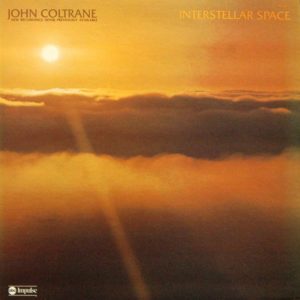
John Coltrane – Interstellar Space

Interstellar Space

John ColtraneInterstellar Space ABC Impulse ASD-9277 (1974)


Coltrane’s Interstellar Space is like a soundtrack to Arthur Rimbaud’s Une Saison En Enfer [A Season in Hell], as Stellar Regions is for Rimbaud’s Les Illuminations [The Illuminations]. This is one of the more challenging Coltrane albums. It demands constant attention. But it is rewarding. Coltrane had added some of the layered approach of his wife Alice into his sound. His fiery forays here are as dazzling as they are ingenious. His passion perfectly matches his virtuosity.

Rashied Ali plays some remarkable non-linear rhythms on drums. Though he keeps time in a sense, it is a subjective time with no predetermined time signature. The music is of the moment, in the sense of having no need of time to progress. It is confusing, but the instantaneous possibility of the moment is supreme and Ali’s rhythms are presented as they are naturally. Instead of conforming to any external formula, Interstellar Space is spontaneously (and thereby simultaneously) composed, lived, and performed.

This is a remarkable effort in musical abstract expressionism. While totally true to the impulsiveness of free improvisation, this is also a strong statement of Coltrane’s (and Ali’s) struggle to resolve the inner self and the outer one in the most idealistic sense of reconciling a personal place in a harmonious social context. Whew, it is that and more. This is one of the great efforts to be a completely free individual in a world as great as imaginable.

Interstellar Space rebels against order and structure, in a sense, but only against falsehood. One of the basic contradictions of so-called “free jazz” was stated quite succinctly by pianist Paul Bley, talking to The Wire magazine in 2007 about the saxophonist Ornette Coleman:

“There was an article in Down Beat in something like 1954, in which I mentioned that jazz had reached a crisis and that AABA form had too many As, and not enough CDEFG.  So I began working with groups where we would play totally free, and that led to a kind of dead end, because ‘totally free’ didn’t necessarily allow you to continue.  A totally free piece is a totally free piece, end of concert. ***  [But Ornette] suggested ABCDEFGHIJK, in which repetition was anathema *** It wasn’t totally free because totally free was A forever, metamorphosing.  It was a form that took hold, because you could finally return to the written music, and the audience had something to hold on to.”

What might be added is the sort of complaint that the feminist Jo Freeman made about (so-called) structureless groups, which tend to have a de facto structure (tyranny) if there is no formal structure.  These things are basically what Coltrane was working through on his own with recordings like those on Interstellar Space.  The music wasn’t just a formless morass, metamorphosing, but neither was it music that was composed in advance according to a detailed score.  It fell somewhere in the middle, loosely organized without that loose organization seeming like a constraint, able to go wherever and equally the product of the efforts of both Coltrane and Ali.  The performers aren’t operating completely independent of one another, in some kind of purely horizontal relationship.  But they are constantly negotiating the terms of how the music evolves.  One might quote a political economist here:

“But is this anything other than picking up Rousseau’s classic idea that being free, in politics, does not mean living outside of all constraint, but living according to rules we have set for ourselves? That is, living according to verticality [that is, hierarchy,] such as we have chosen to institute it, in the form that we have chosen to give it.”

This is a particularly useful analogy, given that Rousseau favored small states, much as a sax/drums duo is the smallest possible “group”, meaning that the problem of negotiations between participants doesn’t face the problem of exponentially-increasing complexity that shackles larger groups.  This isn’t to say that the horizontal vs. vertical question is entirely side-stepped, but rather the question of verticality is addressed in a sort of controlled laboratory setting, if you will.  Rashied Ali just makes it deliciously apparent how much space a “sideman” has within the context of a Coltrane group, and by extension, how the role of a “star” soloist can be rethought within the free jazz movement.

Coltrane recorded Interstellar Space on February 22, 1967; he died on July 17, 1967. For a considerable time these were believed to be the last known studio recordings he made, though additional studio recordings were later discovered. “Venus: Second From the Sun; Love” (AKA “Dream Chant”) is, melodically, extremely similar to “Stellar Regions” from Stellar Regions, which was recorded a week before Interstellar Space but not released until 1995.  Many of these recordings were unnamed and only later named by Alice Coltrane for release.  Though posthumously released in album form, these songs do make up a coherent set of music.  They all cohere around a common musical perspective.

While made up of archival recordings, Interstellar Space remains one of the most essential John Coltrane albums.  Listeners should seek out a reissue that includes the excellent bonus track “Leo,” which was recorded at the same session as the other songs but left off the original LP due to space constraints (but previously released on The Mastery of John Coltrane, Vol. 3: Jupiter Variation), plus a “Jupiter Variation” false start track.

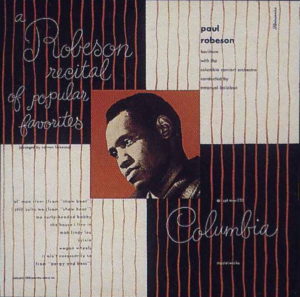
Paul Robeson – A Robeson Recital of Popular Favorites

A Robeson Recital of Popular Favorites

Paul RobesonA Robeson Recital of Popular Favorites Columbia Masterworks 732 (1948)


All show tunes and orchestral pop.  Robeson’s vocals are nothing short of great.  Yet the rather generic orchestral backing does a disservice to the music.  It’s worth noting that on this version of “Ol’ Man River” Robeson has changed (and improved) the lyrics.