Barry Adamson – The King of Nothing Hill

The King of Nothing Hill

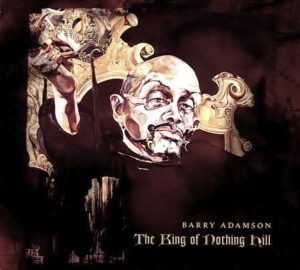
Barry AdamsonThe King of Nothing Hill Mute CDSTUMM176 (2002)


Barry Adamson, the maestro of fake soundtrack music, has a firm conviction to the devilishly absurd.  His ridiculousness is part of his appeal.  He is a collector, suggestor, director and actor.  The illusory story lines hinted at on his albums can pull emotions and moods out of practically nothing.  He takes the listener places.  Plenty of new experiences are waiting.  The King of Nothing Hill fits a sleek action thriller, the sorts with spies, international intrigue — that sort of thing.  While it sounds like an exotic, action-packed journey, it is still pop music.  It is just on the fringes.  That seems like a comfortable home for Adamson.

“The Second Stain” and “Twisted Smile” pulse with monotonous vamps until the mood envelops everything.  The songs point, prod, and push.  Bass and keys alone can rush listeners back and forth between the highs and lows. Adamson can pick you up and place you carefully in new surroundings, ready to experience the moments as they arrive. You have to be open to the possibilities, true.  If you’re not willing to budge then Adamson’s efforts might be an annoyance. He does have a talent for always being inviting though.  You have to be quite closed-minded not to be swayed a little.

A funky workout session takes place on “Cinematic Soul” (cribbing a bass line from “Sing a Simple Song”).  Adamson can be as brash and glitzy as anyone and still pull it off.  His material may be described as rather composed, but it can boogie too.  Then more surprises come when “That Fool Was Me” has the sultry soul comedy of him singing, “only a fool would leave you / and that fool was me.”

The King of Nothing Hill makes considerable use of electronics and sound effect samples.  There is sometimes an erratic pursuit of a number of different styles, but Adamson uses those shifts to convey a sense of changing scenes in a movie.  The effect can be a bit demanding over the course of the rather lengthy runtime of the album though.

As Above So Below, the predecessor album, had more lounge jazz/acid jazz and bleak, blaring trip-hop pushing it ahead even if it subdued the pseudo-soundtrack impressionism.  Both efforts toy with kitsch.  All things said, the albums are about equally good, just in different ways — if anything this album has more cohesive and focused individual songs even as it lacks some of the elusive intrigue overall.

The King of Nothing Hill is refreshing.  Almost a decade and a half after its release, it has to be given credit for capturing the feel of the sorts of action thriller films it evokes.  Granted, the lyrics go beyond what pure soundtrack music would normally do, by suggesting visuals to accompany the music (like the line, “I don’t even know how the gun got in my hand” on “Whispering Streets”).  But that’s part of the fun of this approach to music.  And Barry Adamson is still basically the only one doing what he does.

Patty Loveless – The Definitive Collection

The Definitive Collection

Patty LovelessThe Definitive Collection MCA Nashville (2005)


The gestures are broad.  The lyrics dwell on commonplaces and banalities, especially slightly melodramatic interpersonal relationship issues.  Much of this has the high-contrast, slick production style of typical 1980s country and pop (even the stuff from the 1990s).  It would even be fair to say the music is mostly formulaic.  This is precisely the point though.  This is what might be called rural proletarian music.  It emphasizes shared experience.  The lyrics might focus on an individual protagonist, but often with a certain level of acceptance of social roles (especially gender roles), and any given song as a whole tends to reaffirm familiar musical forms as a way of emphasizing tradition (never challenging it).  So, like a lot of country, this has a slightly reactionary/conservative perspective to it.  And more, it also kind of validates a more rural or at least small town perspective (against that of an urban one).  The effect is much like a feeling of “town pride” in a small town (just a few hundred people), in ways rejected by city folk, with a lot of simple repeated pleasures.  Yet the music largely manages to avoid negative aspersions too.  This might be a bit rural focused (there are references to tractors), but it doesn’t try to put down that which is outside its sphere of influence.  It is what it is.  There is no imposition in this music.  And Loveless has a really good voice.  While this mines old country forms, with a light oompa-oompa beat or honky tonk groove, it does so adeptly  There are some surprises too, like “Don’t Toss Us Away” (written by Bryan MacLean, formerly of the band Love) and “A Little Bit In Love” (written by Steve Earle).  Loveless really shines drawing something out of the simplest tune though. No doubt, Loveless was one of the better things Nashville had going during the time span of this collection — even if that is only a small complement, relatively speaking.

A Brief Summary of Critiques of Slavoj Žižek

Slavoj Žižek is one of the most famous philosophers in the world today.  Because of that status, he is constantly criticized in the media.  It seemed mildly amusing to summarize the most common bases for these critiques.  There are a few common threads, mostly revolving around two principles adopted from Hegel and Rousseau.

The Emperor Has No Clothes

The fist type of critique is to more or less intentionally misrepresent Žižek’s arguments and theories by refusing the acknowledge the underlying basis of theoretical disagreement.  This is the approach most commonly taken by academics who wish to assert that Žižek is wrong but they are right.  A good example is this op-ed by two virtually unknown professors: “Žižek’s Hypocrisy.”  The usual approach for these critiques is to claim that Žižek is a hypocrite by not being a “pure” expression of something he says, even though one of Žižek’s key positions is that there is no such purity possible.  He has written many times about the dangers of “beautiful soul” syndrome (in the Hegelian sense).  Yet these critics demand that Žižek adopt the position of the “beautiful soul” standing apart from the evil of the world. Here is a quote from an interview he gave discussing this very point:

“I think it’s too easy to play this moralistic game — state power is corrupted, so let’s withdraw into this role of ethical critic of power. Here, I’m an old Hegelian. I hate the position of ‘beautiful soul’, which is: ‘I remain outside, in a safe place; I don’t want to dirty my hands.’ In this ironic sense, I am a Leninist. Lenin wasn’t afraid to dirty his hands. That’s what I miss in today’s left. When you get power, if you can, grab it, even if it is a desperate situation. Do whatever is possible.”

In other words, the critics impose their theory on Žižek but claim that Žižek is violating his own theory.  No, all they have done is reject his theory and inserted their own.  Anyone can do that.

All this is largely the basis for Noam Chomsky‘s attack on Žižek as a charlatan: Chomsky comes from the Analytic school of philosophy, whereas Žižek is from the Continental school.  Chomsky acts as if there is no such thing as the Continental tradition, and proceeds to complain about why Žižek does not conform to what are inherently opposing Analytic positions.  Chomsky disavows his ideological position.

Assertions of Naivete, Crypto-fascism

Another common attack is the critique that Žižek is impractically, or even dangerously naive.  Usually these attacks are prefaced with an assurance that the critic actually likes/respects him, but that he’s gone astray on some certain argument or line of argument.  Unlike the “emperor has no clothes” critics, these attacks generally acknowledge that he takes a different position than the critic and assert that where he diverges from the given critic’s own position is where Žižek is being naive.  An example of this tactic is “An Ode to the Death of Europe and a Concerned Love Letter to Žižek.”  Many of these critiques come from anarchist-leaning people, who (and here’s the ironic part) think that Žižek’s Leninist/Rousseauian position is naive.  But from a historical perspective remember that these are anarchists who think that the evils of the world can wither away without being crushed by a strong state, and they have the audacity to call others naive!  This, in many ways, is a deeper disagreement than the “emperor had no clothes” line of attack, though still the same basic disagreement.  Žižek rejects the “beautiful soul” attitude while these critics strictly insist upon it, and, from a Leninist/Rousseauian position disagrees with some kind of jump from late capitalism straight to a purely horizontal society.  But it is also worth noting that, following sociologist Pierre Bourdieu‘s theory of social distinction, the most vociferous of these critiques tend to be the ones from people and publishers that are closest to Žižek on the political spectrum — he has stated that a purely horizontal society would be nice but could never emerge directly from late capitalism.  But these sorts of critiques are the most lamentable, because the critics tend to be people who actually agree with him on most points, but instead of finding common ground they squabble over who should get credit for the best theoretical position — the essence of Left factionalism.

One of the funnier recurring critiques of Žižek along these lines is that he is expressing some kind of right-wing, reactionary, fascist position (despite his reputation and attempts to pursue the opposite position).  He draws the most ire in this respect for his outspoken position against political correctnessAdam Kotsko has explained the source of this disagreement well, highlighting how “Žižek’s political interventions always try to highlight a fundamental conflict or deadlock. He does so not by laying out a step by step argument with a clear thesis statement, but by overidentifying with the (inadequate) terms of public debate in order to press beyond them.”

It is certainly worth noting that Žižek usually takes for granted that he is arguing for an Enlightenment, rational and communist political position to prevail.  He doesn’t spend a lot of time bolstering those points.  That is to say in his mass-media engagements he doesn’t spend a lot of time arguing for why a rational egalitarian social system is better than a power-based (irrational) system of inequality. To be a bit more specific, he adopts a thoroughly Rousseauian conception of a democratic society, in which any vote by a majority to disadvantage a minority is invalid — many critics who reject this Rousseauian position criticize Žižek when he more or less applies it to current events.  Ironically, it is precisely this adoption of Rousseauian conception of democracy that gets him labeled a crypto-fascist (by people who seem to want a society like that depicted in Lars Von Trier‘s Dogville).

He Has No Program

Some say Žižek does not clearly set forth a coherent program for what the world should look like.  The rebuttal to that charge is summed up nicely by Noam Chomsky, who has said, “One commonly hears that carping critics complain about what is wrong, but do not present solutions. There is an accurate translation for that charge: ‘They present solutions, but I don’t like them.'”  But Žižek goes a step further, actually.  He disavows the ideal of the perfect program that overcomes the problems of the present.  Discussing Hegel, in a general way, he has written that

“The critical ‘system’ is the systematic a priori structure of all possible/thinkable ‘errors’ in their immanent necessity: what we get at the end is not the Truth that overcomes/sublates the preceding illusions — the only truth is the inconsistent edifice of the logical interconnection of all possible illusions . . . .”

So again, the claim that “he has no program” is a variant on the “emperor has no clothes” line of attack, yet again rejecting (or ignoring) his theories to impose a different theory.

But Žižek openly acknowledges that he argues from certain positions: “there is a need for radical economic change . . . . When I was young, such an organized attempt at regulation was called communism. Maybe we should reinvent it. Maybe this is, in the long term, the only solution.”  He also says that “a thorough radical transformation of global capitalism that should begin in the developed West itself.”  This is an old left position, not unlike the argument of Judith Katz in the book White Awareness, that racism is a white person’s problem — in contrast to the many contemporary “multicultural” approaches with toothless anti-racism committees staffed entirely by non-white minorities that plead for recognition by the powerful (white) beneficiaries of racism.  He instead wants the people promoting and benefiting from oppression to undergo a radical self-transformation that causes them to adopt universalism and egalitarianism.  So while it is true that he has no fixed notion of what an ideal society should look like, he very much has some clear guidelines on which direction society should head and what are key conditions that should be met.  Really, the idea that a fixed notion of a perfect society can be articulated by one person on behalf of humanity is itself ideological, and so Žižek typically rejects the framing of inquiries that way.

His Writing Is Incoherent

Another key Žižek tactic is to provocatively disregard social distinctions.  This causes people to lambast him as if he does not understand social distinctions.  While his writing is idiosyncratic, his refusal to honor social distinctions is really part of his attempts at overcoming them.  Critics arguing along these lines are usually defenders of the status quo, or at least defenders of privileges associated with social distinctions.

Lies, Damn Lies

Another common approach is to simply misrepresent Žižek.  This is usually about paraphrasing rather than quoting him.  An example of this is Sam Kriss, who misquoted him to turn a critique of fundamentalists into a (supposed) attack on muslims.  These are, of course, the worst sort of critiques because of their basic dishonesty.  There isn’t much more to be said here.

He Repeats Himself

These are the same jokes!  He is self-plagiarizing himself!  These are the sorts accusations hurled at Žižek constantly.  One of the most high-profile examples was his article “ISIS Is a Disgrace to True Fundamentalism” in The New York Times.  He publicly refused to apologize, and thought the incident absurd.  David Gunkel responded to this common accusation by pointing out that Žižek makes mashups and remixes, and self-plagiarism is “the standard accusation leveled against all remixers no matter the medium of their efforts.”  In other words, these opponents presuppose an ideological position of intellectual property ownership (or some such thing) that is incompatible with the position Žižek advances.  It is possible to simply reject the concept of “self-plagiarism.”  But beyond that, or as an alternative perspective, these criticisms also reek of a defense of the status quo of academic hierarchies of prestige, in that he is an independent academic who (seemingly) relies on publication royalties for income, unlike tenured professors who don’t.  So he does perhaps publish what amount to working drafts.

Disingenuous Grandstanding

Now, here is the best and most legitimate criticism: “could it be that Žižek is really not so different to [Donald] Trump? Both thrive on their quotability, knowing full well how easily so much of what they say can provoke outrage when read out of context; and both of them are, in their own very different ways, what the press loves to call ‘big personalities’.”  Is he just a “cheap contrarian”?  The essence of a Žižek argument is to take a “common sense” position that is widely accepted uncritically, then pursue the opposite position to point out how the “common sense” one is driven by ideology to disregard the real disagreements that produce a deadlock or Gordian knot, then he advances a conclusory statement of his rather reasonable position — which usually is quite modest.  The reason that criticisms of him like this have merit, though, is that he is talking about waging a war against the ideological foundations of authority as he self-promotes and builds a “personal brand” (is there any other better way to describe what he does?) with shock tactics that seem to establish himself in a position of authority, of sorts.  That is, he takes on the role of a celebrity public intellectual.  While it is worth remembering here his rejection of the “beautiful soul” position, his tactics should nonetheless be interrogated and contested on this point.  Perhaps he has settled into certain methods too comfortably?  And yet, perhaps the best conclusion to draw from investigating Žižek’s work is that, yes, he is a stupid contrarian and he provides no insight into fundamental truths or guarantees of meaning.  That would almost make him a Lacanian, arguing that we have to be responsible for the stupid, illusory meaning that we create to cover up the meaningless of existence…

Van Dyke Parks – Song Cycle

Song Cycle

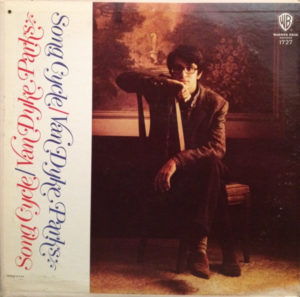
Van Dyke ParksSong Cycle Warner Bros. WS 1727 (1967)


Van Dyke Parks is a notable fringe figure to fans of oddball pop music.  He was associated with a number of popular and notable artists, like The Beach Boys, Harry Nilsson, Frank Sinatra, Ringo Starr, John Cale, Joanna Newsom, etc.  He works out of Los Angeles, and in that barren wasteland of serious culture, he was always an eccentric standout.  He never really had any widespread popularity as a solo artist, but his contributions to popular works by others (The Beach Boys and Joanna Newsom loom large here) are probably why most who have heard of him know about him at all.

Song Cycle is less a work of popular music than it is composed “classical” music in the spirit of Charles Ives, who blended Euro-classical, hymns, folk, pop and more into idiosyncratic and innovative compositions.  Parks simply updates the pop culture reference points — somewhat.  He also draws from Tim Pan Alley, ragtime, vaudeville, bluegrass, marches, and an assortment of old-timey musical forms long since passed from popular favor.  There is particular emphasis on the music of the Great Depression era, and all things uniquely American, especially Californian.  This was an anti-Anglophile stance in the midst of the so-called “British Invasion” period.  It also took high-brow forms of composition and places them into service of more low-brow forms.  It was a serious approach to un-serious music.  Parks adopts cliché/kitsch but re-contextualizes it, in an approach highly similar (in form, though not in substance) to that of the tropicalistas in Brazil around the same time.  It is something of a natural — if impertinent — way to try to break out of imposed restrictions.

The characteristic Parks song jumps from one style to the next, emphasizing the cuts, contrasts and juxtapositions as much as any of the disparate styles he adopts.  Any one approach hardly lasts more than a few seconds, before there is some kind of transition to something else.  But as to those styles, there are many, and he’s obviously a good student of all of them.  He’s even better at deftly making the transitions between the varied passages into something that doesn’t seem completely unnerving — a little perhaps, but that is entirely intentional and necessary, even, to giving this an impact.  Yet for all the formal objectives and technical aptitude, Parks saves plenty of room for humor.  Usually that gets lost in a work this complex and difficult to execute.

This was a lavishly produced album — the budget was more than three times what was typically allotted to a pop album at the time.  Though it sat for about a year before the record label released it, and then commercially it was a flop.  Many listeners fault Parks’ vocals, which aren’t much of an attraction but also aren’t entirely bad.  The other frequent complaints would be coyness, lack of prettiness, willful over-complexity, ostentatious-ness, impenetrability, messiness, … this list goes on.  Song Cycle may well be all those things.  But it also is a very bold in its experimentation and earnest in its admiration for its sources of influence, trying to accomplish a lot without becoming arrogant.  As Parks later said in an interview, “You can exalt what is humble.”

For sheer daring ambition, there aren’t all that many albums of the era (or any others) quite like this.  In fact, probably the most inspiring thing about the album is how absolutely unlikely and improbable it was and is.  It would be wrong to call this a perfect album.  But, looking back, it is one that was headed in a good direction, even if few followed along.

Silver Apples – Silver Apples

Silver Apples

Silver ApplesSilver Apples Kapp KS-3562 (1968)


Few electronic music groups were as innovative and ahead of their time as Silver Apples.  The German Studio für elektronische Musik (WDR) was a a state-of-the-art facility that made music with electronic equipment starting in the 1950s.  But such a facility wasn’t exactly accessible for most ordinary working musicians.  So Silver Apples built their own “Simeon,” described as “a homemade synthesizer consisting of 12 oscillators and an assortment of sound filters, telegraph keys, radio parts, lab gear and a variety of second hand electronic junk.”  There was a U-shaped wooden box structure with a plywood top in which most of the equipment was mounted, with the performer (Simeon) positioned inside the U-shaped part as if in a cockpit.

The basic format of the music features repetitive drumming on a conventional rock drum kit (by Dan Taylor), electronic sounds, plus some vocals.  The vocals are quite of a piece with late 1960s psychedelia.  But what was really unique about this band and its recordings was the juxtaposition of the syncopated yet mechanical and repetitious drumming (“Dancing Gods” is even a take on drum-laden Navajo ceremonial music).  WDR recordings tended to come from an entirely different (and rather elitist) tradition, associated with important composers.  Silver Apples made music a bit closer to popular music — yet at the same time, unlike conventional pop music of the day.

“Oscillations” is the most iconic song on the album.  The drums set out the foundation of the song.  The electronics add commentary, seemingly reacting to the percussion figures but also slashing across it and adding other rhythms.  The falsetto vocals, which are very psychedelic but also offer an odd mix of medieval folk austerity and techno-futurist poetry, provide a semblance of melody.  Mostly the song suggest repeating, cyclic vamps.  This would end up becoming a dominant form of electronic pop music decades later — take away the vocals and “Oscillations” or “Lovefingers” could pass for a new release in the 1990s or 2000s.  Yet Silver Apples were mostly an underground phenomenon.

As innovative and groundbreaking as this music was, the album Silver Apples is a little rough around the edges at times.  Some of the songs are weak (“Velvet Cave”).  That is understandable given the lack of precedent for music like this.  WDR artists would spend up to months continuously revising their works, but Silver Apples obviously had no such luxury when it came to studio time.  They still manage to find a good balance between the electronics, drums and vocals (that aspect could have gone wrong easily).  The songwriting, in general, is not much of an attraction.  The lyrics are often downright silly (“the flame is its own reflection”), merely adding a kind of mood of a psychedelic Sixties “happening”.  But what is unique about the album is the way the music sidesteps the need for great songwriting.  The static rhythms and slowly modulating electronic noises hold seemingly opposite forces together in a kind of suspended state.  Actually, it works much the way a magician does: the drumming focuses attention, almost in a hypnotic trance, and then the electronics play around the edges of perception.  This music is intriguing and surprisingly listenable even without strong melody and no harmony to speak of.  Silver Apples remains one of the more unique pop albums of its time.

Neu! – Neu! 2

Neu! 2

Neu!Neu! 2 Brain 1028 (1973)


Neu!-beat is as distinctive as anything to emerge from the 1970s.  It also became essentially the standard for pop music decades later. Unfortunately for Neu!, their record label and most of the record-buying public didn’t care much at the time.

Neu! was a splinter faction of Kraftwerk. Their music stands entirely on its own though. Neu! is at least as important as their parent group. Their second album volleys back and forth between the influence of Klaus Dinger and Michael Rother. The tension on Neu! 2 has anarchistic rebellion matched against catchy electro-dance rhythms.

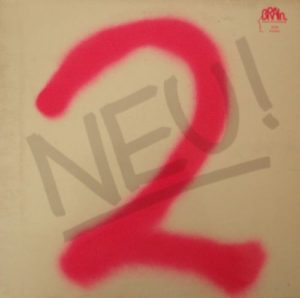
The often-told story of how the record company gave up the album and left Neu! to re-edit and remix three tracks to fill out the disc is fitting but unsurprising — even the album cover is a “remix” of sorts from their debut. It certainly didn’t help their popularity that Neu! was an instrumental band — one that maybe fell between the cracks of rock and roll and avant-garde modern classical.

“Für Immer (Forever)” begins the first of two suites. The chaos creeps in slowly. “Spitzenqualität” has swirling drums and electronic sounds to rival Karlheinz Stockhausen (most assuredly an influence). With “Lila Engel (Lilac Angel),” the processed vocals and aggressive beats channel Neu!’s angst into creative salvation.  Neu! has pulled you from a passing experience to something more total.  The duo intrigues the listener as they wear away expectations.

“Neuschnee 78” (one of the remixed songs) begins the second suite with an almost inappropriate calm. When “Neuschnee” arrives a few songs later, the second side opener suddenly seems paranoid in retrospect.  “Super” also provides the remixes “Super 16” and “Super 78.”  Each progression of remixes actually starts with the remixes and works backwards.

Neu! 2 adds layers then strips them away.  Adding just a tiny piece to existing material puts the entire thing in a new perspective.  The duo then zooms towards what debatably is the essence of the songs. The album’s most unique feature is the way it makes these athletic transformations wholly within itself.  While precision is what makes this album what it is, at the same time the music does away with that which is formal and regulated.

Neu! was just ahead of their time.  Neu! 2 is as likable as it is cool, and it’s pretty cool.