Thelonious Monk – Thelonious Monk Plays the Music of Duke Ellington

Thelonious Monk Plays the Music of Duke Ellington

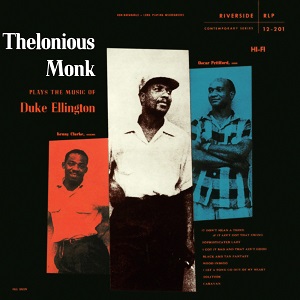
Thelonious MonkThelonious Monk Plays the Music of Duke Ellington Riverside RLP 12-201 (1955)


Okay, but somehow lacking.  Though Clarke and Pettiford make up an A-list rhythm section, they don’t seem to bring their “A” game to this recording.  People often note how Monk softened the edges of his playing during his tenure on Columbia Records, but even here on Riverside he was doing that already.

Sun Ra & His Arkestra – Live at Montreux

Live at Montreux

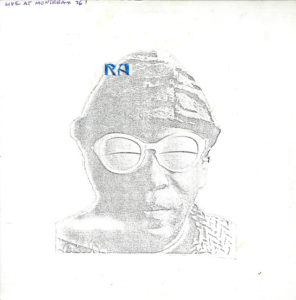
Sun Ra & His ArkestraLive at Montreux El Saturn MS 87976 (1976)


A pretty good live set.  This is one of the most high fidelity live recordings of the Arkestra pre-1980, and it features everything from Cecil Taylor-like piano pounding (“Of the Other Tomorrow”) to synthesizer freak-outs (“Gods of the Thunder Realm”) to afro-futurist space chants (“We Travel the Spaceways”) to big band sci-fi exotica (“Lights on a Satellite” and “El Is the Sound of Joy”) to a loose rendition of a standard (“Take the ‘A’ Train”) to plenty of songs with free soloing (“For the Sunrise,” “The House of Eternal Being” and “Prelude”).  It is somewhat interchangeable with a lot of other live Arkestra recordings of the era though.  Personally, because of the slightly showy, programmatic nature of these performances, I prefer the wild yet stately late 60s recording Pictures of Infinity, some of the more intense early 70s live discs like Nuits de la Fondation Maeght, Vol. 1, It’s After the End of the World: Live at the Donaueschingen and Berlin Festivals, the intimate late 70s sets like Disco 3000 and Media Dreams, the lively mid-80s live sets, Live in Nickelsdorf 1984 (and its counterpart Live at Praxis ’84), and even the coarse Egyptian sets like Live in Egypt 1 and the autumnal Live at the Hackney Empire.  If that seems like a lengthy list, then the point is made.  Live at Montreux is not bad at all, but faces stiff competition from so many other Sun Ra live recordings that it doesn’t merit any special attention.

Sun Ra Arkestra – Live at Praxis ’84

Live at Praxis '84

The Sun Ra ArkestraLive at Praxis ’84 Golden Years GY 5/6 (2000)


The Arkestra has more polished performances on record, as well as numerous live sets that were recorded better.  Yet this collection of the three original Praxis volumes that documented a show in Greece still offers a uniquely comprehensive view of the basic template for late period Sun Ra.  There were noticeably greater numbers of standards, something likely driven by a number of factors including heightened confidence from recent successes, Sun Ra’s advancing age (he was about to enter his seventies), and even overtures to changing commercial tastes (the Eighties being known for a “conservative” movement in jazz).  The band was frequently recreating Fletcher Henderson recordings like “Yeah, Man!” too.  These were not just performances of Henderson’s signature songs with their original arrangements, but actually live, note-for-note recitations of the old recordings in their entirety.  If you dig this, note that a concert from two weeks later is available on Live in Nickelsdorf 1984 that is at least as good (maybe better).

Ornette Coleman – Ornette on Tenor

Ornette on Tenor

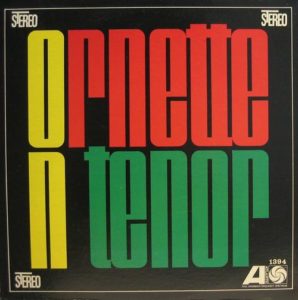
Ornette ColemanOrnette on Tenor Atlantic 394 (1962)


Often considered the least of Ornette Coleman’s albums for Atlantic Records, those statements need to be put in some kind of context.  Even if it is nominally true that this is the least of the Atlantic albums, it is merely the least of one of the most astounding and groundbreaking sets of recordings of the 20th Century.  There is still plenty of amazing music to be found on Ornette on Tenor.

The tenor saxophone was Ornette’s primary instrument when he played in R&B and minstrel bands starting in the 1940s.  The alto sax became his primary instrument as he committed himself to a solo career making his own music.  Using the tenor again here allows Ornette to add some variety to his music, even as his phrasing and musical approach is no different than on alto — save for being a tad slower given the greater volume of breath needed on the tenor.  He calls up a few R&B tricks from his past too, like kind of greasy glissando and honking effects, but there still is no mistaking him for any other performer.

“Eos,” and to some extent “Ecars,” which conclude the album, are lesser cuts (“Eos” was the first song recorded in these sessions).  These are the only hindrances in an otherwise fantastic album.

Personnel discussions are always of relevance on Coleman recordings, because his musical vision (“harmolodics” he later termed it) was, in many ways, fragile.  It depended on assembling a group of performers with shared visions.  When he put together bands with performers who were more timid than he was, or just with different ideas, the results were mixed at best.  Bassist Charlie Haden had left Coleman’s group, and his immediate replacement Scott LaFaro was later killed in a car accident a few months after these sessions.  Jimmy Garrison came on after LaFaro and is featured on these recordings.  He had a rocky relationship with Ornette, and frequently rejected Ornette’s musical ideas (he left to join John Coltrane‘s classic quartet, but returned later to record with Ornette in the late 1960s).  Garrison is also a more conventional bassist than either Haden or LaFaro.  The personal tension surrounding Garrison is evident in places, giving the music a husky aura that Ornette mostly seems to ignore.  But even if Garrison holds back by sticking to static motifs rather than diving in headfirst past the point of no return, drummer Ed Blackwell is in peak form here, making the bass playing less critical.  His rhythms are slippery and agile.  Just when it seems like he’s playing a simple cymbal ride or a march-like beat, he proves otherwise.  He never abandons a sense of meter, but he plays without that ever being a limitation.  The horn payers, for their part, play with delightful contradiction, with happy-sounding melodies played with much dissonance and irreverence.

While this might be the album to turn to last among Ornette’s recordings for Atlantic (setting aside the many outtake collections, which are still pretty good), it is still well worth investigation for fans of the rest.