Anthony Braxton – Trio and Duet

Trio and Duet

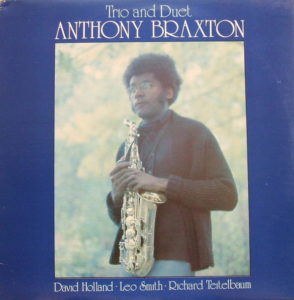
Anthony BraxtonTrio and Duet Sackville 3007 (1975)


Good performances, but, like most Braxton stuff recorded around 1974, this has the feeling of only being at the brink of something big.  The opener “Composition 36,” a trio piece with Richard Teitelbaum and Leo Smith, is definitely cut from the same cloth as New York, Fall 1974, which was recorded at sessions just before and after this one.  The remainder are standards, with just Brax and Dave Holland.  Probably, those new to Braxton should start with Five Pieces 1975 or even New York, Fall 1974 and then work back to this if interested.

Loïc Wacquant – On Urban Relegation

Quote from Loïc Wacquant:

“To speak of urban relegation – rather than ‘territories of poverty’ or ‘low-income community,’ for instance – is to insist that the proper object of inquiry is not the place itself and its residents but the multilevel structural processes whereby persons are selected, thrust and maintained in marginal locations, as well as the social webs and cultural forms they subsequently develop therein.  Relegation is a collective activity, not an individual state; a relation (of economic, social and symbolic power) between collectives, not a gradational attribute of persons. It reminds us that, to avoid falling into the false realism of the ordinary and scholarly common sense of the moment, the sociology of marginality must fasten not on vulnerable ‘groups’ (which often exist merely on paper, if that) but on the institutional mechanisms that produce, reproduce and transform the network of positions to which its supposed members are dispatched and attached. And it urges us to remain agnostic as to the particular social and spatial configuration assumed by the resulting district of dispossession.”

“Revisiting Territories of Relegation: Class, Ethnicity and the State in the Making of Advanced Marginality.” Urban Studies Journal, 53, no. 6, December 2015, Symposium (with responses by Janos Ladanyí, Troels Schultz Larsen, Orlando Patterson, and Emma Shaw Crane): 1077-1088.

Don Cherry – Don Cherry [Orient]

Don Cherry [Orient]

Don CherryDon Cherry [A/K/A Orient] BYG YX 4012/13 (1973)


A live album featuring tracks recorded at concerts in France in April and August of 1971.  This is world fusion jazz, continuing in the tradition Cherry had established on such prior recordings as Eternal Rhythm and “mu” First Part & Second Part.  While this might be less than those other efforts, it is still mighty fine.  Cherry gained renown working with Ornette Coleman, and he seemed to draw from Coleman a kind of anarchic sense of egalitarianism.  But while Coleman’s music presupposed mostly a base in American musical forms, working primarily with players steeped in bebop, blues, R&B, and rock, and balancing individual performances within those realms, Cherry took musics from different cultures and placed those different cultures on equal footing.  Coleman worked with mostly monocultural styles, or at most with roughly binary juxtapositions of jazz and euro-classical composition.  On Don Cherry (confusingly, one of a number of self-titled albums he released, but helpfully renamed Orient for reissues), there is room for extended passages, plus many shifts of styles, with a density that is semi-intimate while retaining a sense of fullness.  Probably not the place to start with Cherry’s music, but a worthwhile stop in his catalog for fans of his other work.

Don Cherry & Ed Blackwell – El Corazón

El Corazón

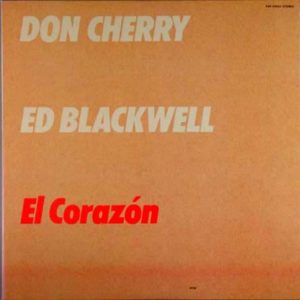
Don Cherry & Ed BlackwellEl Corazón ECM 1230 (1982)


In some ways, El Corazón is a continuation of Cherry’s “mu” First Part and “mu” Second Part from the late 1960s.  Yet a lot had changed in the meantime.  The duo of Cherry and Blackwell are certainly more contemplative and restive here.  This album also features some of the trademark ECM Records chamber jazz sound.  The album remains eclectic.  There is a tribute to The Skatalites‘s sax man Roland Alphonso, a Thelonious Monk song, and various world music influences on display.  Perhaps the best offering is the wonderful percussion-heavy piece “Near-in.”

Tom Zé – Tom Zé [1970]

Tom Zé

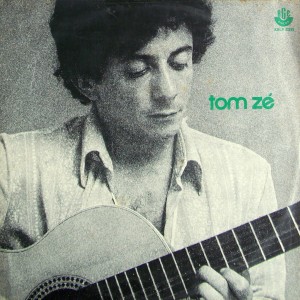
Tom ZéTom Zé RGE Discos XRLP 5351 (1970)


Tom Zé’s second album — and the second of three self-titled albums in a row — isn’t always as highly regarded as his first, but it shows him more versatile as a vocalist.  There are some funky rock riffs with more bass and guitar, without the heavy organ of his debut.  There are more ornate arrangements, with lush strings and horns.  The songwriting is, perhaps, less dripping with irony, but the irony and starkly earnest shock humor is still present.  There are plenty of excellent compositions here.  

In an interview, Zé described this time and album as fraught with personal crisis:

“I was in a kind of crisis because I knew at that time that I didn’t want to do the popular music from my first album again. At the same time I didn’t know what to do and at the same time, João, the guy who freed me from my contract . . . was putting pressure on me to work and do more music. To me, it’s a crisis album and I don’t like to listen to it very often.”

The sorts of crises that he’s referring to weren’t just personal.  This was still a turbulent time in Brazil.  In his memoir Tropical Truth: A Story of Music & Revolution in Brazil (2002), fellow tropicalista Caetano Veloso described the era this way:

“In 1964, the military took power, motivated by the need to perpetuate those disparities [making Brazil the country with the greatest social and economic disparity in the world] that have proven to be the only way to make the Brazilian economy work (badly, needless to say) and, in the international arena, to defend the free market from the threat of the communist bloc (another American front of the Cold War).  Students were either leftist or they would keep their mouths shut.  Within the family or among one’s circle of friends, there was no possibility of disagreeing with a socialist ideology.  The Right existed only to serve vested or unspeakable interests.  Thus, the rallies ‘With God and for Freedom’ organized by the ‘Catholic ladies’ in support of the military coup appeared to us as the cynical, hypocritical gestures of evil people. *** we saw the coup simply as a decision to halt the redress of the horrible social inequities in Brazil and, simultaneously, to sustain North American supremacy in the hemisphere.”

When Veloso and Gilberto Gil were jailed in 1969, Tom Zé took over hosting the TV Tupi show Divino, Maravilhoso for a few episodes.

This album is still about the manifesto of tropicalismo.  There is the famous line Dustin Hoffman delivers in the film The Graduate (1967); when asked what he’s doing, he responds, “Drifting.”  Zé is drifting a bit here, but in the best possible way.  He wonderfully evokes a kind of unsatisfied boredom and uncertainty, matched with curiosity and open-mindedness.  There are very poppy tunes, verging on the commercial (“Passageiro,” “Jeitinho dela”).  And there are ballads (“O riso e a faco,” “Me dá, me dê, me diz”).  But there is more than that too.  “Jymmy Rende-se” has a tight groove.  The lyrics are playful nonsense,  but that kind of sums up the best of what the album as a whole has to offer.  Some of the other upbeat numbers (“Guindaste a rigor,” “Escolinha de robô”) are quite good too. And this isn’t all just variations on conventional pop/rock forms — some of this stuff is dissonant and weird too (“Qualquer bobagem”).

This might not be Zé’s most highly regarded album, but it’s still up there with his best.  Though it isn’t like he’s ever really made a bad album in a decades-long career.

Sauve qui peut (la vie)

Sauve qui peut (la vie) [Every Man For Himself]

Sauve qui peut (la vie) [Every Man For Himself] (1980)

MK2 Diffusion

Director: Jean-Luc Godard

Main Cast: Isabelle Huppert, Jacques Dutronc, Nathalie Baye


After a period of making aggressively experimental films and becoming isolated (his own word for it), Jean-Luc Godard returned to making widely shown and distributed films with Sauve qui peut (la vie) (released in the USA under the title “Every Man for Himself”).  Decades later, other works like Film Socialisme were still resembling this film.  That makes Sauve qui peut a landmark within Godard’s career.

The composer Karlkheinz Stockhausen has spoken (Musical Forming: Composing Statistically (1971)) about how “if you are able to compress an entire Beethoven symphony into half a second, then you have a new sound, and its inner microstructure has been composed by Beethoven.”  It would not sound like a symphony, but to human perception would resemble a single tone with a particular timbre.  The individual elements surpass a group, and completely different relationships begin.  Godard is concerned with the cinematic equivalent of that issue of the temporal limits of human perception — though tending toward expansion rather than the compression Stockhausen discussed (and maybe akin to key parts of Blow-Up).  A technique he had developed working with videotape for a television mini-series shortly before making Sauve qui peut had him deploying slow motion effects.  He applies a version of that to film here.  One scene has two of the main characters fighting in a kitchen, and Godard said he decided to show the incident in slow motion to reveal meaning that would not be perceptible at regular speed.  He wanted to show that as they physically fight and fall to the ground — what would happen in an instant in real time — the characters maybe still love each other, something that viewers tend to contemplate as the characters are held in contact as they fall.

Godard biographer Colin MacCabe wrote that men become film directors to meet women, and that quip at one time seemed to accurately describe Jean-Luc Godard, in his early career, but that phase was a distant memory by the the time of his “Second Debut” Sauve qui peut (la vie).  There are strong feminist themes here.  Though Godard emphasized in interviews in this era how a key preoccupation of the film was with workers and their work.  The absurdities, degradation, and obstacles bound up in working are sublimely stylized and symbolized in scene after scene — many of which ponder questions around privilege, exploitation and self-identity.  In the decades immediately following the film’s release, these aspects of work have not changed but perhaps only intensified, making Godard’s oblique insights of what might have been passing sociopolitical circumstance still seem compelling and relevant.  Godard’s films might be many things, but they are certainly not lacking for starkly original images.  This one is a bit more grounded than some of his early films, in that the romanticism and cinephilia is less pronounced, and in place a more nuanced view of the travails of “ordinary” life.

This is yet another astounding film from one of cinema’s truly great and visionary figures.  Count this as essential viewing for his admirers.

Bobby McFerrin – The Voice

The Voice

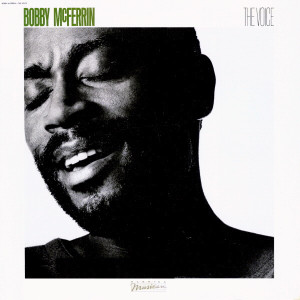
Bobby McFerrinThe Voice Elektra Musician 9 60366-1-E (1984)


Best known for his fluke 1988 mega-hit “Don’t Worry, Be Happy!,” Bobby McFerrin had before that managed to establish himself as a very singular vocalist.  He was obviously working from a jazz tradition, of sorts, but he also weaved in a lot of pop sensibilities and pure showmanship.

The Voice was assembled from live recordings made on tour in March of 1984, exclusively featuring unaccompanied vocal performances.  In lieu of instrumental accompaniment, McFerrin provides his own assortment of sounds that create the effect or impression of a group performance (without overdubs).  He quickly and seamlessly switches between singing words and adding non-syllabic sounds to maintain a syncopated feeling and give the appearance of harmonies that aren’t literally possible from one singer.  Key to doing all that was an uncanny ability to make large, sudden, and abrupt leaps in register — not to mention rhythm and cadence — while staying in pitch.  And he did all this in a fairly relentless way, using these techniques as the basis for entire songs not just as a brief solo or attention-grabbing interlude (like Sarah Vaughan had done, for example on “They Can’t Take That Away From Me,” by going off-key then back into key).  So, on the opener, “Blackbird,” he sings long syncopated, almost scat-like passages in a staccato cadence, then shifts to shifts to shorter, conventionally sung passages (legato), then back again, plus a segment at the end where he simulates a reverb/echo effect.  The second track, “The Jump,” uses some of the same techniques, but McFerrin shifts back and forth between the staccato, scat-like, vocal percussion sections, accentuated by slapping his chest rhythmically (both to make additional percussive sounds and to alter his vocalizations) and using overtone singing (throat singing) techniques, and the legato, “conventionally” sung passages almost from word-to-word.  By the third song, James Brown‘s “I Feel Good,” he is also prominently shifting vocal registers, from a low growl to a high falsetto.  The next song, “I’m My Own Walkman,” a song referencing the still somewhat recent technological invention of a portable audio cassette player.  The Walkman cassette player was revolutionary, and, as one source puts it, “It was the privatization and personalization offered by the Walkman that lead to its success.”

But it is worth putting this album in a historical context.  Individualism had become a dominant conceptual framework by the mid-1980s.  This is to say that there were political overtones to the promotion of individualism and privatization of formerly public goods/values.  Discussing the rise and fall of political — and specifically presidential — regimes, Corey Robin has identified the “Reagan Republican regime, which began in 1980” as one that managed to defeat the labor movement (which rose from the New Deal), the Black Freedom movement, and feminism.

An album of solo virtuoso performance (while not unprecedented; see, for example, any number of solo jazz piano albums, or vibraphonist Gary Burton‘s Alone At Last) fit perfectly within such a paradigm, at least in the sense of framing an argument within the parameters of that social and political climate.  So McFerrin’s music (and the hit “Don’t Worry, Be Happy!” kind of fits this political program as well), perhaps unintentionally, or at least not consciously, was bound up in the politics of its time.  Sonny Sharrock‘s solo Guitar album also deserves mention in the same way.

Feminists have complained about the neoliberal version of female empowerment premised on a few exceptional individuals:

“Because so few women can succeed under current conditions, it is imperative to hold up and valorize the exemplary ones who can. *** But a feminism centered on admirable women also hides the gears that run the social machine. It cannot interrogate the dubious bargains sometimes struck by woman who accrue power in a framework designed by and for wealthy white men. It can only nod approvingly as whatever the ruling class currently requires becomes synonymous with feminism itself.”

It is that same sort of “exceptionalism” that lurks in the background of McFerrin’s album The Voice, the relentless displays of virtuoso singing, which conveniently supports the ruling class narrative that success (or failure) is premised entirely upon individual initiative, and that there are no (or no longer) any structural impediments like racism or sexism or class-base antagonisms worthy of discussion.

If all this seems removed from the music of The Voice, it shouldn’t.  There is evidence that this style of music served the ruling class, and that the ruling class recognized as much.  When future U.S. President George H.W. Bush (a Republican) used “Don’t Worry, Be Happy!” as his official campaign song for the 1988 election, McFerrin protested (indicating he was a Democrat).  Bush, of course, was Reagan’s Vice-President, and a part of the Regan Regime.  While there was a time, during the Jim Crow Era, when jazz musicians like Louis Armstrong and Charlie Parker could make an (implicit) political statement by demonstrating virtuosity, by the 1980s the sociopolitical backdrop rendered such exercises problematic, in the sense that they no longer supported black liberation, but were congruent with the positions of those opposed to black liberation.  Indeed, the largely concert-hall audiences for McFerrin’s performances on this album suggest almost a kind of de-politicized, collaborationist agenda, the sort that led Frantz Fanon to write, “What matters is not so much the color of your skin as the power you serve and the millions you betray.” Black Skin, White Masks.  In the coming years McFerrin would sing a version of the theme song to the disgraced comedian Bill Cosby‘s hit TV show, “The Cosby Show,” and Cosby was somewhat notorious for advocating a neoliberal form of multiculturalism that preached personal responsibility as both the necessary and sufficient causal factors for the material circumstances of poor minorities.  He also would go on to work for a Chamber Orchestra, the sort of organization that is a haven for the rich and self-styled aristocrats (and wanna-bes).

If all this makes McFerrin’s music seem problematic, it should only do so in a certain context.  The music itself, heard in a proverbial vacuum, is wonderful.  But its success was due, in part, to its proximity to the dictates of the ruling ideology of the day.  Sonny Sharrock’s album Guitar had, on its surface, all the same traits: individual solo performance (albeit with overdubs), virtuoso technique, etc.  But Sharrock went for a completely different tone.  His album had a dreamy, almost mystically searching quality, with a pervasive sense of hopefulness and longing.  McFerrin’s The Voice, in contrast, features songs that mostly trade in hedonistic pursuits, and the occasional retro triumphalism (his use of James Brown’s “I Feel Good” is both a dose of hedonism and an assertion that the civil rights movement is over and was won, not an ongoing struggle or even mostly a loss).  Take also Rahzel, the hip-hop vocalist/beatboxer who kind of took McFerrin’s vocal approach a step further (just check out “If Your Mother Only Knew”), but who also made music that was far less compatible with mainstream tastes (and ruling ideology), due to his focus on the characteristics of a more lower-class lifestyle.

So, The Voice deserves a place among the finest jazz albums of its decade.  Yet, it should also be consciously associated with the conservative (centrist [neo]liberal) strain of jazz music of the time (ref. Wynton Marsalis).  That shouldn’t take away from what it achieves in purely artistic terms, but it should contextualize those achievements, and, more importantly, explain McFerrin’s success as being dependent upon much more than the purely artistic elements of this album or his other work.

Hélio Oiticica – Seja marginal, seja herói

“Seja marginal, seja herói”

[“Be an Outlaw, Be a Hero”]

– quote from the famous banner created in 1968 by Hélio Oiticica with an image of Manoel Moreira (nicknamed “Cara de Cavalo” [Horse Face]) after being killed by a paramilitary death squad

Here are links to more information:

http://tropicalia.com.br/en/ruidos-pulsativos/marginalia

http://www.santasombra.com/portfolio/seja-marginal-seja-heroi/