
Link to an article by James Pinnock:
Category: Uncategorized
Karl Marx Quote
“the workers must be armed and organized. The whole proletariat must be armed at once with muskets, rifles, cannon and ammunition, and the revival of the old-style citizens’ militia, directed against the workers, must be opposed. Where the formation of this militia cannot be prevented, the workers must try to organize themselves independently as a proletarian guard, with elected leaders and with their own elected general staff; they must try to place themselves not under the orders of the state authority but of the revolutionary local councils set up by the workers. Where the workers are employed by the state, they must arm and organize themselves into special corps with elected leaders, or as a part of the proletarian guard. Under no pretext should arms and ammunition be surrendered; any attempt to disarm the workers must be frustrated, by force if necessary.”
Address of the Central Committee to the Communist League (1850)
Bonus links: “The Rifle on the Wall: A Left Argument for Gun Rights (Reprise)” (“The political principle at stake is simple: to deny the state the monopoly of armed force, and, obversely, to empower the citizenry, to distribute the power of armed force among the people.”), April Theses (“Abolition of the police, the army and the bureaucracy . . . to be replaced by the arming of the whole people.”), Chairman Mao Quote (“political power grows out of the barrel of a gun.”), Painting & Guns Quote (“After a shooting spree, they always want to take the guns away from the people who didn’t do it. I sure as hell wouldn’t want to live in a society where the only people allowed guns are the police and the military.”), “Draft Declaration of the Rights of Man and of the Citizen” (“XXII. But any act against liberty, against the security or against the property of a man, exercised by anyone, even in the name of the law, except in the cases determined by it, and the forms which they prescribe, is arbitrary and void; the very respect of the law forbids us to submit to it, and if we wish to execute it by violence; it is permissible to repel it by force.”) and “Violence” and Links to books about black armed resistance in freedom movements and “Things That Can and Cannot Be Said” (“And I thought, fuck this. My question is, if, let’s say, there are people who live in villages deep in the forest, four days walk from anywhere, and a thousand soldiers arrive and burn their villages and kill and rape people to scare them off their land because mining companies want it—what brand of non-violence would the stalwarts of the establishment recommend? Non-violence is radical political theatre. *** And who can pull in an audience? You need some capital, some stars, right? Gandhi was a superstar. The people in the forest don’t have that capital, that drawing power. So they have no audience. Non-violence should be a tactic—not an ideology preached from the sidelines to victims of massive violence…. With me, it’s been an evolution of seeing through these things.”) and Barrett Brown on kids’ march for gun rights (“If all these hundreds of thousands of kids had brought guns with them they could have seized control of the capitol and enacted whatever anti-gun legislation they wanted. Catch-22!”) and Battlefield America: The War On The American People. And for anarchist perspectives, see “School Shootings: Who to Listen to Instead of Mainstream Shrinks” and “How Nonviolence Protects the State”
Miya Tokumitsu – Time After Capitalism
Link to an article by Miya Tokumitsu:
Bonus links: Friedrich Engels‘ personal motto was “take it easy,” and On Boredom
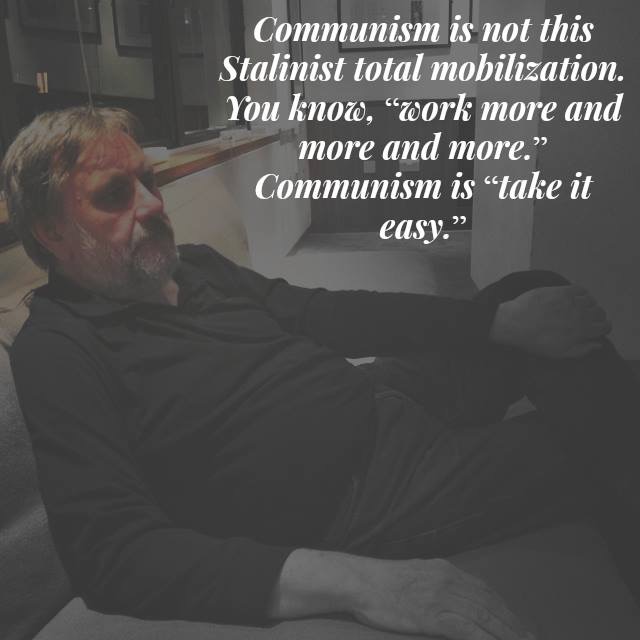
Bonus quote: “No more doing evil, it’s vacation time.” Film Socialisme
Johann Hari – Depressed? Anxious? Blame Neoliberalism.
Link to an article by Johann Hari:
“Depressed? Anxious? Blame Neoliberalism.”
I very much question why this writer singles out neoliberalism, specifically, rather than capitalism, generally. There is nothing in the article to suggest that only neoliberalism — but no other forms of liberalism or capitalism — is problematic. While he has established that eliminating neoliberalism is necessary, he has failed to establish that doing so is sufficient.
Bonus link: “Lacan Between Cultural Studies And Cognitivism”
Torkil Lauesen & Gabriel Kuhn – Radical Theory and Academia
Link to an article by Torkil Lauesen & Gabriel Kuhn:
“Radical Theory and Academia: A Thorny Relationship”
Bonus links: The Higher Learning in America: A Memorandum on the Conduct of Universities by Business Men and “The Professor’s Literature of Protest” and “The Forms of Capital” and Crowds and Party and “Lacan Between Cultural Studies And Cognitivism” and “Cracks in the Wall of Capitalism: The Zapatistas and the Struggle to Decolonize Science”
Rebecca Burns – The Troubled History of the Fund Tapped for Rahm’s Controversial Cop Academy
Link to an article by Rebecca Burns:
“INVESTIGATION: The Troubled History of the Fund Tapped for Rahm’s Controversial Cop Academy”
Bonus links: “The Left Hand and the Right Hand of the State” and “Why Are Police the Priority in Rahm’s Chicago?” and “Corporate Welfare Fails to Deliver the Jobs: The Sad Case of Start-Up NY” and The Great American Jobs Scam: Corporate Tax Dodging and the Myth of Job Creation
Riley Quinn – Theresa May Has Brought a Knife to a Gunfight
Link to an article by Riley Quinn:
William S. Burroughs Quote
“After a shooting spree, they always want to take the guns away from the people who didn’t do it. I sure as hell wouldn’t want to live in a society where the only people allowed guns are the police and the military.”
William S. Burroughs, Painting & Guns
Bonus links: “The Rifle on the Wall: A Left Argument for Gun Rights (Reprise)” (“The political principle at stake is simple: to deny the state the monopoly of armed force, and, obversely, to empower the citizenry, to distribute the power of armed force among the people.”) and Links to books about black armed resistance in freedom movements
Susan Roberts – Are Modern Cities Sustainable?
Link to an article by Susan Roberts:
“Are Modern Cities Sustainable?”
Bonus quote: “9. Combination of agriculture with manufacturing industries; gradual abolition of all the distinction between town and country by a more equable distribution of the populace over the country.” The Communist Manifesto
Slavoj Žižek on Victimhood Status
“one should . . . admit how problematic it is to anchor one’s political demands to status of victimhood. Is the basic characteristic of today’s subjectivity not the weird combination of the free subject who believes themselves ultimately responsible for their own fate and the subject who bases their argument on their status as a victim of circumstances beyond their own control? Every contact with another human being is experienced as a potential threat – if the other smokes, if he casts a covetous glance at me, he already hurts me; this logic of victimization is today universalized, reaching well beyond the standard cases of sexual or racist harassment.”
Slavoj Žižek, “Sex and ’68: Liberal Movement Revolutionized ‘Sexuality’ But at What Cost?”
Bonus quote:
“Social valorization of affects basically means that we pay the plaintiff with her own money: oh, but your feelings are so precious, you are so precious! The more you feel, the more precious you are. This is a typical neoliberal maneuver, which transforms even our traumatic experiences into possible social capital. If we can capitalize on our affects, we will limit out protests to declarations of these affects — say, declarations of suffering — rather than becoming active agents of social change. I’m of course not saying that suffering shouldn’t be expressed and talked about, but that this should not ‘freeze’ the subject into the figure of the victim. The revolt should be precisely about refusing to be a victim, rejecting the position of the victim on all possible levels.
…this bind derives precisely from the subjective gain or gratification that this positioning offers. (Moral) outrage is a particularly unproductive affect, yet it is one that offers considerable libidinal satisfaction. By ‘unproductive’ I mean this: it gives us the satisfaction of feeling morally superior, the feeling that we are in the right and others are in the wrong. Now for this to work, things must not really change. We are much less interested in changing things than in proving, again and again, that we are in the right, or on the right side, the side of the good. Hegel invented a great name for this position: the ‘beautiful soul.’ A ‘beautiful soul’ sees evil and baseness all around it but fails to see to what extent it participates in the perpetuation of that same order of things. The point of course is not that the world isn’t really evil, the point is that we are part of this evil world.”
Alenka Zupančič, “Too Much of Not Enough: An Interview with Alenka Zupančič”
Bonus links: “The Politics of Identity” and “Who Gets Ownership of Pain and Victimhood?” and “Art and Exploitation: Ai Weiwei, Dissidence and the Refugee Crisis” and “What’s Wrong With Identity Politics (and Intersectionality Theory)? A Response to Mark Fisher’s “Exiting the Vampire Castle” (And Its Critics)” (“The upshot [of intersectionality theory] in political practice is a static pluralism of reified social categories, each vying for more-subaltern-than-thou status on a field of one-downsmanship.”) and “On Sex Without Identity: Feminist Politics and Sexual Difference” (“The way things stand now, this kind of [victimhood] assertion comes with a certain social capital, and this tends to stop emancipatory movements before they even start to develop their emancipatory potential.”) and “Die Dreigroschenoper [The Threepenny Opera]” (Notes to the Threepenny Opera: Jonathan Peachum “is undoubtedly a villain . . . . his crime consists in his conception of the world . . . ; yet he is only following the ‘trend of the times’ when he regards misery as a commodity.”) and “Mutter Courage und ihre Kinder [Mother Courage and Her Children]” and Safe and “Who Gets Ownership of Pain and Victimhood?” and The Holocaust Industry and Hate, Inc. (“People need to start understanding the news not as ‘the news,’ but as . . . an individualized consumer experience — anger just for you. This is not reporting. It’s a marketing process designed to create rhetorical addictions and shut down any non-consumerist doors in your mind.”) and “Amuse-Bouches II – Testimony and the Pass”