The Beach Boys – Beach Boys’ Party!

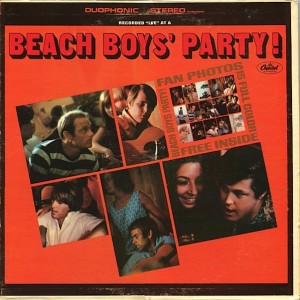
Beach Boys' Party!

The Beach BoysBeach Boys’ Party! Capitol MAS-2398 (1965)


A better album than it usually gets credit for.  Not truly a “live” album, it was certainly a step up from their only real live album of the 1960s, Beach Boys Concert.  The whole thing seems quite influenced by the urban folk movement still underway.  This is the only Beach Boys album that could draw comparisons to Peter, Paul & Mary and the like.  But this is more carefree and juvenile than any folk albums proper of the day.

The Beach Boys – The Beach Boys Today!

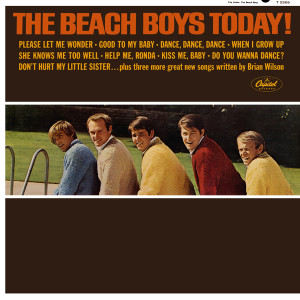
The Beach Boys Today!

The Beach BoysThe Beach Boys Today! Capitol T-2269 (1965)


Brian Wilson was a disturbed guy too sensitive for the smallest amounts of social normalcy. This led him down the erratic and grand path that plays out across the Beach Boys’ many albums. Those wanderings really began with The Beach Boys Today! The result is the complete range of wonder and horror pared down to universal experience lying within not just Mr. Wilson but the rest of us too.

There are three versions of the Beach Boys. Beginning with their scrappy little surf doo-wop number “Surfin’,” they were the extension of a teenage garage band, and they made great songs that were catchy for all the usual reasons. The band, complete with Wilson brothers Brian, Dennis and Carl, were in it together. Things just came easily. Next came a split. With The Beach Boys Today!, Brian Wilson stopped performing live and focused solely on recording. Studio musicians came in to play on the records. This began the Pet Sounds era, with Brian Wilson’s avant-pop genius at its peak. Then Finally, there was the lessening of Brian Wilson’s input and the Beach Boys returned to a more commercial and “live” approach to their records. Maybe their oldies circuit geezer period makes a fourth, but the story is better without that part.

The songs of The Beach Boys Today! make pleasant companions. There are ones with a strong beat leaning more towards the surfin’/cars/girls attitude of the teenage Beach Boys. Then side two debuts the orchestrated pop that became Brian Wilson’s signature. “When I Grow Up (To Be A Man)” is the kind of song ideal for a Wes Anderson film. “Please Let Me Wonder” takes the aching bewilderment of the newly reasserted Beach Boys to the precise affectation of wizened masters. And the opening cover of Bobby Freeman’s “Do You Wanna Dance?” has Beach Boys harmony in one of its most dynamic settings. Brian Wilson has timpani rolls bouncing the beat. Dennis Wilson sings one of the refrains with a muffled, “squ-kiss me baby.” The indecisive fronting belies the song’s dead-on portrayal of longing and dreaming.

“Help Me Ronda” is the original album version and not the hit “Help Me Rhonda.” This original is far denser and more intricate than the later incarnation issued as a single. The LP version does say something about what The Beach Boys Today! stands for. Though perhaps taking only a small step, this album goes beyond a mere collection of songs.

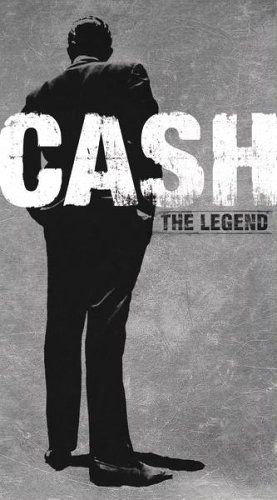
Johnny Cash – Cash: The Legend

Cash: The Legend

Johnny CashCash: The Legend Legacy C4K 92802 (2005)


A very nice though still imperfect set covering many sides of the Man in Black’s career.  There are plenty of opportunities to take in that inimitable voice.  This would make a very good introduction for a newcomer.  But let me comment on a few of the benefits and drawbacks of this particular collection.  On the plus side, there is a lot of fantastic material here, including just about all of Cash’s most essential cuts.  This boxed set is long enough to accomplish that feat.  The last disc features only collaborations and selections of other artists’ recordings where Cash guested, which is nice in bringing you to things like a selection from Bob Dylan‘s Nashville Skyline album and other things that might not otherwise come to your attention, even though it is the weakest of the four discs here.  There are some curious choices and glaring omissions — notably, nothing with Cash’s daughter Rosanne (their duet of “September When It Comes” would have been a better choice than the version with The Nitty Gritty Dirt Band).  Scattered here and there, especially on disc three, there are also a select few recordings that originally went unreleased, like the gem “Goodnight Irene”.  As for the drawbacks, on the other hand, I could quibble about a few song choices and exclusions, which tend toward rather conservative picks.   There aren’t too many epiphanies here for those familiar with Johnny Cash’s catalog, so there is nothing like “Happiness Is You,” “Orphan of the Road,” “The Folk Singer,” “Sugartime” or “Blistered” thrown in to surprise you.  Aside from a few minor gospel albums, Cash recorded for just four record labels: Sun, Columbia, Mercury and American.  The Sun, Columbia and Mercury recordings are the ones represented here. His Mercury recordings aren’t well liked critically or commercially, so their sparse representation here is probably appropriate, though again there are no surprise inclusions of great tunes like “The Hobo Song” from the Mercury years.  There is nothing at all included from Cash’s American Recordings comeback.  While the American Recordings material is sometimes overvalued by listeners who weren’t alive during the early part of Cash’s career, there is important material contained in it.  So, the lack of any American Recordings material is a big drawback, if for no other reason than it leaves the uninitiated wondering what Cash’s comeback was all about.  It probably also bears mentioning that some posthumously-discovered recordings from Personal File are some of the best things he ever recorded (!), and, while as a practical matter those weren’t available in time for inclusion on this set, in retrospect they can been seen as something necessary for that elusive “perfect” Cash collection that as of yet does not exist. The same might go for other posthumous archival releases like Out Among the Stars.  Lastly, the “thematic” arrangement of material across the discs is kind of a drawback, with a few commercially popular but artistically mediocre songs sprinkled ineffectively across the set.  In spite of all that, this still may be the best Johnny Cash boxed set available.  (See also Traveling These Roads Between Heaven & Hell: Johnny Cash, Singer of Songs).

Albert Ayler – Live in Greenwich Village

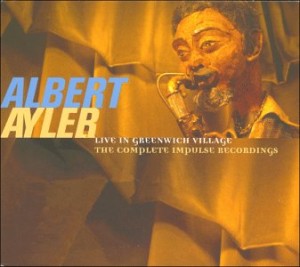
Live in Greenwich Village: The Complete Impulse Recordings

Albert AylerLive in Greenwich Village: The Complete Impulse Recordings Impulse! IMPD-2-273 (1998)


A compilation of Albert Ayler in Greenwich Village and The Village Concerts plus one track from the comp The New Wave in Jazz and one previously unreleased track, all of which were recorded in the same timeframe of 1965-67.  I guess this set is pretty uneven.  It gained a sort of inflated reputation because it came along when practically none of Ayler’s recordings were available on CD — something that has since changed considerably.  When I say uneven, I’m talking primarily of Ayler’s band.  Ayler himself is in quite good form throughout.  However his brother Donald is lagging most of the time, the violin (Michel Samson) is out of place as well.  Sunny Murray and Beaver Harris can’t be heard all that well on drums amongst so many other players.  But despite all that, this still manages to be a pretty good set when everything clicks.  “Omega is the Alpha” is probably my favorite Ayler recording.

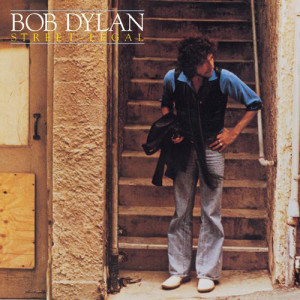
Bob Dylan – Street-Legal

Street-Legal

Bob DylanStreet-Legal Columbia JC 35453  (1978)


I’ve mentioned that Planet Waves was a bad omen.  I think, at the time, it could be passed off as just lazy, a fluke misfire on some fundamentally good songwriting material.  Street-Legal was something else.  Here, Dylan was confirming that he was a brat, someone just unwilling to look outside himself.  It’s clear what he was going for here.  The backing singers, saxophone.  This was a show band.  After struggling and failing to make The Rolling Thunder Revue a commercial success, he seemed to be aiming for an Elvis-style Vegas act (see also At Budokan).  Or maybe even some kind of second-hand Van Morrison approach, by way of Bruce Springsteen‘s E-Street Band.  But Dylan really wasn’t that kind of a performer.  He insisted on a “raw” sound recorded in some old warehouse dubbed “Rundown Studio” with temporary recording equipment set up with wires running out the window (similar to what was done on Elvis’ recent From Elvis Presley Boulevard, Memphis, Tennessee).  In principle, that kind of an approach might work, but not with this material and this band.   It’s as if Dylan just can’t commit himself to the commercial aspects of what his band proposes.  This is one of those albums where he struggles to come to terms with the expectations laid upon him, and so he self-sabotages the product.  A shame, too, because there are definitely some good new songs here, like “Señor (Tales of Yankee Power),” one of Dylan’s now rare attempts to do the kind of social and political commentary that he managed so adeptly back in his early folk days (“With God on Our Side,” etc.).  So, Street-Legal was probably one intervention away from being a success.  The committed will find things to like if they focus hard, but, at the same time, there is no excuse for the amount of effort necessary to appreciate this one.

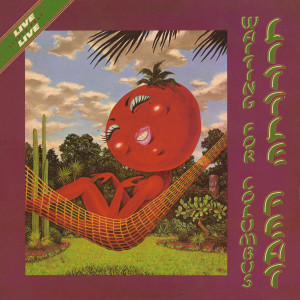
Little Feat – Waiting for Columbus

Waiting for Columbus

Little FeatWaiting for Columbus Warner Bros. 2BS 3140 (1978)


Perhaps the most overrated album in Little Feat’s discography is Waiting for Columbus.  It is a decent live set, with most of their best songs accounted for.  Still, this came at a time when Lowell George‘s influence was waning and things were drifting towards bland, shallow blues knock offs and limp groove rock.  In all, not bad, but hardly anything that special.  Then again, if all along you thought the problem with Little Feat was that they didn’t sound enough like The Doobie Brothers, well, this might be exactly what you were waiting for.

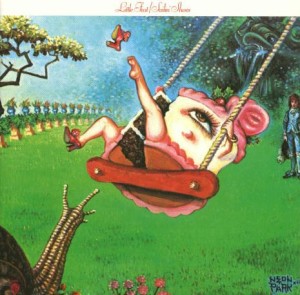
Little Feat – Sailin’ Shoes

Sailin' Shoes

Little FeatSailin’ Shoes Warner Bros. BS 2600 (1972)


Sailin’ Shoes may be the best Little Feat album.  I like the eclecticism of their debut, and this one tones that down a bit.  But the focus and polish here works for the band rather than against them.  The songwriting is again superb, thanks to Lowell George.  It embraces rather than fears the weirdness out there in the world.  I wish all southern/classic rock held up this well.

Hozier – Hozier

Hozier

HozierHozier Island 3792808 (2014)


Basically a white person singing in an African-American style, much like Adele et al.  There is some catchy guitar on “Jackie and Wilson,” for example, but mostly this album seeks to simply appropriate riffs, vocal tones, and other musical elements that have been built up by others rather than forge anything new or unique.  Pass.

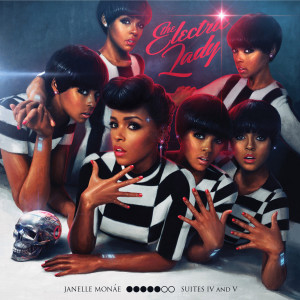
Janelle Monáe – The Electric Lady

The Electric Lady

Janelle MonáeThe Electric Lady Bad Boy Records 536210-2 (2013)


If The ArchAndroid seemed almost claustrophobically overproduced at times, then The Electric Lady goes in the other direction and risks being underproduced and underdeveloped.  But no matter.  For me, this is Monáe at her most likeable and sublime.  By this point, the R&B/soul saga of the android character Cindi Mayweather, chronicled in all of Monáe’s recordings, continues, long after it seemed like the story would come to an end.  Her first EP indicated four circles on the cover image, with one-and-a-half filled in to represent that it was the first installment and the others hollow to indicate what was to come, the full-length début had just one hollow, but now, suddenly there are seven circles, with two left hollow.  This is like some Hollywood movie franchise that suddenly conjures up a few “prequels” to keep itself lumbering along.  Yet, if movie analogies are appropriate, this album seems most like an Oliver Stone film: literate, well-informed, incisive, yet a little preachy and always just over the top with drama.  But the music is maybe a bit, er, a lot cheerier than typical Stone fare.  The album’s heart is its fondness for the past and desire to avoid losing what was valuable in it against the crush of modern corruptions (just like a Stone film).  Monáe clearly has a love of 1970s and 80s soul and rock, from Stevie Wonder to Prince to Os Mutantes (she name-drops them in the liner notes!), to, well, you name it.  So, if this is less ambitious than her last effort, on the surface, it also has a more solid footing in a broad continuum of music that is at once open-minded and engaged with music/culture that is less open-minded — as a positive challenge to the dominance of the latter, refusing to sit idly by.  It is great to hear music looking to make a world that isn’t ruled by fear, and that recognizes that there are precedents for such thinking already out there that provide a kind of strength for subtle but necessary battles of the present.  After a few years of listening, this still holds up really well.