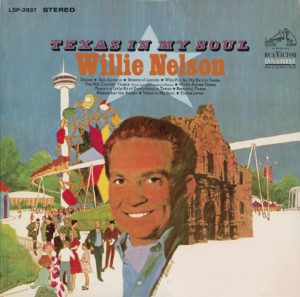
Willie Nelson – Texas in My Soul

Texas in My Soul

Willie NelsonTexas in My Soul RCA Victor LSP-3937 (1968)


Here is an album that sort of epitomizes the problems with Willie’s early recordings for RCA.  While it is common to hear that Willie’s recordings while part of the Nashville music machine are weighed down by the production, that is somewhat misleading.  Certainly there were some recordings for RCA that were bloated with orchestration and effects that didn’t work — usually due to poor arrangements more than anything.  But most of Willie’s RCA recordings in the mid-1960s had fairly minimal accompaniment.  The biggest problem was that he sounded stiff, forcing himself into a “commercial” sound like a square peg in a round hole, coupled with an unfortunate willingness to pander to commercial gimmicks.  Texas in My Soul is a prime example of Willie’s vocals sounding stiff, as he tries to feign gravitas by singing in a crooner’s style where he holds notes in a resonant way.  In the early 70s he would start to move away from this style of singing, and would shed the last vestiges before his rise to fame in the mid-70s.  The last part of the album gives way to western swing, which would remain a kind of self-indulgent interest throughout Willie’s career.  The title track is a western swing number and is the best thing here.  But, all in all, this is a lesser album.
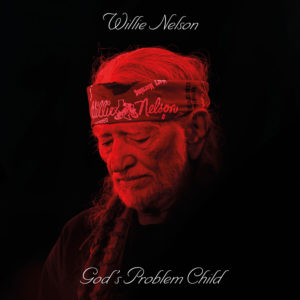
Willie Nelson – God’s Problem Child

God's Problem Child

Willie NelsonGod’s Problem Child Legacy 541573 (2017)


Most musical artists still recording past the age of 70 tend to slow down and mellow out.  There are exceptions of course (Yoko Ono, Elza Soares, Tom Zé, Scott Walker).  But they tend to just prove the rule.  In the twilight of his life and career, Willie Nelson has certainly not slowed down, still cranking out albums and touring incessantly, but he has mellowed some.  In particular, he has indulged his fondness for western swing more and more often.  There is some of that here.  Though mostly God’s Problem Child emphasizes the slick contemporary country style of many of producer Buddy Cannon‘s collaborations with Willie.  The best thing here is probably the novelty song “Not Dead Yet,” reminiscent of Tom T. Hall or Johnny Cash.  It is an age-appropriate song for the 84-year-old Nelson.  On the whole, this is just another of those decent but unremarkable albums of which Willie has so many.

Slavoj Žižek – Beautiful Soul Quote

“They play the Beautiful Soul, which feels superior to the corrupted world while secretly participating in it: they need this corrupted world as the only terrain where they can exert their moral superiority.”

Slavoj Žižek, Refugees, Terror and Other Troubles with the Neighbors: Against the Double Blackmail (2016)


Bonus links: Phenomenology of Spirit and Wilhelm Meister’s Apprenticeship and “Margaret Atwood’s Work Illustrates Our Need to Enjoy Other People’s Pain” and The Twilight Zone Episode 63: “The Mind and The Matter” (essentially endorses the “beautiful soul” position)

Pascal Blackfoot – Beyond the Class Ceiling

Link to an article by Pascal Blackfoot:

“Beyond the Class Ceiling: Education and Upward Social Mobility”


This excellent article explicitly references the work of Pierre Bourdieu.  However, the specific questions address under that theoretical framework resemble Jonathan Cobb and Richard Sennett‘s The Hidden Injuries of Class, and some further examples of the concepts discussed specific to the academic/educational context can be found in books like This Fine Place So Far from Home: Voices of Academics from the Working Class and Strangers in Paradise: Academics from the Working Class

Lloyd Alter – New Study Looks at Attitudes of Drivers Toward Cyclists, and It Ain’t Pretty

Link to an article by Lloyd Alter:

“New Study Looks at Attitudes of Drivers Toward Cyclists, and It Ain’t Pretty”


Bonus links: “Shoulda Run Him in the Ditch” and “Lexus Drivers” and “Ideology and Ideological State Apparatuses
(Notes towards an Investigation)”

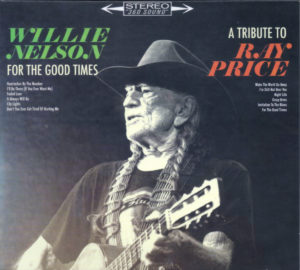
Willie Nelson – For the Good Times: A Tribute to Ray Price

For the Good Times: A Tribute to Ray Price

Willie NelsonFor the Good Times: A Tribute to Ray Price Legacy 88985315522 (2016)


The opening “Heartaches by the Numbers” is fairly good, and the follow-up “I’ll Be There (If You Ever Want Me)” has decent pedal steel (from The Time Jumpers).  From there, though, there is nothing but varying degrees of schmaltz.  The cloying orchestration by Bergen White is really too much.  And often the orchestration is pointless too, as on “Faded Love,” where there is an orchestra introduction that drops off and does not return.  It is as if the label paid for the orchestra in advance and felt like they needed to get their money’s worth.  Take a hard pass on this one.

Jemeel Moondoc Quintet – Nostalgia in Times Square

Nostalgia in Times Square

Jemeel Moondoc QuintetNostalgia in Times Square Soul Note SN 1141 (1986)


In the 1980s there was an unmistakable “conservative” trend in jazz.  At its worst, this involved musicians picking some arbitrary point in time and disregarding all of jazz history beyond that point (Amish-style).  But not all music of this nature was so reactionary.  David Murray‘s Ming is often cited as the foundational document for another approach, one that took elements of the past and built upon them without being beholden to them.  Another example would be James Newton‘s The African Flower (The Music of Duke Ellington and Billy Strayhorn), with a bit more restrained tone.  Jemeel Moondoc’s Nostalgia in Times Square fits into this continuum.  Moondoc was a veteran of Cecil Taylor‘s student bands in the 1970s, and had jumped over to New York City where he enmeshed himself in the loft jazz scene there.  He has a pretty clear tone and identifiable voice.  It’s lyrical and precise, with an undercurrent of ironic humor.  The whole album takes off from older jazz styles, kind of a swinging hard bop form, but adds to that more modern solos.  Each soloist is free to deploy unusual squeaks, intervals and harmonies, but the music generally is anchored in a more defined rhythm and flirts with a somewhat conventional melodic and harmonic base much more than the free music of the preceding two decades.  Moondoc has a great band.  Bassist William Parker would return to the same framework two decades later with albums like Sound Unity and Petit oiseau.  If this album has a flaw it’s that it occasionally feels a little rough around the edges, like the band could have used some more time to play together before recording, as sometimes soloists seem to clash in ways not fully intended.  But that’s a petty concern with what is generally a very good album.