Tom Waits – Mule Variations | Review

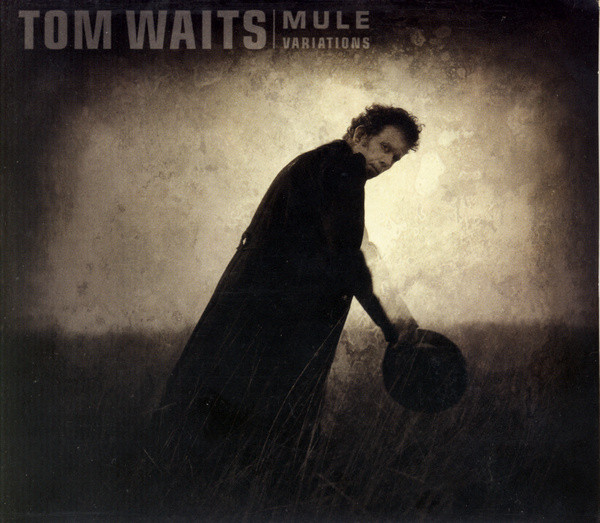
Mule Variations album cover

Tom WaitsMule Variations Anti- Records 86547-2 (1999)


Waits’ late-90s “comeback” album has aged well.  After the achievement of Rain Dogs in the mid-80s, and Bone Machine in the early 90s, he largely slipped from view for a few years.  His comeback positioned him as something of an elder statesman of the independent rock scene, which still had some vitality even as major labels had already started to consolidate their investments around a fairly narrow range of music that excluded stuff like this.

When David Bowie had mild resurgence a couple years prior with EART HL I NG, he seemed to draw his subject matter from watching movies on TV.  Although Bowie and Waits go in much different directions in terms of genre, and only Waits leans on the use of humor, Waits’ lyrical focus has shifted to more middle-aged circumstances as well here too.  Take “Come on Up to the House,” which might be viewed as one of the best rock songs about a dinner party.  The lyrics, which cajole someone loaded with excuses to come over for a visit, have some great turns of phrases (like about coming down from that cross because we could use the wood).  It also features orchestration that recalls the album-closing style of “Anywhere I Lay My Head” from Rain Dogs or, reaching back further, “Cripple Creek Ferry” from Neil Young‘s After the Gold Rush.  As Harry Nilsson once did so well, “Cold Water” also evokes the mundane aspects of daily life, like taking a shower.  And “What’s He Building?” is an eerie rock monologue in the tradition of The Velvet Underground‘s “Lady Godiva’s Operation” but with a neighborly suspicion narrative like that of the Tom Hanks film The ‘Burbs.  Sure, Waits had released “In the Neighborhood” on Swordfishtrombones, but the irony of that song in muted if not absent here more than fifteen years later.

At the time the album came out, “Hold On” was the single, and it met with success.  It hearkens back to the sentimental (and sometimes maudlin) side of Waits’ music—think “Tom Traubert’s Blues (Four Sheets to the Wind in Copenhagen)” from Small Change, “Ruby’s Arms” from Heartattack and Vine, and “time” or “Blind Love” from Rain Dogs. This is something that appears elsewhere on the album too.  Yet this is a softened, more mature sentimentality that stops just short of being truly maudlin.  These songs work well here.  The opener “Big in Japan” also tended to be liked by audiences.  It has a heavier beat and more rock and roll edge to it, with some gruff histrionics.  While these are solid songs, the album as a whole has much more to offer.  It is really the more mature, middle-aged attitude (Waits was nearly 50 years old when it was released) that shines through in hindsight.  It lacks nothing in terms of relevance and appeal to listeners of all ages.

Maybe surprisingly, this is really one of the finest full-length albums of Waits’ entire career, all told.  He continued to put out some decent music later on but despite some nice highlights it was not as consistently solid at album length.

Willie Nelson – Here’s Willie Nelson

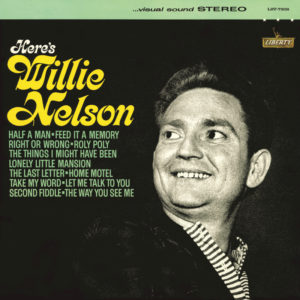
Here's Willie Nelson

Willie NelsonHere’s Willie Nelson Liberty LST-7308 (1963)


A common opinion is that Willie Nelson’s second full-length album Here’s Willie Nelson was a step back from his debut …And Then I Wrote.  Those people often say that this is “Nashville cliché”, referring to the “countrypolitan” style it evinces.  But a response to all that should be, “And?”  Yes, Here’s Willie Nelson fits in the mold of the weepy drama of the “Nashville Sound” — a close comparison would be Skeeter Davis“End of the World.”  But it really represents the best possible execution of the Nashville Sound.

There are a couple of things that boost this album.  First is producer Tommy Allsup.  He was a touring member of The Crickets and once lost a coin flip to Ritchie Valens such that he lost a seat and was not on the plane that crashed near Clear Lake, Iowa on February 3, 1959 that killed Valens, Buddy Holly and The Big Bopper.  Allsup brings out the best in the instrumental performances, accentuating the spark and energy of all the performers and balancing Willie’s vocals with the orchestration.  He eschews the prominent focus on Nelson’s vocals evident on his debut.  Surprisingly, pushing the vocals down a little in the mix works well.

Another key factor in the album’s success is the arranging work of Ernie Freeman and Jimmy Day.  The orchestral treatments by Freeman are really quite excellent and much better than the formulaic leftovers that characterized Willie’s albums later in the decade for the RCA Victor label.  Each song gets its own distinct character, matched to the tone of each song.  Just check the calmly sizzling trills and glissandos from the strings on the bluesy closer “Home Motel,” and contrast the pastoral elegance and more complex harmonic blocking of “Half of Man” or the busy energy of the strings on “Take My Word,” or the juxtaposition of pedal steel guitar with sweeping string orchestration and indistinct backing vocal chorus of “Second Fiddle” where the orchestra briefly trades off with a solitary country fiddle solo and closes with a country/Euro-classical solo fiddle flourish.  “The Way You See Me” displays masterful balancing of traded instrumental backing behind Willie’s insistent singing and a gently and slowly walking bass — alternating the more prominent voicing between fiddle, piano and pedal steel guitar in a way that reflects the song’s protagonist’s attempt to put up a dignified and happy facade to conceal his heartbroken loneliness.  The vocal choruses combine both male and female voices, which adds a rich textural/timbral dimension. “Lonely Little Mansion” uses sustained vocal backing to add a kind of protestant church aesthetic of serene, austere, atmospherics, somewhat like what Johnny Cash used on songs like the B-side “Were You There (When They Crucified My Lord).”  But then “The Last Letter” uses the vocal chorus’ expanding vibrato to emphasize a slight polyrhythm against the song’s core waltz rhythm.  The orchestration is never overly complex or abstract.  Yet there is still clearly much more effort put into it than on so many other Nashville sound recordings of the day.

After releasing his debut, Willie lamented that he wasted too many good songs on it.  In other words, he felt the album was too good and should have been watered down!  Unfortunately, that sort of thinking would prevail all too often over his long career.  But it is also kind of a self-important statement, because it implies that his own songwriting was inherently better than that of cover songs he might record.  Here’s Willie Nelson features a mix of original songs and covers.  The covers are quite good though!  There is absolutely nothing wrong with something like “Feed It a Memory” or a chestnut like “Roly Poly.”  The stately elegance of a song like “Things I Might Have Been” captures the frustrated aspirations that perfectly fits the “countrypolitan” style.  He may have choosen some covers rather than all originals here, but nothing is watered down.

Willie’s singing here is much looser and relaxed than on his recordings from later in the 1960s.  He also tempers the “jazzy” affectations of his debut somewhat.  Though those tendencies are still here.  He still sings with a vibrato-less tone way behind the beat.  On the opener, the western swing staple “Roly Poly,” he gets so far behind the beat that he barely finishes the verse he’s on before the band has moved on to another part of the song!  In these various ways he finds a balance that suits the “countrypolitan” style better than on any of his other recordings in that style.  His singing, honestly, isn’t always particularly great on the second side of the album.  But it is never bad.  But for the most part Willie singing on record became less welcoming for many years, until he passed through a sort of existential personal crisis in the early 1970s.

“Take My Word” is a weaker offering (but is also the shortest song here), as is “Let Me Talk to You,” with Willie limping along with jazzily dissonant phrasing.  And, no, nothing here quite matches the heights of the best songs on the debut …And Then I Wrote.  But this album still avoids the more jarring discontinuities between Willie’s singing and the studio band’s performances that appeared on his debut, and it manages to be more consistent on the whole.  Frankly, Willie wouldn’t make a record this uniformly rewarding until 1971’s Yesterday’s Wine.

Willie Nelson – Good Times

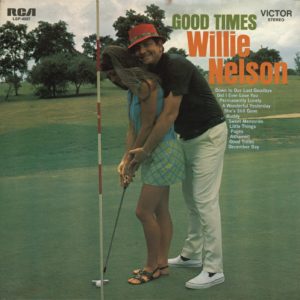
Good Times

Willie NelsonGood Times RCA Victor LSP-4057 (1968)


Even if Good Times isn’t Willie’s best early (pre-fame) album, an argument can be made that it is his most important. All his prior albums on the RCA Victor label in the 1960s looked back to styles that had already been established by other artists. Willie just dropped in his own songs and vocals. Texas in My Soul — amazingly, also released in 1968 — is a Nashville take on western swing and honky tonk that was more popular a decade or two earlier, with really stiff vocals and feigned gravitas. Willie appeared on these early album covers wearing a suit, or dressed as a country bumpkin. He was acceding to industry demands and fitting himself into the mold of what the Nashville music machine deemed salable.  Suddenly, though, Willie sounded more relaxed and…modern. This album’s cover features a photo of Nelson in casual attire on a golf course green (he actually really liked golf) with his arms wrapped around some young woman helping her putt, a goofy grin on his face.  The photo makes a number of allusions.  For one, the presence of the woman and Willie’s grin suggest sexism and patriarchy.  Willie’s clothes and association with golf suggest middle class economic security.  And his grin and the title lettering stating “Good Times” suggest a shift away from they way he was previously marketed as either a “serious” songwriter or an “authentic” country hick — or both, as kind of an anthropological cultural translator or “cross-over” envoy — instead hinting at a kind of sarcastic and ironic distance.  Many of these things seem to stand in conflict with one another.  But most importantly there were now multiple plausible meanings and messages.  These presented a sort of challenge.  How would these conflicts be resolved?

This is an early appearance of the style that would develop into the likes of The Words Don’t Fit the Picture. As another reviewer put it, “Nothing here screams chart topping hit and it must have been nightmare for recording company who wanted to sell this, on the other hand music actually stands the test of time quite nicely and for once it doesn’t sound dated at all but actually timeless. ” His original songs, some co-written with his then-wife Shirley, make extensive use of irony. He had used irony before (“Hello Walls,” “Undo the Right”), but now this was a more melancholy and existential irony. On the title track, “Good Times,” he is describing sarcastically the suburban, middle-class “American Dream” (and the Viet Nam War) alongside innocent childhood activities.  This was the sort of stuff much more prevalent in “rock” and rock-influenced pop music of the day. “December Day” even deploys jazzy chords that use dissonance that was (and still is) quite unusual for country music.  These descriptions only fit side one of the album though. On side two, Willie is back within the confines of the “Nashville Sound,” with plenty of string orchestration, a little pedal steel guitar, coy backing vocal choruses, and the other usual Nashville trappings. Now, the “typical Nashville” stuff on side two is not bad, and actually is better than many of Willie’s other forays into that territory.  But there is a sense of retreat. It is very hard to listen to this now and not lament how much better this album would have been if the whole thing was done in the pared-back acoustic style of side one.

When Willie really hit it big in the mid-1970s, he had a reputation for bringing together rock and country audiences.  The fact that he was interested in the music of each of those disparate demographics first made an appearance on Good Times.  He hadn’t quite figured out how to balance his appeal to both of those frequently antagonistic listening audiences yet, but this was kind of a trial run.  He would continue to tinker and experiment in this direction in to the early 1970s, though as he remained within the Nashville system there was really no way to advance Willie’s line of thinking far enough.  It was when he went to New York and teamed up with rock/soul/R&B people that everything finally fell into place on record.

Willie Nelson – Make Way for Willie Nelson

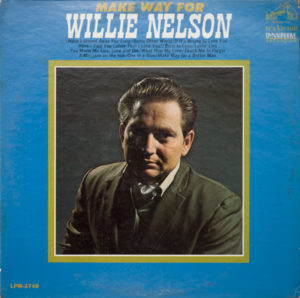
Make Way for Willie Nelson

Willie NelsonMake Way for Willie Nelson RCA Victor LPM-3748 (1967)


Here’s a rather forgotten early Willie Nelson LP that is actually among his better early albums, relatively speaking.  Recorded in Nashville, this teamed Willie with producer Felton Jarvis after RCA Records’ main producer Chet Atkins was too busy to handle the recording sessions.  This proves to be a boon for the recordings, by sparing them from Atkins’ unsympathetic production style and its usual cloying bourgeois and petite-bourgeois aspirations evident on the same year’s The Party’s Over (And Other Great Willie Nelson Songs), for instance.  This is an album recorded much the same way as Country Willie — His Own Songs (1965), another decent early Willie Nelson album.  There is only one of Nelson’s own compositions here.  These are mostly cover songs.  This album can still be described as having the Nashville sound, but it retains a honky tonk influence.  Nelson would return to honky tonk on and off again for his entire career.  The opening “Make Way for a Better Man” is good, with understated backing orchestration.  Other songs like “Have I Stayed Away Too Long?” are decent too, even though the guitar and vocals sometimes sink into a leaden rhythm.  There are signs that there was perhaps insufficient rehearsal, and some of these recordings might be first takes.  But even if the recordings seem relatively raw at times, that actually suits Willie’s style of singing — actually being crucial to the success of later albums like Yesterday’s Wine and Phases and Stages.  There are some odd song choices here, like the 1960s pop staple “What Now My Love [“Et maintenant”]” (even The Temptations released a version of the song in ’67).  Willie’s own “One in a Row” is also one of his lesser compositions — recorded here in the same ornate style as “What Now My Love.”  On the whole, this holds up well enough all the way through.  It isn’t a great album, and it certainly doesn’t do much to distinguish itself from other country albums of the day, but it has a sort of charm in its predictability and familiar approach.  As for this album being mostly forgotten, at this writing, the album is not even listed in the Musicbrainz database and there is no track listing in the RateYourMusic database; there is also no review on AllMusic or on RateYourMusic.  It was, however, one of his more commercially successful albums at the time, peaking higher on the country music “charts” than any of his other pre-Red Headed Stranger albums.

Willie Nelson – The Party’s Over

The Party's Over (And Other Great Willie Nelson Songs)

Willie NelsonThe Party’s Over (And Other Great Willie Nelson Songs) RCA LSP-3858 (1967)


One of the biggest problem’s with Willie’s singing on his RCA albums in the 1960s was his tendency to over-enunciate.  This really put him in a rhythmic straitjacket, and limited his options for vocal phrasing.  Aside from the inherent timbre of his voice, one of his greatest strengths as a vocalist was his idiosyncratic, non-conformist rhythmic phrasing — already evident to some degree on his debut album …And Then I Wrote but generally scaled back over the following decade.  The sort of ragged, welcoming, down-home glory that characterized his most successful recordings from the mid-1970s on finds no room in a typical Nashville “countrypolitan” production style.  But that was kind of the point of middlebrow countrypolitan music, which epitomized the (still racist and sexist) “golden age” of post-WWII American prosperity in which ordinary, uneducated workers saw rising living standards and could see themselves as part of a newly emerging middle class with its own self-styled sophistication — something that might be described as attempting to project an aura of sophistication beyond class boundaries via ideas about “proper” diction and enunciation cribbed from upper classes and merged with lower-class folk/country musical forms.  Looked at another way, the temporary willingness of elite classes to permit rising working and middle classes was fostered by inculcating country music listeners with upper-class values as well as the speech patterns and more urban culture that went along with those values (when elites withdrew their permissive and benevolent attitude starting in the 1970s, the countrypolitan style faded almost in lockstep and is now commonly derided as low-class and unsophisticated).  When it came to Willie Nelson’s career, the thing was, no matter how many great songs he wrote — and he was writing many — he just wasn’t cut out to follow in the footsteps of someone like Patsy Cline, at least not for long.  In the end, Willie was better suited to being a pot-smoking, feel-good layabout with an endearing but weird way of singing that was largely incompatible with the implicit “countrypolitan” agenda of ascending (and reinforcing) a social hierarchy to find a comfortable place in it.  Willie was, in a way, proud of his humble roots — post-fame, he often payed tribute to his childhood musical influences, who were always working-class heroes.  There was room for all sorts of things in Willie best music, but not on The Party’s Over.

The title track here is a keeper, and a “A Moment Isn’t Very Long” clings to enough of a honky tonk feel to be interesting for the first half.  But there isn’t much else here to particularly recommend.  This isn’t a bad record by any means, but Willie is choosing to play by a strange set of rules.  The lachrymose strings on “To Make a Long Story Short (She’s Gone)” epitomize the bland melodrama that swallows most of this.  Excepting Good Times, Willie’s albums got somewhat less interesting in the late 60s, before picking up again in the 70s and then running away with the hearts and minds of listeners by the middle of that decade.

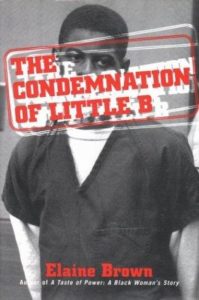
Elaine Brown – The Condemnation of Little B | Review

The Condemnation of Little B

Elaine BrownThe Condemnation of Little B (Beacon Press 2002)


More than 15 years ago, Elaine Brown wrote a wonderful book named The Condemnation of Little B.  It is both a sympathetic tale of Michel Lewis, known as “Little B,” who — when he was barely a teenager — was tried as an adult and convicted for a murder he most certainly did not commit, and a larger story of “New Age Racism” that explains why Little B’s individual story is, unfortunately, not all that unique.

The thrust of Brown’s analysis is conveyed by the way she recounts the prosecutor’s closing statement in Little B’s trial, which she says ended “with a dramatic flourish that revealed what the case against Little B was really about, about accommodating a powerful racist political socioeconomic agenda that at once invented and condemned black boys as superpredators.”  (p. 336).  This is part of the “New Age Racism” she describes, which is but an extension of old-fashioned racism:

“More than a century after the passage of the Thirteenth Amendment, more than 130 years since the legal end of slavery, the black communities of the United States effectively formed a third world enclave of subcitizens within the confines of this richest nation in the world.  Indeed, among the richest nations in the world, the United States, as the richest, maintained the highest poverty rate, with blacks at the bottom.”  (p. 355).

Brown’s scope is sweeping.  She manages to balance a sort of fast-paced “true crime” courtroom drama with a broader social science analysis of societal tends, as well as injecting the story of her own involvement investigating the case — while making that merely a framework to tell the story in an engaging way, without being a distraction from the real substance of the book.  The book opens with a tale of how Brown became aware of Little B and the dominant media narrative about him, which leads into an explanation of how her research ended up debunking that narrative.  She returns to Little B’s trial at the end of the book.  Throughout, it is as if she repeatedly asks, “Qui bono? [to whose benefit?],” in analyzing Little B’s situation and the actions of all the players involved.

In the middle part of the book, she covers the politicians who grandstand about being “tough on crime” while being fully aware of the racially discriminatory purpose and effect of the policies they enact behind a wall of public denial and feigned ignorance.  She covers the police and prison functionaries who viciously enforce degrading policies, careful not to question their own moral culpability in the process.  She discusses how courts have failed to uphold principles of universal justice, for instance, ruling that plea bargains for witnesses are shielded from laws against bribing witnesses that on on their face would make prosecutors dealing them out felons.  She discusses prosecutors repaying political supporters by engaging in witch hunts and duplicitous prosecutions — she even tells an anecdote about calling a prosecutor duplicitous to his face.  She critiques lickspittle journalists of the so-called “fourth estate” who act as “an extension of the powerful” (p. 37) and who promote narratives that are contrary to fact but bolster the policies of ruling elites — others have called this a “propaganda model” or simply the media socially constructing phenomena.  She calls out many who benefited from past affirmative action programs only to now kick the ladder away and deny others the benefits they themselves received.  She also discusses how the United States’ “founding fathers” were unrepentant slave owners.  In short, she portrays the larger context for how Little B’s story is the natural and intended consequence of the interrelated institutions of government, law enforcement, and society that today make up the politically dominant neoliberal program, itself a product of a top-down reassertion of power.  And she names names.  She never blinks in calling out by name the particular actors in Little B’s saga, or those on a regional or national level, even historical figures, who have acted to maintain systems of (racial) oppression.

The person who comes in her sights for the most criticism is undoubtedly former President Bill Clinton.  There is a wealth of information here about Clinton’s duplicity, not only betraying campaign promises but ushering in the “New Age Racism” that Brown describes as a return to the Plessy v. Ferguson era.  Central to this is the Clinton crime bill of 1994, which greatly expanded incarceration rates, predominantly among blacks, introduced severe mandatory sentencing, increased prison and law enforcement spending, and was an ignoble model for similarly severe state laws, combined with Clinton and Al Gore‘s legislative push (again an inspiration to states) to “end welfare as we know it.”  For that matter this trend was just a continuing part of what Thomas Ferguson and Joel Rogers called a “Right Turn” in American politics.  It is summed up well by the French sociologist Pierre Bourdieu‘s metaphor of “the left hand and the right hand of the state” — with the “left hand” social welfare programs starved of funds and the “right hand” (really, more of a right fist) coercive police and military institutions expanded — a metaphor explored in depth in by Loïc Wacquant‘s Punishing the Poor: The Neoliberal Government of Social Insecurity, and echoing the “Pyrrhic Defeat” theory of Jeffrey Reiman‘s The Rich Get Richer and the Poor Get Prison, Katherine Beckett‘s Making Crime Pay: Law and Order in Contemporary American Politics, etc.

Brown’s research is astute and reliable.  As one example, she even mentions government involvement in promoting drug trafficking in a way that acknowledges the still under-publicized and under-taught history of such activities.  She also peers into the so-called “prison-industrial complex” to explain how private for-profit prisons need a supply of prisoners, and how manufacturing companies exploit forced convict labor.  She peppers statistics throughout the book to support her arguments, without ever becoming bogged down in them.  This is how readers know that during the 1990s, there was a 465.5% increase in the number of blacks imprisoned for drugs!  (p. 352).  And, at that, mostly for victimless nonviolent drug charges.

While much of her general historical analysis relies on Howard Zinn‘s A People’s History of the United States, a central part of her discussion of the “New Age Racism” of the people directly and indirectly involved in Little B’s case leans on Malcolm X‘s parable about the “field negro” and the “house negro”.  (See pp. 209-212).  Brown adopts the parallel terminology “New Age House Negros” — the contemporary version of Harriet Beecher Stowe‘s “Uncle Tom” character.  Norman Kelley coined the derisive term The Head Negro in Charge Syndrome to describe the same phenomenon.  This is very much the same concept that political economist Ruy Mauro Marini noted (the same year Malcolm X was assassinated) in relation to a “sub-imperialism” that involved peripheral economies (like the Brazilian junta) collaborating actively with the imperialist expansion of core economies (like the United States), assuming in that expansion the position of a key nation.  It is also something Thomas Sankara, President of Burkina Faso, mentioned in his speech at the United Nations on October 4, 1984.  For these “New Age House Negros” — Brown names people like Condoleezza Rice, Colin Powell, Clarence Thomas, William Julius Wilson, Henry Louis Gates, Jr. and others in this ignoble role — they are accepting personal benefits in exchange for betraying the larger cause of racial justice on a society-wide basis.  It is worth quoting Brown at length here:

“More than merely advocating and sanctioning government policies that contributed to and maintained the wretched state of ghettoized and millions of other poor blacks, there had now come to be a new crop of Negros who, positioned to actually influence the outcome of government activity, were actively undermining the cause of improving the lot of blacks in America.  Although their positions had been purchased with black blood in more than one hundred years of struggle, these new Negroes had become collaborators in a scheme that was imprisoning and further impoverishing more and more blacks.  Given the moribund state of independent efforts by blacks for freedom, government policies and programs still represented the sole resort of blacks for redress and remedy for past harm, the sole relief and hope for the millions of Little Bs.”  (p. 220).

These aren’t just blanket accusations.  Brown goes into sufficient depth to identify precisely the positions publicly advocated, the benefits obtained, as well as contrasting examples for context.  The people she criticizes generally deny these things, naturally, but Brown’s evidence in each case is more than adequate to convincingly show that these individuals got ahead by participating — as privileged collaborators and exceptions — to social systems of (racial) oppression.  And she does that without leaning merely on a “Beautiful Soul” contradiction or the inadequate description of “tokenism”.  Her position ends up close to that of Adolph Reed, Jr.‘s essay, “What Are the Drums Saying, Booker?: The Curious Role of the Black Public intellectual.”

A useful critique she offers in passing is of rapper Sean “P-Diddy” (formerly “Puff Daddy”) Combs, and the way his music’s message revolves around “a presumed conflict between the ‘player’ — a ghetto black who has gotten rich — and the resentment of the ‘player-hater’ — the black still stuck in the ghetto.”  (p. 240).  As a contrast, the TV show Good Times had a season two episode in 1975 called “The Debutante Ball” in which the protagonist Evans family, living in a public housing project, is confronted by the Robinson family, led by a father who became rich, left the ghetto, and wishes to sever all ties and connections to it — and hence does not want his daughter to attend a debutante ball with J.J. Evans, who is from the ghetto.  Unlike Puff Daddy/P. Diddy, who sides with the “player”, the Good Times episode has sympathies in the other direction, accusing the rich man (“player”) of forgetting where he came from and suggesting that he is being anti-social and betraying necessary black solidarity.  This regression is precisely the point Brown makes so well about “New Age Racism.”

When it comes to the discussion of Little B’s trial, Brown is critical of mistakes that his own lawyer made.  Actually, she felt that the senior defense attorney was ineffective and Little B would have been better served by his less experienced but more competent co-defense counsel.  In some instances, Brown has the benefit of hindsight.  Yet there were still some rather glaring errors and oversights made.  Those were compounded by a disinterested judge droning on in a monotone voice — something all too typical in criminal cases.  But Brown spends ample time on the prosecutor, who used “emotionalism to cover the barrenness of facts” in the state’s case.  (p. 327).  In other words, she calls her out for utilizing a psychological persuasion trick that lowers public opinion of lawyers in general:  like a magician using distraction to perform a sleight of hand illusion, the prosecutor makes an emotionally manipulative case that distracts from the cold impersonal evidence that leads to a different conclusion.  Partly for this reason, some other countries use professional jurors, who can become more familiar with both courtroom procedure and tenth rate lawyer tricks, to perhaps see beyond them.  For those interested, Brown does point a finger at the mostly likely murderer, a neighborhood drug dealer known as “Big E”, who avoided a life sentence on other charges as part of a deal with prosecutors to testify against Little B (the guilty party providing false testimony against another to avoid consequences is hardly unique to Little B).

While Brown’s book is about as thorough and well grounded as could be hoped, there are a few minor points where it might be improved.  Brown frequently reproduces quotes using “[sic]” to highlight supposed errors.  In at least a few cases there are no errors to be found, and Brown comes across as trying to shame the quoted speakers/writers in an exceptionally petty way.  Cornell West gets dissed here, which may have been fair at the time of publication, but since Brown’s book was published West has changed his public positions in ways that would seemingly satisfy Brown.  She also comes close to taking a very reductionist stance on racism, nearly divorcing it from other factors like economics, though she always pulls back from falling into that trap — resoundingly so with an MLK quote that closes the book.  Still, much of her analysis of political ideology comes up a bit short in general, left mostly to implication, and might have been bolstered by citing to some other authors who have already developed similar lines of thinking.  Adolph Reed, Jr. and Walter Benn Michaels come to mind.  It also would have been interesting, if a digression, to have read Brown’s views on the argument that race is a social construct not supported by scientific genetics.  Anyway, back on point, in the middle part of the book Brown criticizes “Enlightenment” era thinkers in a somewhat slipshod way.  She lists many of the big names, and then criticizes most of them.  But, for instance, she never gets around to debunking Jean-Jacques Rousseau on her list, which is curious because most of the framework of her book rests on concepts that run through Rousseau one way or another.  It isn’t so much that her political/philosophical analysis is wrong as much as it is vague and undeveloped.  Domenico Losurdo‘s Liberalism: A Counter-History was published after Brown’s book, which is too bad because it fills in the holes in Brown’s analysis in a perfectly complementary way.  Losurdo argued that Liberalism is and always has been premised on the exclusion of some from enjoyment of its loudly self-professed support of freedoms and civil rights.  He details at length how Liberalism has always advocated freedom while seeing no contradiction in supporting slavery at the same time — this being an essential aspect of Liberalism and not a deviation from it.  Rather, Liberalism always places the maintenance of some form of social hierarchy, however softened or limited, above rights and freedoms.  That is why the freedom that Liberalism promotes most strongly is ultimately only that of the unimpeded movement of economic capital.  Brown is advocating for the universal applicability of personal freedom, seemingly free from the limits of hierarchy.  This underscores something that is never explicitly stated in Brown’s book: she is really criticizing neoliberalism (the dominant strain of Liberalism at the time) from the left through the lens of one particular person’s story and the context behind it.

In this light, Brown’s book presents Little B’s case as a situation not terribly unlike the so-called “Dreyfus Affair” in Third Republic France a hundred years previous (1894-1906), in which an article by Émile Zola run under the iconic headline, “J’accuse!” publicized how the Jewish military captain Alfred Dreyfus was framed by military commanders.  That case illustrates a political divide manifested through law enforcement and judicial proceedings.  The basic split is between, on the one hand, those who believe that every person is equally entitled to a fair trial and that the innocent should never be punished for crimes they did not commit, and, on the other hand, those who believe in maintaining social institutions and traditions even at the cost of throwing a few innocent people in prison once and a while.  The latter tend to evoke Plato‘s idea of a “noble lie” used by elites to sustain a society of their own design, and Kant‘s position that such lies must never be questioned or exposed or else the legal foundation of society will collapse.  In this way, the people who throw innocents in prison often sincerely believe that they are doing good, even if they lie, plant evidence, deny access to an attorney, etc., because they are preserving a system that is necessary in their eyes — denying or concealing the essentially political choice involved in selecting a particular system in the first instance that puts some in power over others.  Elaine Brown is of course on the former side, decrying the imprisonment and punishment of any innocent person, and, by extension, seeing corresponding change to existing social systems to equalize power relations as desperately needed and long overdue.  Another reviewer put it well by writing, “She is witheringly good at exposing the myths that allow power groups, both black and white, to exploit and crush the weak with a comparatively untroubled conscience — all more or less veiled versions of racism, ranging from Jefferson‘s theories on why blacks can’t write poetry to today’s trumpeted ‘new phenomenon’ of young, black male ‘Superpredators’ sprouting in our midst.”  Taking Losurdo’s analysis as a reference, this amounts to saying that the centrist neoliberals are, at a very fundamental level, actually more aligned with the conservative/reactionary right than they admit.

Brown does inject herself into the narrative, particularly in the very beginning and very end of the book.  It is clear she rejects the so-called journalistic “ethics” of “non-involvement”, which can be questioned on moral grounds as being far too convenient for journalists.  But her perspective adds to the story, and orients readers to the author’s perspective.

The Condemnation of Little B is a landmark.  Unlike trashy, novelistic “true crime” books like Truman Capote‘s In Cold Blood, which epitomize an emotionalism that sidesteps the deeper moral questions about social constructs and institutions, Brown dissects and critiques those overlooked questions with surgical precision.  It is remarkably comprehensive, always defends the moral high ground, and is relentless in questioning the legitimacy of social power structures.  Hats off to Brown.

Michael Lewis, “Little B”, remains in prison:  http://freelittleb.com/