Link to an article by Rob Urie:
“Climate Crisis, ‘Smart’ Growth and the Logic of Calamity”
Bonus link: Review of Robert Pollin’s Back to Full Employment
Cultural Detritus, Reviews, and Commentary

Link to an article by Rob Urie:
“Climate Crisis, ‘Smart’ Growth and the Logic of Calamity”
Bonus link: Review of Robert Pollin’s Back to Full Employment
Link to an article by Michael Hudson, excerpted from the 2017 edition of his essential Super Imperialism: The Economic Strategy of American Empire:
Link to an article by Slavoj Žižek:
Bonus quote:
“The fear not to make any compromises with the alt-right can muddy the degree to which we are already compromised by it. One should greet every sign of this self-critical reflection which is gradually emerging and which, while remaining thoroughly anti-fascist, casts also a critical glance on the weaknesses of the liberal left.
***
“The obscenity of the situation is breath-taking: global capitalism is now presenting itself as the last protection against fascism, and if you try to point this out you are accused of complicity with fascism.”
Bonus links: “15 Writers Confess the Worst Thing They Wrote in 2017” and “Why We All Love to Hate Haider”
Link to an interview of Peter Waldron, conducted by Paul Mitchell:
“Radical Russia: An Interview with Curator Peter Waldron”
Bonus link: “How the Bolshevik Revolution Saved Avant-garde Art”
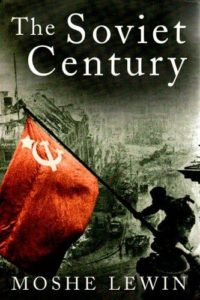
Moshe Lewin – The Soviet Century (Verso 2005)
Moshe Lewin was one of the great historians of the former Soviet Union writing in English. He actually lived in the Soviet Union for a time, working on a collective farm and later in the Soviet Army, eventually ending up in the West in academic positions. His breakthrough book in the late 1960s was the superb Lenin’s Last Struggle (first published in French), which here he confirms was on the right track but which formerly secret documents now show did not go far enough in establishing how much Lenin despised Stalin and his political ambitions. What separates Lewin from so many other English-language historians is that he approaches the Soviet government, and its attempts to realize the “communist hypothesis” (Alain Badiou‘s term), in a sympathetic yet critical light. Mostly that takes the form of accepting the original Bolshevik objective in founding the USSR, together with rather commonplace statistical measures and evaluations against the government’s own internal objectives, and asking how well the government operated against those sorts of metrics, in context, without dwelling on the insentience that Bolshevik objectives were and are normatively wrong. As Lewin puts it near the end of this book:
“Reflection on the USSR has been marred — and still is — by two frequent errors . . . . The first is to take anti-communism for a study of the Soviet Union. The second — a consequence of the first — consists in ‘Stalinizing’ the whole Soviet phenomenon, as if it had been one giant gulag from beginning to end.
“Anti-communism (and its offshoots) is not historical scholarship: it is ideology masquerading as such.”
To that end, Lewin occasionally reminds readers how anti-communist detractors are often quick to criticize the Soviet Union while at the same time overlooking similar if not worse occurrences in other countries. Such a decontextualized approach he likens to propaganda.
Lewin does not resort to hagiography or fawning praise for the former Soviet Union. He does hew pretty close to the Lenin/Trotsky analysis of the new nation’s prospects for becoming socialist (which in turn drew from various non-Bolshevik commentators of the day), describing Stalinism as “agrarian despotism” that rebuilt many aspects of the failed tsarist system, and the post-Stalin period as “bureaucratic absolutism”. As Lenin and Trotsky both believed that it would take a long time and much effort to actually reach socialism, Lewin looks back and finds that socialist objectives were never achieved (though such conclusions can be taken too far, suggesting an impossible purity). But he is ready to credit many advances in industrialization, literacy and education, feminism, science, life expectancy, and so on, plus a critical role in the defeat of Nazism. He laments how some scholars have omitted the decline in many of these measures after the fall of the Soviet Union — he likens the immediate post-Soviet economy to a “mafia” capitalism, something that he suggests materialized in part because there was already a kind of privatization of the commons underway in the late Soviet era proper.
The book is not a chronological history, but rather is more of a collection of essays on various topics. This fits in the category of reflective history, cutting across subspecies of universal, pragmatic, critical and fragmentary methodologies, following Hegel‘s taxonomy in Reason in History. What emerges here is a useful portrait of the administrative and bureaucratic aspects of the state, and how those elements rose and fell, and engaged in internal fields of struggle with other social elements. The segments on Stalinism make for difficult reading, given the gruesome nature of arbitrary persecutions that involved massive waves of executions and institutionalized slavery via the gulag system. And yet, Lewin admirably traces the both the rise and fall of Stalinism, and some of its lingering effects.
There is an enlightening segment tracing the careers of various post-Stalin politburo members (i.e., the top leaders). Lewin shines in some of these portraits, drawing on a host of memoirs from these figures and the people working around them, as well as from reports made public only decades later. He skips past many of these politicians as hapless fools, and focuses only on those with wits about them. Khrushchev is the first of them. He was a kind of country-bumpkin of sorts, who did numerous admirable things leavened with politically naive mistakes. It was Khrushchev who dismantled the gulag system and instituted reforms of the NKVD (the predecessor to the KGB that operated the gulags) and the state’s dependence on the economics of gulag slave labor. And yet, he was ousted and the incoming Brezhnev regime was neo-Stalinist in some respects, setting the stage for overall decline based on a tendency to corruption (including, in Stalinist style, blaming all mistakes on the lower rungs but taking all credit at the top) and ineffectiveness (epitomized by surrounding the general secretary with mostly dumb, non-threatening, and self-interested loyalists). For comparative purposes, the Khrushchev era offers useful examples for how the dismantling of corrupt and discriminatory policing structures in other countries, like the United States, might proceed, and the challenges those efforts will face during the inevitable pushback by those invested in the status quo. Andropov is the most interesting figure chronicled (I admit to being unfamiliar with him until this book). A former head of the KGB, he was well-informed about the unvarnished facts of the state’s decline and inefficiency, and encouraged free communication in his office, thereby developing new theories and rapport with officials who reported to him. This is surprising, in that he was seen as part of the conservative Brezhnev block and headed the KGB — although he was a liberalizer when it came to internal political repression via the KGB. Although Andropov died too quickly to achieve anything of significance once he assumed the position of general secretary, Lewin ponders what a vaguely Leninist but quite radical restructuring of the state under Andropov might have accomplished to avoid the entire state’s collapse a decade later (most likely a sort of New Economic Policy [NEP] part two).
Another memorable passage is Lewin’s takedown of the writer Aleksandr Solzhenitsyn. He says, “Solzhenitsyn considered himself the depository of higher values inherited from Russia’s distant past[,] *** [a] fine writer, but politically inept and with a highly inflated sense of his own importance . . . .” He considered him a dubious source of information on the gulag system, quoting extensively Vladimir Lakshin, of the literary magazine Novyi Mir, an outspoken contemporary Soviet critic of Solzhenitsyn. Lewin also suggests that Solzhenitsyn was a bit of a fraud in the way he criticized the gulag system after it was essentially dismantled, without ever explicitly noting that the gulag system was already a relic of the past. He sees Solzhenitsyn as finding notoriety principally via anti-communists who didn’t question his underlying reactionary anti-democratic impulses. These are biting criticisms, and worth reading for anyone who might otherwise rely on Solzhenitsyn.
Lewin is a fine writer and historian, drawing mostly from secondary sources with a scrupulous eye for their shortcomings and biases. This is still “eat your vegetables” sort of reading, though well worth it in terms of revealing a lot of information that was previously secret during the Soviet era and most certainly presenting a view of the former Soviet Union not regularly taught (or even suggested) in Western schools. It would have been nice had Lewin included a few more topics, such as more about the arts, and some sort of discussion about ecology (in a country whose government basically destroyed the Aral Sea). But no matter. Historians have a tough task, in that mere collections of isolated facts serve no purpose, and meaningful histories tend to require the application of theory from sociology, political science, and even, in the case of sketches of important personages, psychoanalysis. Lewin proves adept in many of those areas, even if he occasionally stumbles by suggesting that it is possible for historical analysis to step outside of ideology and be “objective”.
Link to a report by Project Censored:

Scott Walker – Tilt Fontana 526 859-2 (1995)
Scott Walker’s later career has been enigmatic, to say the least. He got his start singing light pop, and ended up in one of the first successful UK “boy band” rock acts, The Walker Brothers. But friction over Scott’s obviously superior vocal abilities led to the band splitting up after just a few years. His solo career burned brightly at first, but his finest work just didn’t meet with enough commercial success, and he drifted into country-pop terrain for a time, then reunited with The Walker Brothers. Something unusual happened on the group’s post-reunion Nite Flights album, though. Walker unveiled new, dark, menacing and genre-defying compositions like “The Electrician” and “Fat Mama Kick.” He released one solo album, Climate of Hunter, in the early 1980s, but, despite an aborted effort with Daniel Lanois and Brian Eno, nothing further that decade. By the early 1990s, he had started writing numerous new songs for a new album project finally released in 1995, Tilt. Commenting on this paucity of output, he said, “I’ve become the Orson Welles of the record industry. People want to take me to lunch, but nobody wants to finance the picture.”
While some of Walker’s earlier works hint at the general contours of Tilt, the album is unique in a way few albums are. Walker takes pop/rock song structures, strips away some of the most typical features of “rock” music, like a syncopated beat, then adds in industrial noises, obscure orchestration and quasi-operatic singing. This was partly about taking elements of “high” and “low” culture that don’t typically appear together, and coming up with a hybrid that finds its feet not in fully synthesizing the disparate elements, but holding them in a kind of part synthesis and part oppositional juxtaposition. This naturally leans toward the counterculture, in that pure “highbrow” arts admit nothing from outside their exclusive remit, save for the occasional “exoticism” or a tactical renormalization of an outside threat. There are some musical precedents for this kind of approach in the most general sense, namely Nico‘s striking The Marble Index, which took gothic Euro-classical music and merged it with urban folk. But Walker’s precise musical coordinates are different, and lean on obscure yet decidedly non-mainstream politics — they are overt, yet oblique enough to avoid easy identification with precise political currents. He also developed a penchant for making his listeners stop and ask, “What?” are least once or twice per album.
If there is any great, lasting achievement here, it is that Walker reconfigures the relationship between singing and musical accompaniment in nominally pop/rock music. The lyrics are non-linear, often cycling and vamping on brief phrases and sounds that mutate slowly, and they convey almost cinematic scenes, the contours of which are only hinted at. His goal, he stated in an interview is for his singing to be “not too emotional and not too deadpan.” The sonic accompaniment adds mood, and moves almost in loose parallel with the vocals, never really seeming like an integral part of the vocals in a harmonic or melodic sense, but linked to the lyrics to expand upon their meaning. The result is something uncommonly dense.
The opener, “Farmer in the City: Remembering Pasolini” is dedicated to the late Italian filmmaker and poet Pier Paolo Pasolini. The next song, “The Cockfighter,” includes bits of text lifted from the transcripts of the trials of Queen Caroline in 1820 (in English Parliament) and Nazi administrator Adolph Eichmann in 1961 (in Israel). One was about a bill of attainder, a legislative act declaring a particularly person guilty of some crime and punishing them that took on the characteristics of a legislative “trial”, and the other an ex post facto trial, criminalizing conduct after it was conducted. What commonalities these trials share is murky in Walker’s invocation, though both were constitutionally banned in the United States. And how cockfighting relates to those trials is anyone’s guess, though it is a gruesome “sport” banned almost everywhere—it is also the title of a 1974 Monte Hellman film. “Bolivia ’95” deals with the South American country that grew turbulent when national industries were being privatized. Walker called the title track a “black Country music song.” What do all these disparate things mean pulled together on one album? What exactly. It represents the new opacity and mystification of daily life under modernity. There is a part of all this a bit like Thomas Pynchon‘s novel Gravity’s Rainbow, or Goethe‘s Wilhelm Meister’s Journeyman Years, or The Renunciants, in which the very diffuseness and difficulty of piecing together meaning is itself the focus.
In an interview more than a decade after the release of Tilt, promoting his next album, Walker said, “Essentially, I’m really trying to find a way to talk about the things that cannot be spoken of. I cannot fake that or take short cuts. There is an absurdity there, too, of course, and I hope that people pick up on that. Without the humour, it would just be heavy and boring. I hope people get that. If you’re not connecting with the absurdity, you shouldn’t be there.” He cites Kafka as an influence, who used to laugh when reading his writing to friends.
“Bouncer See Bouncer…” introduces a device he would revisit on later albums (as with a bell on “Herod 2014” from Soused). A repeating sound, not made by a conventional musical instrument, but sounding like a broken metal hinge banging together, chimes throughout the song. It continues largely independent of everything else happening in the song.
Tilt has held up as one of Walker’s finest full-length albums. It doesn’t make for casual listening, exactly. But there is a mocking sarcasm beneath the dark and morbid exterior of these songs. Tilt remains something rarely imitated, excepting perhaps Walker’s later albums.

Lorde – Melodrama Republic B0026615‐02 (2017)
OK, but a lesser album than Lorde’s debut. This time around her vocal affectations start to feel stale, and the songwriting is a bit bland. Curiously, though, “Liability” bears more than a few melodic resemblances to Nico‘s “Afraid” (from Desertshore).

Tomorrowland (2015)
Walt Disney Pictures
Director: Brad Bird
Main Cast: Britt Robertson, Raffey Cassidy, George Clooney
What is worthy about Tomorrowland is that it starts out as a typical young-adult exceptionalism fantasy, draws in a few action scenes, an unusual blend of futurist and quasi-steampunk elements, and a standard vision of a technocratic utopia, then gets around to critiquing all that. Basically, the premise is that around the turn of the nineteenth century a group of scientists created a utopian society called “Tomorrowland” in another dimension, freed from all the bureaucracy of the “real world.” Frank Walker (George Clooney) lived there as a child, but was exiled and now lives as a recluse on Earth. A robot friend of his Athena (Raffey Cassidy) then recruits a teenage girl (Britt Robertson) to help him get back to Tomorrowland and fix the thing he built that led to his exile. But, what is most intriguing are two things. First, when the trio does arrive in Tomorrowland, they discover that the problem is not really about science and engineering (“fixing” the device that Walker had built), but about politics, and dislodging the essentially corrupt leader in Tomorrowland David Nix (Hugh Laurie) who knew all along — unlike Walker (?) — how the device was destroying Earth. Basically, the trio realize that people are stupid, but, unlike Laurie’s character, don’t feel that widespread human stupidity justifies allowing the destruction of humanity on Earth. And in that process, they basically stage a violent coup — though the film does not explicitly emphasize this aspect of political revolution, it does happen on screen. Then, with the old regime toppled, Walker sets up a program to recruit new people to Tomorrowland, and in a speech he acknowledges that toppling the old regime was the easy part and what comes next, actually building a better utopia, is the hard part. While the film shows this next phase in a very cursory way, and avoids the sort of difficult theoretical aspects of describing how that hard work should proceed, it at least realistically suggests where the hard work must take place. This is a film for young people, and is rather light entertainment, but at the same time the film’s message is a good one (basically Leninist).
Link to a video of a lecture by Jodi Dean:
“The Limits of the Web in an Age of Communicative Capitalism”
Bonus quote:
“In communicative capitalism, capitalist productivity derives from its expropriation and exploitation of communicative processes.
***
“If we are honest, we have to admit that there is actually no such thing as social media. Digital media is class media. Networked communication does not eliminate hierarchy, as we believed, in entrenches it as it uses our own choices against us.
***
“Dispossession, rather than happening all at once, is an ongoing process. No one will deny the ongoingness of data dispossession. Sometimes it is blatant: the announcement that our call will be monitored for quality assurance, the injunctions to approve Apple’s privacy changes again or the necessity of renewing passwords and credit card information. Sometimes the ongoingness is more subtle; in maps, GPS signals, video surveillance, and the RFID tags on and in items we purchase. And sometimes the ongoingness is completely beyond our grasp, as when datasets are combined and mined so as to give states and corporations actionable data for producing products, patterns, and policies based on knowing things about our interrelations one to another that we do not know ourselves. Here the currents of lives as they are lived are frozen into infinitely separable, countable, and combinatory data-points.
“Approached in terms of class struggle, big data looks like further escalation of capital’s war against labor.”
“Communicative Capitalism and Class Struggle”
Bonus links: C.T. Kurien, “The Market Economy: Theory, Ideology and Reality” and Astra Taylor, The People’s Platform and “The Power Of Selling Out: Your Customers As Political Capital” and Nick Srnicek, Platform Capitalism and Nick Dyer-Witheford, Cyber-Proletariat: Global Labour in the Digital Vortex and Alexander Galloway and Eugene Thacker, The Exploit: A Theory of Networks and The Uprising: On Poetry and Finance and Victor Pickard, “Net Neutrality Is Just the Beginning” and “The Collapse of Media and What You Can Do About It” (this article discusses the “breaking” of a self-described “exclusive” story in January 2015 that was for the most part already suggested in When Google Met Wikileaks published in September 2014, though this story was certainly fleshed out further by the later report; this also was used as a plot point in the film Jason Bourne) and “Prosumer Capitalism: Mario Maker 3DS”