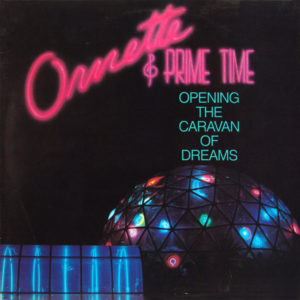
Ornette Coleman & Prime Time – Opening the Caravan of Dreams

Opening The Caravan of Dreams

Ornette & Prime TimeOpening the Caravan of Dreams Caravan of Dreams CDP85001 (1986)


Presented on this album are live recordings of Ornette and his Prime Time band performing for the opening of the Caravan of Dreams club/cultural center in Ornette’s home town of Fort Worth Texas.  This is basically an extension of the same funk/R&B and free jazz fusion that the group had performed and recorded in the past.  Though this particular set of performances has a more raw and visceral tone than the group’s last studio album, Of Human Feelings.  The band gets to wail away with each band member going in his own direction and it kind of makes some intuitive sense that facilitating this is their objective.  Yet they also come together for joint or “unison” statements on songs like “City Living” and “Compute.”  One commentator referred to this as a riff hybrid format, with repeatable riffs organized within a structure that recalled pre-Prime Time efforts.  Ornette’s own performances aren’t perhaps as memorable as elsewhere, though he does deploy a remarkably wide assortment of stylistic flourishes, but the rest of the band sounds tighter than usual.  Occasional use of cowbell, a whistle and some kind of electronic beeper add nice little touches too.  If you like Prime Time’s music, this is sure to please.  If you don’t, this probably won’t change your mind, though to these ears the live setting does make this more engaging than most Prime Time albums.

William S. Burroughs Quote

“After a shooting spree, they always want to take the guns away from the people who didn’t do it. I sure as hell wouldn’t want to live in a society where the only people allowed guns are the police and the military.”

William S. Burroughs, Painting & Guns


Bonus links: “The Rifle on the Wall: A Left Argument for Gun Rights (Reprise)” (“The political principle at stake is simple: to deny the state the monopoly of armed force, and, obversely, to empower the citizenry, to distribute the power of armed force among the people.”) and Links to books about black armed resistance in freedom movements

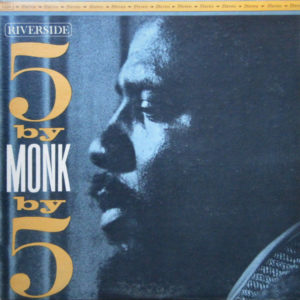
Thelonious Monk – 5 by Monk by 5

5 by Monk by 5

Thelonious Monk5 by Monk by 5 Riverside RS 12-9305 (1959)


A pretty mediocre Monk album.  This is a one-off quintet with a cornet, and there are some new songs debuted.  But the playing is rather programmatic.  The players generally don’t push themselves, and there is nothing in the way of interesting interactions between them.  Monk plays well, but that just isn’t enough.  I would place this near the bottom of the pack when ranking the Riverside albums.

Slavoj Žižek on Victimhood Status

“one should . . . admit how problematic it is to anchor one’s political demands to status of victimhood. Is the basic characteristic of today’s subjectivity not the weird combination of the free subject who believes themselves ultimately responsible for their own fate and the subject who bases their argument on their status as a victim of circumstances beyond their own control? Every contact with another human being is experienced as a potential threat – if the other smokes, if he casts a covetous glance at me, he already hurts me; this logic of victimization is today universalized, reaching well beyond the standard cases of sexual or racist harassment.”

Slavoj Žižek, “Sex and ’68: Liberal Movement Revolutionized ‘Sexuality’ But at What Cost?”

Bonus quote:

“Social valorization of affects basically means that we pay the plaintiff with her own money: oh, but your feelings are so precious, you are so precious! The more you feel, the more precious you are. This is a typical neoliberal maneuver, which transforms even our traumatic experiences into possible social capital. If we can capitalize on our affects, we will limit out protests to declarations of these affects — say, declarations of suffering — rather than becoming active agents of social change. I’m of course not saying that suffering shouldn’t be expressed and talked about, but that this should not ‘freeze’ the subject into the figure of the victim. The revolt should be precisely about refusing to be a victim, rejecting the position of the victim on all possible levels.

…this bind derives precisely from the subjective gain or gratification that this positioning offers. (Moral) outrage is a particularly unproductive affect, yet it is one that offers considerable libidinal satisfaction. By ‘unproductive’ I mean this: it gives us the satisfaction of feeling morally superior, the feeling that we are in the right and others are in the wrong. Now for this to work, things must not really change. We are much less interested in changing things than in proving, again and again, that we are in the right, or on the right side, the side of the good. Hegel invented a great name for this position: the ‘beautiful soul.’ A ‘beautiful soul’ sees evil and baseness all around it but fails to see to what extent it participates in the perpetuation of that same order of things. The point of course is not that the world isn’t really evil, the point is that we are part of this evil world.”

Alenka Zupančič, “Too Much of Not Enough: An Interview with Alenka Zupančič”

Bonus links: “The Politics of Identity” and “Who Gets Ownership of Pain and Victimhood?” and “Art and Exploitation: Ai Weiwei, Dissidence and the Refugee Crisis” and “What’s Wrong With Identity Politics (and Intersectionality Theory)? A Response to Mark Fisher’s “Exiting the Vampire Castle” (And Its Critics)” (“The upshot [of intersectionality theory] in political practice is a static pluralism of reified social categories, each vying for more-subaltern-than-thou status on a field of one-downsmanship.”) and “On Sex Without Identity: Feminist Politics and Sexual Difference” (“The way things stand now, this kind of [victimhood] assertion comes with a certain social capital, and this tends to stop emancipatory movements before they even start to develop their emancipatory potential.”) and “Die Dreigroschenoper [The Threepenny Opera]” (Notes to the Threepenny Opera: Jonathan Peachum “is undoubtedly a villain . . . .  his crime consists in his conception of the world . . . ; yet he is only following the ‘trend of the times’ when he regards misery as a commodity.”) and “Mutter Courage und ihre Kinder [Mother Courage and Her Children]” and Safe and “Who Gets Ownership of Pain and Victimhood?” and The Holocaust Industry and Hate, Inc. (“People need to start understanding the news not as ‘the news,’ but as . . . an individualized consumer experience — anger just for you. This is not reporting. It’s a marketing process designed to create rhetorical addictions and shut down any non-consumerist doors in your mind.”) and Amuse-Bouches II – Testimony and the Pass”

Mike Beggs – The Keynesian Counterrevolution

Link to a book review by Mike Beggs of In the Long Run We Are All Dead: Keynesianism, Political Economy and Revolution by Geoff Mann:

“The Keynesian Counterrevolution”


Bonus links: “The Left in a Foxhole?” (excerpt from Mann’s book) and “Liberalism: An Ideology of Exclusion” (this article rebuts Begg’s discussion of classical and modern liberalism, indicating that the archetype of all forms of liberalism is a politics of exclusion; in this case, merely elevating “the bourgeois and the intelligentsia” above others) and War and Revolution. Rethinking the Twentieth Century and Domenico Losurdo on Two Epidemics and “The Class Struggle on Wall Street” (“The problem [with Keynesianism] is, the rentier doesn’t want to be euthanized. Capital is not going to say, ‘okay, our work here is done, goodbye.’ So to maintain the social position of money-owners, you have to create an artificial shortage of money, and that’s another way of looking at the job of the central bank.”)


Bonus quote:

“class struggle is ultimately the struggle for the meaning of society ‘as such’, the struggle for which of the two classes will impose itself as the stand-in for society ‘as such’, thereby degrading its other into the stand-in for the non-Social (the destruction of, the threat to, society).

“To simplify: Does the masses’ struggle for emancipation pose a threat to civilization as such, since civilization can thrive only in a hierarchical social order?  Or is it that the ruling class is a parasite threatening to drag society into self-destruction, so that the only alternative to socialism is barbarism?”  Slavoj Žižek, Afterword to Revolution at the Gates: Selected Writings of Lenin From 1917 (pp. 209-10).

Adam Johnson – DSA-Endorsed Judge’s Bail Reforms Prompt Media Attack

Link to an article by Adam Johnson:

“DSA-Endorsed Judge’s Bail Reforms Prompt Media Attack”


Bonus links: …And the Poor Get Prison, The Five Filters of the Mass Media Machine, “Liberal Philadelphia DA is Impeached by Pennsylvania House; What Are the Allegations?” and “Meet Larry Krasner”

Jonathan Cook – The UK’s Hidden Role in Assange’s Detention

Link to an article by Jonathan Cook:

“The UK’s Hidden Role in Assange’s Detention”


Bonus links: “The Scourging of Julian Assange” and “British Judge Refuses to Overturn Julian Assange’s Arrest Warrant” and “Inside WikiLeaks: Working with the Publisher that Changed the World” and “U.K. and Ecuador Conspire to Deliver Julian Assange to U.S. Authorities” and “Guardian Ups Its Vilification of Julian Assange”

Rob Urie – Why ‘Russian Meddling’ is a Trojan Horse

“A political Left with a brain would be busy thinking through strategy for when the internet becomes completely unusable for organizing and communication. The unifying factor in the initial ‘fake news’ purge was criticism of Hillary Clinton. Print media, a once viable alternative, has been all but destroyed by the move to the internet. This capability needs to be rebuilt.”

Rob Urie, “Why ‘Russian Meddling’ is a Trojan Horse”