Joan Roelofs – Alexandra Kollontai: Socialist Feminism in Theory and Practice

Link to an article by Joan Roelofs:

“Alexandra Kollontai: Socialist Feminism in Theory and Practice”


Bonus links: “‘If Only There Were More Female Billionaires!’— New York Times” and “Soviet Power and the Status of Women” and “Capitalism and Female Labor”

Ben Norton – Former CIA Director Admits to US Foreign Meddling, Laughs About It

Link to a news video by Ben Norton:

“Former CIA Director Admits to US Foreign Meddling, Laughs About It”


Bonus links: “Fake News on Russia and Other Official Enemies” and Killing Hope and “Overthrow: 100 Years of U.S. Meddling & Regime Change, from Iran to Nicaragua to Hawaii to Cuba”

Bonus quote: “Go search where you will, roam through all the monarchies and despotisms of the Old World, travel through South America, search out every abuse and when you have found the last, lay your facts by the side of the everyday practices of this nation, and you will say with me that, for revolting barbarity and shameless hypocrisy, America reigns without a rival.” Frederick Douglass – July 4, 1852

Sarah Bruch & Joe Soss – The Lessons Students Learn

Link to an article by Sarah Bruch & Joe Soss:

“The Lessons Students Learn”


Bonus links: “Red Diaper Babies” and Pedagogy of the Oppressed and Richard Shaull Quote (“There is no such thing as a neutral educational process.  Education either functions as an instrument that is used to facilitate the integration of the younger generation into the logic of the present system and bring about conformity to it, or it becomes ‘the practice of freedom,’ the means by which men and women deal critically and creatively with reality and discover how to participate in the transformation of their world.”) and Deschooling Society and The Struggle for the Meaning of Society As Such and “Elite Universities Are Turning Our Kids Into Corporate Stooges”

Poesía sin fin [Endless Poetry]

Poesía sin fin [Endless Poetry]

Poesía sin fin [Endless Poetry] (2016)

Satori Films

Director: Alejandro Jodorowsky

Main Cast: Adan Jodorowsky, Pamela Flores, Brontis Jodorowsky


This is the best new(-ish) film I can remember seeing, a fact bolstered by watching the horrendous Star Wars: The Last Jedi at a second-run theater shortly after it.  This autobiographical work draws from the second part of The Dance of Reality: A Psychomagical Autobiography (2001), and chronologically follows Alejandro Jodorowsky’s previous film La danza de la realidad [The Dance of Reality] (2013), which also drew from his autobiography.  This is not a conventional, “accurate” or “realistic” autobiographical picture.  Some scenes are altered from their historical sources, and most of the film represents stylized exaggerations of real-life events for artistic effect.  While this can definitely be called Felliniesque — Amarcord, Satyricon and 8 1/2 being perhaps the closest counterparts — everything here is unique to Jodo and nothing can really be said to be copied from Fellini or anyone else.  Jodo’s predilection for combining psychoanalysis and shamanism completely and irrevocably marks his own style.  But perhaps it suffices to say this is about as good as Fellini at his best.

The film opens with Jodorowsky in his teens, still living in Tocopilla, Chile.  Jeremias Herskovits reprises his role as the young Jodo.  But his family relocates to Santiago.  He develops a love of poetry.  Eventually he runs away from home and is taken in by kindred spirits at a kind of artist commune.  There he works on his poetry and begins making puppets for a puppet show he presents with a friend.  He cultivates relationships with local poets and spends time in bars recreated here with surreal decor.  He then is given a loft apartment, by chance, where he comes into himself as a young adult.  A particularly moving scene is the very end of the film.  This is where Jodorowsky decides to leave Chile for France.  His father meets him at the port as he is leaving.  In real life, he never saw his father or other family members again.  But here, as a kind of narrator, he steps in to ask his younger self to forgive his father and insist on a different interaction with the father character.  The film is historical, but also a dialog with the director’s own past, as a kind of quest to confront and overcome his own mistakes.  Numerous scenes depart from the way Jodo described them in his earlier book The Dance of Reality.  While sometimes that means the filmic depiction is exaggerated, in some instances things are toned down to be more presentable on screen.

One recurring effect is the presence of stage hands dressed entirely in black, including gloves and full-head hoods.  These stage hands take things from the actors’ hands and hand them other things.  Familiar in theater productions, here the effect is to consciously direct the audience to the symbolic significance of characters’ actions on screen and to heighten emphasis on the characters’ emotional states.  Another device used repeatedly is the active unveiling and movement of life-size black-and-white posters of buildings and a train.  These convey the past in a kind of distant echo, real yet unreal.  They allude to the past while recognizing that events can’t be fully re-created, only conjured up from vague memories from a new perspective.  Then the end of the film features a crowd, half dressed in skeleton costumes and half dressed in red devil costumes.  The skeletons appear elsewhere in the film too.  These images are striking and indelible.

Jodorowsky’s wife Pascale Montandon-Jodorowsky provides lighting, color and costume contributions.  All of these aspects are particularly striking and effective.  His son Aden plays his teenage self, and his oldest son Brontis reprises his role as his father.  Pamaela Flores reprises her role as his mother, again singing all her lines in an operatic style, but she also portrays the poet Stella Díaz Varín, Jodo’s first girlfriend.

This is a somewhat smaller-budget film.  Moviemaking is an industrial art, demanding substantial funds.  It is simply not possible to realize certain things without money.  Jodorowsky is quite open about his outsider status as a filmmaker, and his acceptance that his quest to make art for art’s sake places him squarely in opposition to the profit-focused Hollywood machine.  He ran out of funds mid-way through filming Endless Poetry, and raised the remaining funds through a “crowdfunding” campaign.  While there is the potential to see his efforts as self-aggrandizing, taking Jodo’s mysticism — drawn from zen buddhism, the tarot, and elsewhere — at face value, he doesn’t hesitate to work on his own personal “inner” growth, or to use himself as an example — good or bad — for others.  This attests to some sort of more noble purpose.  Returning to the Last Jedi comparison, this film presents a much more worthwhile exploration of a master/apprentice framework, particularly in the way Jodo appears directly as a kind of narrator.  The Last Jedi is sub-moronic in that respect, when you get down its anti-zen “striving” narrative.  These elements become even more pronounced in later parts of Jodo’s real life.

Jodo is still only part way through film adaptations of the book The Dance of Reality, and that isn’t even counting his other memoirs about episodes of his adult life like The Spiritual Journey of Alejandro Jodorowsky.  Supposedly he plans a five film cycle, of which this is the second.  Though it does seem that the third installment is underway in some form.

Being more about Jodo’s inner struggles to “become himself” when he a teenager, rather than being about his father, makes this just a bit more interesting than its predecessor The Dance of Reality.  The visuals are also more extravagant and memorable here.  This is why movies are made!

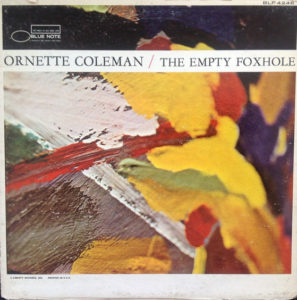
Ornette Coleman – The Empty Foxhole

The Empty Foxhole

Ornette ColemanThe Empty Foxhole Blue Note
BLP 4246 (2966)


For better or worse, The Empty Foxhole represented Ornette Coleman trying to break from his earlier styles of writing and performing and develop new innovations.  This was a looser, more free-form style that tended toward the chaotic.  Infamously, his untrained ten-year-old son Denardo plays drums.  There are a few hints of the “slice of life” melodicism from the later years of Ornette’s mid-60s Izenzon/Moffett trio.  Yet Ornette branches away from even that, particularly when he plays violin and trumpet.  Ornette recorded this after returning from extended European touring.  In Europe, the foundations for late-60s leftist uprisings were being lain, such as with the publication of Roland BarthesCriticism and Truth, and it seems that Ornette taps into some of that here.  The album title seems to reference the Vietnam War, from a vaguely dissident/pacifist perspective.

To a point at least, I happen to like this album, which tends to be much derided by listeners.  Sure, Denardo’s drumming is inept and is a distraction.  But the overall looseness of these performances is purposefully reigned in somewhat in a way that many other late-60s Coleman recordings are not.  It must be said that while Ornette was one of a very tiny handful of iconoclastic jazz innovators of the 1950s, a decade later many others had taken up the cause and it was now necessary to judge Ornette’s recordings against those of others.  There is a quality to The Empty Foxhole that reminds me of a miniaturized version of Marzette WattsMarzette & Company, or even Don Cherry‘s Eternal Rhythm, though I like the later Watts and Cherry albums much more.  So, while I admire this album, and it certainly marked an important shift in Ornette’s music from a historical perspective, it isn’t one of his essential albums by any means.

Karl Marx Quote

“the workers must be armed and organized. The whole proletariat must be armed at once with muskets, rifles, cannon and ammunition, and the revival of the old-style citizens’ militia, directed against the workers, must be opposed. Where the formation of this militia cannot be prevented, the workers must try to organize themselves independently as a proletarian guard, with elected leaders and with their own elected general staff; they must try to place themselves not under the orders of the state authority but of the revolutionary local councils set up by the workers. Where the workers are employed by the state, they must arm and organize themselves into special corps with elected leaders, or as a part of the proletarian guard. Under no pretext should arms and ammunition be surrendered; any attempt to disarm the workers must be frustrated, by force if necessary.”

Address of the Central Committee to the Communist League (1850)


Bonus links: “The Rifle on the Wall: A Left Argument for Gun Rights (Reprise)” (“The political principle at stake is simple: to deny the state the monopoly of armed force, and, obversely, to empower the citizenry, to distribute the power of armed force among the people.”), April Theses (“Abolition of the police, the army and the bureaucracy . . . to be replaced by the arming of the whole people.”),  Chairman Mao Quote (“political power grows out of the barrel of a gun.”), Painting & Guns Quote (“After a shooting spree, they always want to take the guns away from the people who didn’t do it. I sure as hell wouldn’t want to live in a society where the only people allowed guns are the police and the military.”), “Draft Declaration of the Rights of Man and of the Citizen” (“XXII. But any act against liberty, against the security or against the property of a man, exercised by anyone, even in the name of the law, except in the cases determined by it, and the forms which they prescribe, is arbitrary and void; the very respect of the law forbids us to submit to it, and if we wish to execute it by violence; it is permissible to repel it by force.”) and “Violence” and Links to books about black armed resistance in freedom movements and “Things That Can and Cannot Be Said” (“And I thought, fuck this. My question is, if, let’s say, there are people who live in villages deep in the forest, four days walk from anywhere, and a thousand soldiers arrive and burn their villages and kill and rape people to scare them off their land because mining companies want it—what brand of non-violence would the stalwarts of the establishment recommend? Non-violence is radical political theatre. *** And who can pull in an audience? You need some capital, some stars, right? Gandhi was a superstar. The people in the forest don’t have that capital, that drawing power. So they have no audience. Non-violence should be a tactic—not an ideology preached from the sidelines to victims of massive violence…. With me, it’s been an evolution of seeing through these things.”) and Barrett Brown on kids’ march for gun rights (“If all these hundreds of thousands of kids had brought guns with them they could have seized control of the capitol and enacted whatever anti-gun legislation they wanted. Catch-22!”) and Battlefield America: The War On The American People.  And for anarchist perspectives, see “School Shootings: Who to Listen to Instead of Mainstream Shrinks” and “How Nonviolence Protects the State”