Rahsaan Roland Kirk – Bright Moments

Bright Moments

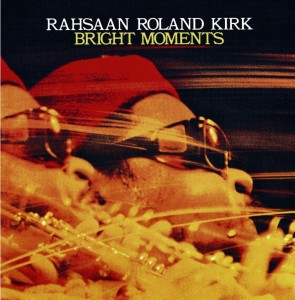
Rahsaan Roland KirkBright Moments Atlantic SD 2-907 (1974)


Rahsaan makes goofing off a profound experience. If only people spent more time doing just that, maybe there would be more bright moments and less fabricated problems in this world. Such is the shoot-from-the-hip philosophy Rahsaan promotes.

His style was a little Afro-centric, but that sells him short. Rahsaan made humane music. Everyone is involved. Here, there is plenty of opportunity for the audience to holler, testify, and clap along with every song and interlude. It isn’t just Rahsaan who makes Bright Moments what it is. Unlike his studio masterpieces Rip, Rig & Panic and The Inflated Tear, Kirk’s band here is not made of big-name superstars. It doesn’t take a band from the short list of jazz masters to make a great album.

Bright Moments is a fantastic example of the power of live recordings. Great live albums should make it a trivial fact that you aren’t actually at the concert as you listen. It is vaudevillian, and makes the effort to craft the performance into one tailored just for the audience. With the right set of ears it’s obvious Rahsaan is spinning his craft just for you.

Rahsaan certainly brought his bag of tricks at this date. He played three saxophones at once. He played a flute with his nose. These aren’t gimmicks. Kirk was talented enough to make sounds these unusual ways, but also to do a little more. “Fly Town Nose Blues” has him playing the flute with his nose with vibrato! When he plays multiple saxophones, there are certain logistical difficulties — three instruments and two hands. Kirk could deftly make the drone an integral part of some complex solos.

Few people could accuse their audience of not knowing everything about John Coltrane “and the beautiful ballad he wrote called ‘After the Rain’” and turn the accusation into a peace offering. Rahsaan was the people’s sax man. That isn’t any big secret, because in so many words he certainly lets you know.

Yeah, it takes a little something to blow such ragged solos. Rahsaan let all the breathy, clipped, muffled noise coming from his saxophones have their moments in the lights, hanging there as invisible sound sculptures.

At some point the criticism that jazz became academic gained supporters. It’s not that Rahsaan went out of his way to dispel that myth, but he did dispel it. Rahsaan Roland Kirk is like good whiskey. There are supporters, but the rest — even those finding it hard to swallow — can be easy converts.
Sun Ra – Cosmic Tones for Mental Therapy

Cosmic Tones for Mental Therapy

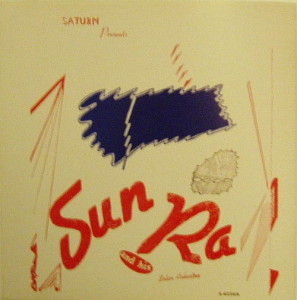
Sun Ra and His Solar ArkestraCosmic Tones for Mental Therapy El Saturn LP 408 (1967)


One of the more difficult Sun Ra albums, but a great one too.  It was recorded in 1963.  Like some of the other recordings from the early 1960s in New York this features vaguely psychedelic reverb effects.  These recordings are the most effective of Sun Ra’s experiments of the era.  The reed players are stretching (“Voice of Space”) and laying the foundation for what they would do after the October Revolution in Jazz the following year.  While the band had experimented with dissonant, spacey sounds for years, they use those techniques for longer, sustained stretches on many of these songs.  The polyrhythmic percussion finds new life here by bridging the newer recording effects and soloing with sci-fi exotica stylings the band had used for years.  That is to say that this actually marks a break from the merely superficially “exotic” approach of the prior years, giving way to something a lot less bound to conventional swing and bop structures and more able to float about purely on moods and washes of sound.  If this doesn’t sink in right away, give it time.

[Historical note: This music was recorded in New York City in the early 1960s, but was inspired by a performance at the Edward Hines, Jr. VA Hospital in Chicago on February 28, 1957, at which a (formerly) catatonic woman who supposedly hadn’t spoken in years exclaimed at the end of the performance, “You call that music?!”]

The Swan Silvertones – The Swan Silvertones

The Swan Silvertones

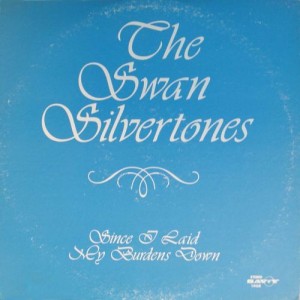
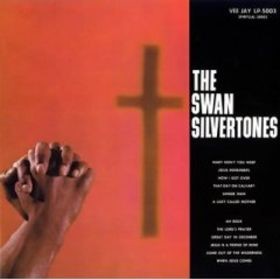
The Swan SilvertonesThe Swan Silvertones Vee-Jay LP 5003 (1959)


The Swan Silvertones had been around for over two decades before they released their first album of new material.  Their previous new recordings had been released as singles, first for King Records and then Specialty.  In the late 1950s, they switched to Vee-Jay Records, the label that released The Swan Silvertones.

The group’s first full-length album marked a new approach for the group.  Having already developed their own style by the end of their tenure at King and perfected their musical ideas at Specialty, they transitioned to a phase where they were now expanding upon the elements of their music that were already in place.  The Swan Silvertones really set the tone for all the albums the group would release through the 1960s, with an increased use of instrumental accompaniment and more ornate arrangements.  Often the use of instrumental accompanists went hand in hand with allowing more layers in the song arrangements.  There was also a more liberal use of space.  These trends combined to give everything a softer edge than the “hard gospel” recorded for Specialty.  The LP format also allowed them to record a lot of slower songs to break up the more familiar up-tempo numbers in the album sequencing.  This works well, and the group would only improve on those kinds of subtleties of the album format on subsequent releases.

Songs like “Mary Don’t You Weep” and “Jesus Remembers” demonstrate the full power of what The Swans were capable of in their Vee-Jay era.  Elsewhere on the album particularly in the middle, the results aren’t quite as exciting.  Some songs with a rather conventional doo-wop feel tend to come across as filler.  And at times the arrangements, as on the version of “How I Got Over” included here, feel a bit forced and claustrophobic.  The group’s ambitions seem to get ahead of themselves in piling too much into a single song.  This isn’t a condemnation of the album though.  In fact, there really isn’t a bad track here.

As a bit of trivia, note that some of the lyrics sung by Claude Jeter or possibly Paul Owens (“I’ll be your bridge over deep water if you trust in my name”) from the opener “Mary Don’t You Weep” inspired Paul Simon to write “Bridge Over Troubled Water”.  Jeter later was a guest vocalist on one of Simon’s solo albums.

The Swan Silvertones – Since I Laid My Burdens Down

Since I Laid My Burdens Down

The Swan SilvertonesSince I Laid My Burdens Down Savoy MG 14468 (1978)


There a number of observations I can make about The Swan Silvertones’ material for the Savoy label from the late 1970s and early 1980s.  The group was in its autumn years, and this was most evident in the song arrangements.  Once a hallmark that placed the group above their peers, in the Savoy years the song arrangements tended to be more utilitarian.  The backing vocals use rather boilerplate harmonies that add almost no rhythmic embellishment.  This makes the backing vocals sound almost the same for every song, and the points of interest are almost never the backing vocals.  Louis Johnson was the only recognizable member from the group’s heyday, and he handled essentially all of the lead vocal duties.  That isn’t to say the songs are always dull.  They tend to be mellow, but are often heartfelt enough to be enjoyable.  The instrumental accompaniment is generally quite respectable, and often is the factor that makes certain songs stand out.  The instrumental performances may not innovate, but are skillful enough to match a typical 1970s soul outfit.  The last point I will make about the Swan Silvertones’ Savoy albums is that they tend to be quite short, typically including only eight rather compact songs — this particular album tops out at just over 25 minutes of music.  About half the material is also usually filler.

Regarding this album in particular, it probably falls somewhere between At the Cross and Day By Day in both style and quality.  Side one might be a little stronger than side two.  But the filler tends toward the tedious more often than not.  The new version of “Mary Don’t You Weep” here pales in comparison to the group’s classic version from the late 1950s, instead being vaguely comparable to the earlier re-make on Only Believe.  The bass line on “Trying to Reach Perfection” is lifted straight from “Chameleon” on Herbie Hancock‘s Head Hunters.  Still, the smooth and mellow “The Lord Will Make a Way” and “It’s Hell” are among the group’s best recordings of the late 70s, those and “Lord I Thank You” being probably the only reasons for fans to bother with the album.

Pharoah Sanders – Deaf Dumb Blind (Summun Bukmun Umyun)

Deaf Dumb Blind (Summun Bukmun Umyun)

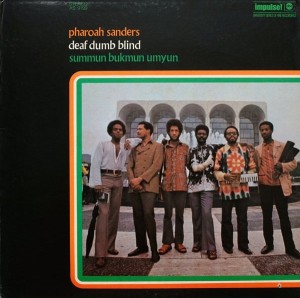
Pharoah SandersDeaf Dumb Blind (Summun Bukmun Umyun) Impulse! AS-9199 (1970)


If you liked Karma, you’ll probably like this too.  It melds bold African rhythms with free-form soloing like on Andrew Hill‘s Compulsion and Archie Shepp‘s The Magic of Ju-Ju, but Pharoah Sanders’ sound is altogether more upbeat.  The solos aren’t especially great by the standards of this set of performers.  But the most interesting aspect of this music is how accessible it remains throughout, making it a lot more palatable for those listeners skeptical of free jazz or anything remotely connected to the avant-garde.  That is no small achievement.

Dave Van Ronk With The Red Onion Jazz Band – In the Tradition

In the Tradition

Dave Van Ronk With The Red Onion Jazz BandIn the Tradition Folklore FL-14001 (1963)


Dave Van Ronk’s music is tedious.  It is so imposing and yet at the same time rather unfocused in its energies.  He was a below average singer and only a good (but not great) guitarist.  Although bits of this — the parts without the horns — seem to have had a big impact on the sound of early Tom Waits, Van Ronk kind of falls down compared to Waits.  My biggest gripe with Van Ronk is that he clearly had too high an opinion of himself.  He saw himself as a huge innovator and great talent, at least he thought that whatever he did have should have bestowed upon him great influence.  Looking back on his albums, it is hard to find anything that holds up to even the level of fair-to-middling.  He had his talents and his interests, but everybody does.  He makes his case that his talents and interests are (or should be) considered better, more influential, more important than what other people have, but this comes across as more self-serving than he lets on.  This is epitomized by his appearance in the Bob Dylan documentary No Direction Home, in which he displays a kind of “sour grapes” attitude, clearly still after all those years, thinking that he should have been bigger than Dylan, even as he feigns that he got over all that years ago.  His professed innovations in singing more gruffly and such were really just adaptations of afro-American music to white middle class settings, and his supposedly innovating guitar arrangements seem like a joke compared to what the American Primitive guitarists (John Fahey) were doing around the same time, and later.  But all that aside, Van Ronk has better stuff out there than In the Tradition.

Reds

Reds

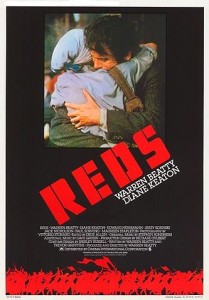
Reds (1981)

Paramount Pictures

Director: Warren Beatty

Main Cast: Warren Beatty, Diane Keaton, Jack Nicholson, Edward Herrmann


Although there is frequently an accusation of “Hollywood Liberalism,” after the McCarthy witch hunts of the 1950s, the political left had a fairly low profile in Hollywood post-WWII.  During the “New Hollywood” movement, beginning in the late 1960s, that changed, somewhat.  In the early 1980s, at the tail end of that movement, there were at least a couple of politically leftist epics — no less — that represented some of the last and best examples of what was possible for the political left working in conjunction with big business movie making (the other being Heaven’s Gate (1980)).

Reds is the biographical story of John “Jack” Reed (Warren Beatty), the journalist and author of Ten Days That Shook the World (1919), an account of the October (Bolshevik) Revolution in Russia, and his companion Louise Bryant (Diane Keaton).  Reed is the only American buried in Red Square in Moscow.  The film opens at the beginning of WWI.  One of the finest moments in the entire film comes in the first few scenes when Reed, a journalist just returned from the front in Europe, is asked to speak at a high society gathering about the real cause of the war.  He stands up and says, “Profit.”  He then immediately sits back down.  Could there be a clearer explanation in any number of words?  Interspersed with the historical dramatizations are documentary interviews with “witnesses,” people who knew Reed and Bryant long ago retelling anecdotes for Reds.  Some were friends, while others don’t have anything particularly kind to say.  Jack Nicholson portrays playwright Eugene O’Neill.  His misanthropic character has clearly been a model for plenty of other Hollywood actors in later films.

Many leftists despise Reds, often because it subordinates the October Revolution to a romantic melodrama.  This seems unfair.  If the romantic drama were not in the forefront, this would not be a Hollywood movie.  As it is, there are hardly any Hollywood films that paint authentic leftist revolutionary activity in such a positive light.  Of course, Michael Cimino‘s Heaven’s Gate overcomes all the difficulties with Reds‘ treatment of romantic melodrama (Kris Kristofferson ends the movie married and bored on a yacht) — though at the same time Cimino’s film was butchered to a condensed version that bombed, only to be resurrected with a director’s cut later on.

It is difficult to maintain a suitable pacing throughout an epic.  Reds does well in that regard, even if things slow a bit toward the end when during the midst of the post-revolution civil war the film, paradoxically, focuses on the powerlessness of the characters.  There are bits of Ten Days That Shook the World that might have added some levity, like when the only restaurant open after Reed investigates the storming of the Winter Palace is a vegetarian restaurant called “I Eat No One” with a picture of Leo Tolstoy in the front window.  But, such changes would, again, make this something other than a Hollywood romance film.

As it stands, Reds is one of Hollywood’s finest dramas of the early 1980s.  Beatty and Keaton are fantastic, Keaton as someone from a privileged background desperately striving to cultivate cultural capital in the artistic/journalistic world and Beatty as the slightly vain and adventurous but nonetheless immensely talented figure who made important contributions to the historical documentation of the October Revolution in the English language.

Robespierre on Property

“The first social law is therefore the one that guarantees all members of society the means to live; all others are subordinate to that one; property was only instituted and guaranteed to cement it.  It is in order to live that we have property in the first case. It is not true that property can ever be in opposition with men’s subsistence.

“The aliments necessary to man are as sacred as life itself.  Everything essential to conserve life is property common to the whole of society.  Only the surplus can be individual property and left subject to the enterprise of merchants.  Any mercantile speculation that I make at the cost of the life of my like is not a traffic, but brigandage and fratricide.”

Maximillien Robespierre “The Incorruptible”, December 2, 1792.