Michael Hudson – Russia, China and the Battle Against Dollar Hegemony

Link to an interview with Michael Hudson:

“The Saker Interviews Michael Hudson”

Excerpt:

“Classical economics was a doctrine of how to industrialize and become more competitive – and at the same time, more fair – by bringing prices in line with actual, socially necessary costs of production. The resulting doctrine (with Marx and Thorstein Veblen being the last great classical economists) was largely a guide to what to avoid: special privilege, unearned income, unproductive overhead.

“The aim was to create a circular flow model of national income distinguishing real wealth from mere overhead. The idea was to strip away what was unnecessary – what Marx called the ‘excrescences’ of post-feudal society that remained embedded in the industrial economies of his day. When the great classical economists spoke of a ‘free market,’ they meant a market free from rentier classes, free from monopolies and above all free from predatory bank credit.

“Of course, we know now that Marx was too optimistic. He described the destiny of industrial capitalism as being to liberate economies from the rentiers. But World War I changed the momentum of Western civilization. The rentiers fought back – the Austrian School, von Mises and Hayek, fascism and the University of Chicago’s ideologues redefined ‘free markets’ to mean markets free for rentiers, free from government taxation of land and natural resources, free from public price regulation and oversight. The Reform Era was called ‘the road to serfdom’ – and in its place, the post-classical neoliberals promoted today’s road to debt peonage.

“Today’s Cold War may be viewed in its intellectual aspects as an attempt to prevent countries outside of the United States from realizing that (contra Thatcher) there is an alternative, and acting on it. The struggle is for the economy’s brain and understanding on the part of governments. Only a strong government has the power to achieve the reforms at which 19th century reformers failed to achieve.

“The alternative is what happened as Rome collapsed into serfdom and feudalism.”
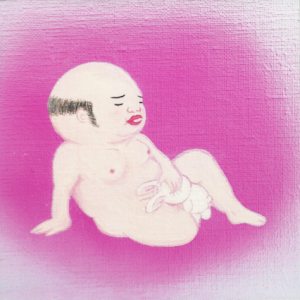
Jim O’Rourke – Eureka

Eureka

Jim O’Rourke – Eureka Drag City dc162cd (1999)


With Eureka Jim O’Rourke started to look like one of the most significant pop/rock artists of his time.  While some of the American Primitivisms of his previous album Bad Timing are still present here, O’Rourke had now became noticeably more eclectic.  You can trace influences of Brian Wilson, Van Dyke Parks, Burt Bacharach, Robert Wyatt beyond those of John Fahey.  O’Rourke employs a kind of allegorical approach here.  Whether you adopt the classical Greek formulation (something that “speaks otherwise”) or the more modern one formulated by Walter Benjamin (“Allegories are, in the realm of thought, what ruins are in the realm of things.”), there are fragments of (recent, popular) musical history employed in a way that takes on other meaning.  The fragments he appropriates are used reverentially — you can tell O’Rourke deeply appreciates it all — though at the same time there is a tacit acceptance that it all is of the past and can’t be reproduced in its original context or with its original meaning.

I really loved this when it came out, and it was probably the first O’Rourke solo album I remember hearing.  If looking back this seems less than it did at first it’s only because O’Rourke outdid himself on Halfway to a Threeway and Insignificance in the coming years.  And perhaps also the magnificence of the first six tracks here greatly outstrip the rather weak last two.  Still, I have to say something like Eureka, and contemporaneous efforts like his contribution to Illuminati, seemed a big influence on the mild resurgence of orchestrated pop that led to things like Joanna Newsom‘s Ys a few years down the line.  I guess I’ll have to wait and see if he ever releases an album titled “Castaway” to continue the trend of naming stuff after Nicolas Roeg movies — Bad Timing, Eureka, Insignificance…

Sonic-Youth – Sonic-Youth

Sonic Youth

Sonic-Youth – Sonic-Youth Neutral Records N-ONE (1982)


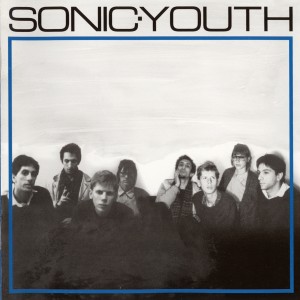
Sonic Youth’s debut (at about 24 minutes in length, straddling the line between an EP and LP) might shock listeners who came to the band much later.  It is pretty firmly rooted in New York City No-wave punk, reminiscent of DNA and Glenn Branca — especially his The Ascension.  Noisy yet anthemic guitar riffs are nowhere to be found here.  Instead, the record is dominated by wide-ranging drums and ironically monotonous bass.  There is a sparseness here that the band would pretty much never return to.  Elements of this sound hung around for some of their early recordings like Confusion Is Sex, but (not coincidentally) disappeared by the time the band broke to a national audience with EVOL, Sister and Daydream Nation.  They reappeared only for brief changes of pace and coloring on much later (and, not coincidentally, somewhat unpopular) albums like NYC Ghosts & Flowers.  All that historical stuff aside, this record holds up pretty well decades later.  It might not be the most original of no-wave albums, but anyone with an inkling of interest in the sub-genre should get a kick out of it.

Sonic Youth – NYC Ghosts & Flowers

NYC Ghosts & Flowers

Sonic Youth – NYC Ghosts & Flowers Geffen 069490650-2 (2000)


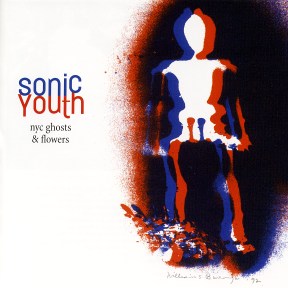
NYC Ghosts & Flowers caters to a very specific audience as it began a planned trilogy in tribute to New York City and all it represents. Opinions differ greatly on the album’s merits — to some this is the band’s single worst album, to others this is a return to underground authenticity. Though this remains one of my favorites. There are a few slow moments and it’s certainly not a watershed Sister or Daydream Nation, but this is the Sonic Youth at their most experimental. It isn’t experimentation for its own sake either. The inventive spirit overpowers the nostalgia (and the name-checking references to the past). Maybe I’m a sucker for underground culture. But anything that so insightfully captures shadings of people like William S. Burroughs (the album cover is an image he created), Hubert Selby Jr. and Jean-Michel Basquiat and of the ongoing revolution of the universal consciousness is okay by me.  This album is kind of like a research project, going back to explore the pre-history of the punk movement that is typically associated with Sonic Youth and its fan base and exploring how that legacy is still relevant.  That especially means looking to the 1950s Beat Generation bohemianism and the 1960s hippie/Yippie counterculture, but also perhaps the free jazz and experimental music scenes of those eras.  The lyrics are as good here as anything Sonic Youth had conjured up before.  The sneering snottiness is held in check and instead they present thoughtful long-form concepts, adapting the vocal mannerism of the past to reference a kind of evolution of different modes of artistic discourse.  The song structures are also more open-ended, and they find ways to transition between spoken monologues, white noise set pieces, guitar riffs, and guitar solos that seemed lacking though much of their mid/late 90s albums.  I suspect that Sonic Youth looking back before the 1970s put off many listeners, who only wanted the band to have loud, crunchy guitar solos appear with predictable regularity — there isn’t much of that here.  That, and there are markedly different rhythms in play here, which are frequently static and cerebral while being insistent and present as a force equal to or great than the vocals, melodies or noise effects.  But in displacing of all the familiar devices with new techniques, the band (and co-producer Jim O’Rourke) deliver a recording that is as refined and well-recorded as anything they ever released, even as it revels in dissonance and artistic devices that alienate the audience to make certain points (usually by transitioning from or contrasting with the aspects with a distancing effect).  If you don’t want a rock album to challenge you, then of course you won’t like this album.  If you do, however, you might get something out of this one.

The Sonic Youth – Sister

Sister

The Sonic Youth – Sister SST 134 (1987)


The Sonic Youth at their best master the simplest points of music. They arrived at songs with insight and momentum, just from unique angles.  While the follow-up Daydream Nation may be canonized as the band’s finest album, Sister has a stomping, (intentionally) irritating attitude with a wonderful balance of noise and tangible rhythm and melody.  This is the more immanently listenable.

The Youth did have some of the most inventive rock instrumentalists in the game, but there was no need to dazzle listeners with gratuities. Lee Ranaldo and Thurston Moore excel at shading distortion with their improvisational attack. The raw technical aspects seem simple, but chalk that up to these stylistic wonder-kids making the impossible seem effortless. Hardly since The Velvet Underground‘s White Light/White Heat had a band pushed guitars past their breaking point like this.

In their early noise band days Sonic Youth were exciting and original but an exceedingly challenging listen. With EVOL, Sister, and Daydream Nation the Youth continually increased the complexity and but also the rewards.  EVOL came close, but Sister was truly the record that put them on the map.

Noisy as they were, the Sonic Youth put together some great anthemic tunes. The opener “Schizophrenia” tells of haunting thoughts: “My future’s static/ It’s already had it.” The Youth grew out of no-wave. Every step they took added to that movement. There was some distance between them and no-wave but it was assuredly the result of forward movement.

You gotta hear the album from start to finish since every track burns its own kind of fuel. “Pipeline/Kill Time” moves into a passage near the end where Steve Shelley’s drums beat out a slowing pattern, enough to slow your existence with the rhythm. The guitars dish out a reminder they are electric. “Tuff Gnarl” is the very essence of the Sonic Youth. It’s loud, non-linear, and has plenty of R&B riffs to keep you dodging the jabs. Pretty soon something sticks. The relentless advance will knock you down, and out. Kim Gordon has her nasty bass action in effect on “(I Got A) Catholic Block.” The rendition of Johnny Strike of Crime‘s “Hot Wire My Heart” has the most abrasive guitar work on the disc. It doesn’t grind away at you. It polishes rock ‘n’ roll. The result isn’t a shine, but more one that glints to eyes opened just right to look outside. “Master-Dik” is a reminder that Alice Cooper and Madonna influenced them as much as the Velvet Underground.

The Sonic Youth were key figures of the post-punk explosion who achieved success without compromising. They had the drive and the blood-rush rock ‘n’ roll attitude that was already in decline around them. Somehow they held on to it.

Mike Norman – Dean Baker

Link to an article by Mike Norman:

“Dean Baker…Perfect Example of Why the Progressive Movement Goes Nowhere”

See also Robin Marie Averbeck on Liberalism

I have always disliked Dean Baker’s writing for a number of reasons, many of which are explicitly mentioned in the comments section of the Mike Norman blog post, and, indirectly, in Robin Marie Averbeck’s articles.  In short, Baker adopts a strict center-right Keynesian (i.e. New Deal) economic theory but staunchly refuses to acknowledge that ideological position, instead opting to write shrill screeds that do little more than describe how economists who promote other economic theories are “mistaken” due to their (quite intentional) disregard for and non-adherence to Keynesian economic theory.  He never justifies the assumptions that underlie his Keynesian theories, and when pressed on such points from the left simply responds that alternatives are “unrealistic” (thereby shutting down debate regarding such assumptions).  This is a gutless approach that simply denies the existence of real disputes — it isn’t that neo-liberals fail to recognize how their economic policies promote inequality; most are actively trying to increase inequality — and ultimately, to quote Alain Badiou, maintains “silent acceptance of . . . external corruption under the cover of practical ‘realism'” that assumes away the possibility of a paradigm shift or of the tacit political underpinnings of all economic theory.  And anyway, aren’t even his own inadequate, self-defeating Keynesian policies “unrealistic” too, in the sense that neo-liberals refuse to endorse them?  At least people from the MMT, institutional and Marxist economic schools of thought openly acknowledge that they are relying on political policy assumptions.

Bonus link: “Keynesianism Will Not Save the World”

Sonic Youth – Daydream Nation

Daydream Nation

Sonic Youth – Daydream Nation Enigma 7 75403-1 (1988)


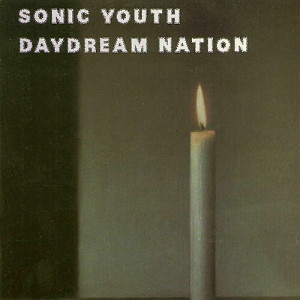
Exploding in all directions, Daydream Nation marks a dramatic apex in rock music.  Moving from the raunchy attack of Sister, the Sonic Youth developed a wall of guitar sound similar to Phil Spector. They tame noise. Daydream Nation builds on far-reaching experimentation while staying fairly accessible. Long albums usually wander but this effort stays focused. Few groups could produce a worthy follow-up to Sister, but Sonic Youth proved they were in this for the long haul by delivering something even broader in scope.

Drifting into “Teen Age Riot,” the album sets its goals high from the beginning. It may be the song of the decade. A blend of carefree innocence and well-intentioned desire, it marks the end of the 80s and ushered in the cynical 90s. “Silver Rocket” then steps up the pace to slashing melodies and power chords. Other highlights include “Eric’s Trip,” “Candle,” and “Total Trash.”

Individual songs do stand out, but really it’s the combined effect that characterizes the record. The attack of Thurston Moore and Lee Ranaldo on guitars blends seamlessly with Kim Gordon’s bass. Sporting some of the best guitarist in the game, Gordon blasts away on songs like “Hey Joni” adding her own kick to the already lethal mix. Without losing any power, the band mixes sonic textures on a level few bands ever reach. Steve Shelley’s drum work writhes in endless rhythms. He adds enough groove to keep any R&B band envious and stretches abstract beats into a firm base. Amidst the sound textures, Shelley is the elusive catalyst in this otherwise dreamy music.

Daydream Nation is so thoroughly integrated it is difficult to pick out individual songs from the flow. While still comprised of distinct songs, that device does not confine the group. Themes of troubling disillusionment and imagined contentment pervade. More prophetic than personal, the broad social focus doesn’t dwell on autobiographical narratives. The Sonic Youth use their experiences as raw material for a bigger purpose. Biographical portraits occasionally slide in to cement the album’s developing themes. Right to the closer, “Trilogy,” Daydream Nation brings out the band’s best songwriting while brilliant performances beat down any trace of predictability.

Naked motives exist somewhere beyond written lyrics. Vocals put the album in context. Shifts between singers expand the changing dynamics. Warbled cries and monotone rants document a tension between disillusionment and acquiescence. No other similar statement exists so beautifully executed — particularly from a production standpoint. Hundreds of years from now historians and anthropologists will analyze this record to understand one small part of the twentieth century.

Sonic Youth – Sonic Nurse

Sonic Nurse

Sonic Youth – Sonic Nurse Geffen B0002549-12 (2004)


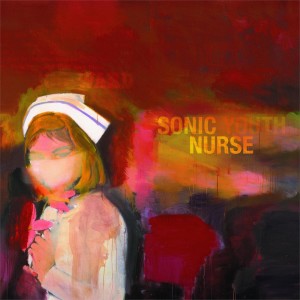
And suddenly, after a string of excellent — if frequently under-appreciated — albums, Sonic Youth deliver a backwards-looking dud.  Sonic Nurse isn’t a bad album, so much as a boring one that traverses territory very familiar to the band.  The opening “Pattern Recognition” sounds like the Youth of the late 1980s (Daydream Nation), just sort of older-sounding, er, “senior”-sounding?  Maybe that is what listeners wanted, after the band explored new and different approaches for the previous few years this album won them many more accolades.  But none of the noise at the end of “Pattern Recognition” comes close to, say, “Karen Revisited” from Murray Street.  The lengthy jam “Stones” is a really good one that nonetheless at times seems like just a more melancholy retread of “Rain on Tin” from Murray Street.  Another of the best songs here is “Unmade Bed” which is a dad-rock version of the the mellow noise ballads the band had been exploring since the mid-1990s.  It has abrupt transitions between noisier guitar solos and sparser yet also choppier vocal segments — reminiscent of Experimental Jet Set, Trash and No Star.  Nothing flows.  Overall, if there is one thing that disappoints more than others it is Jim O’Rourke‘s electronic noise, which seems more of an afterthought, and for that matter tends toward the obvious more than it should. These songs always seem to undermine themselves just as they start to get going — much like the self-consciously frustrating approach of O’Rourke’s later solo album The Visitor.  Giving this album a listen ten years after first release, it isn’t bad, but still seems fundamentally nostalgic and sentimental in ways that are contrary to everything that this band used to stand for, making this almost their Achtung Baby moment.