
Link to an article by Linda Gordon:
Kitty Wells – The Kitty Wells Story
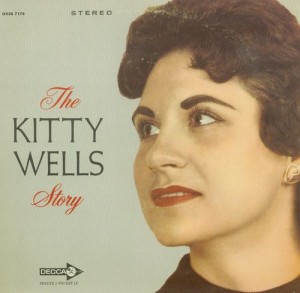
Kitty Wells – The Kitty Wells Story Decca DXS-7174 (1963)
Kitty Wells was arguably the first major female solo recording star in country music. Before, women tended to be part of a group (think Mother Maybelle and Sara Carter of The Carter Family) or “girl singers” rotated in and out of predominantly male bands. Her music was proto-feminist, and an inspiration to many who came after her. Many of the songs on this early collection are sort of response songs, adding a woman’s rebuttal to a possibly male chauvinist song. That goes for the opener, her first big hit, “It Wasn’t God Who Made Honky Tonk Angels.” But that only amounts to “proto-” feminism in some ways, because it cedes to men the ability to set the terms of debate, offering only a rebuttal.
Wells grew up in Nashville, and her voice relies on an urban diction. Loretta Lynn was a huge Kitty Wells fan, and Lynn’s early recordings are cut from the same cloth, though many are even better than Wells’ because Lynn carried more sassy rural weight in the tone and timbre of her voice. But regardless of which female country star of the 1960s or beyond is your favorite, most owed some debt to the ways Kitty Wells (and Patsy Cline) made possible a market for independent-minded solo artists who weren’t male. This music also occupies a special place in which it is unmistakably country, with “sophistication” like having The Jordanaires on backing vocals, and elegant traded solos from instrumentalists (especially with pedal steel guitar), yet without the dumbed-down hypocrisy of the countrypolitan style that came to prominence in the 1960s.
There are a lot of great songs here, from “It Wasn’t God Who Made Honky Tonk Angels” to “Lonely Side of Town” to “Making Believe” to “A Wedding Ring Ago.” And of course there is one of the most famous country songs, too, in “Makin’ Believe.” The balance between sophisticated vibrato and half-growled words like “I’ll” and “ain’t”, against plaintive guitar, bass and often wordless vocal backing harmonies, it has just about a perfect confluence of consonance and contrast. Wells earned the title of the Queen of Country Music with these recordings. Over a half-century later they still sound great.
Erik Olin Wright – Why Class Matters
Link to an interview with Erik Olin Wright by Mike Beggs:
Bruce Springsteen – The River
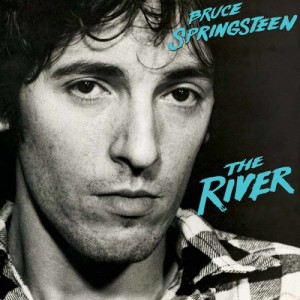
Bruce Springsteen – The River Columbia PC2 36854 (1980)
So I was standing around with some people talking to critic Dave Marsh years ago, and Marsh was going on about how The River was the best of Springsteen. So I gave it a try. I can’t say I agree, at all. Another reviewer cast this off as too much like Billy Joel. These songs are a bit too slick for their own good, and self-indulgent too. Ahh, the 1980s were clearly underway by this point I guess. But, there are still some good tunes here, and the jangly 12-string guitar adds a nice touch. “Hungry Heart” is great (sounding exactly like what that kind of song should sound like), and “Sherry Darling” is a great song, somewhat ineptly produced (too much glitz and clutter). “The Ties That Bind” is the other really good one. There is a handful of other pretty decent cuts and the rest forgettable — really there is nothing to recommend about the entire second disc, which should have been omitted. Springsteen often does the thing that was by this point his shtick: the wall of sound that makes his narratives seem inevitable, with the band members shouting along trying to be heard among the din. This, I guess, is Springsteen’s go-to metaphor for American society. His sense of irony is like a fart in the wind though — people tend to like Springsteen for all his worst qualities and the irony can’t stop that from happening.
Just to draw out these points a little further, “The Ties That Bind” illustrate an important aspect of Springsteen and his politics. He came along right when the New Deal coalition was falling apart, and he represented an ultimately failed attempt to prop it up — Johnny Cash was doing this too around this time. Anyway, the point can be illustrated with reference to Sigmund Freud‘s notion of the primal father figure. Not necessarily a male parent, but any authority, the “father” represented the injunction to sacrifice one’s own enjoyment for the good of family/community/society. But the modern father instead commands individual enjoyment. This is basically what Christopher Lasch described as The Culture of Narcissism. Lament for this shift — anomie — practically pours from the lyrics of “The Ties That Bind.” But it is a a kind of inauthentic lament, because it dwells in a pre-established ethics that can’t help but contribute to the decay it purports to oppose, if for no other reason than, in hindsight, it was insufficient to prevent its own demise, though mostly because it looks backwards to recreation of dubious traditions rather than forward towards authentic freedom.
John Fahey – Christmas Guitar Volume One
John Fahey – Christmas Guitar Volume One Varrick VR-002 (1982)
John Fahey turned christmas albums into a sort of a fall-back position. Every few years or so he turned out a new one. Christmas Guitar Volume One features a number of new recordings of holiday songs he had previously recorded. The new recordings tended to use more or less the same arrangements as before. What had changed though was Fahey’s style. His playing was more deliberate, even austere. From a cynical point of view, his playing seemed to focus on a kind of clinical precision for lack of any new ideas about how to present the music. Still, even if it can fairly be said Fahey has done better with christmas music, this album is better than your run-of-the-mill holiday claptrap.
Johnny Cash – Christmas with Johnny Cash
Johnny Cash – Christmas with Johnny Cash Legacy CK 90701 (2003)
Christmas recordings predominately fall into three categories: novelty (The Chipmunks, The Ventures, Jingle Cats), smooth crooning (Bing Crosby, Johnny Mathis, Nat “King” Cole), and solemn/devout (Mahalia Jackson, John Fahey). Far and away, most christmas music that receives radio airplay is of the novelty or crooning varieties (including more contemporary pop varieties of crooning). The solemn and devout material gets its due, but tends to have more private audiences. Johnny Cash doesn’t fit any of those categories. But he did record for a major label and it is axiomatic that long-term major label acts (unless obviously of a different religion) will record christmas music. There is nothing overtly “wrong” with Cash’s treatments of christmas warhorses like “Oh Come All Ye Faithful” and “Hark, the Herald Angels Sing,” but they don’t suit him. His voice — iconic though it was — wasn’t sweetly smooth and velvety like a good crooner. He did do novelty music, but with too much of a rural “aw shucks” kick to it for the peppy, sprightly style of most novelty christmas music. Cash was a christian, and it was often his Achilles heel by allowing him to coast on inferior performances that recycled stock protestant religiosity. This collection places him somewhere in between crooning and solemn music. It’s an awkward place. Nothing goes seriously awry. Yet, nothing ever clicks either. He’s going through the motions and there are no compelling reasons to go along for the ride.
Mahalia Jackson – Christmas With Mahalia
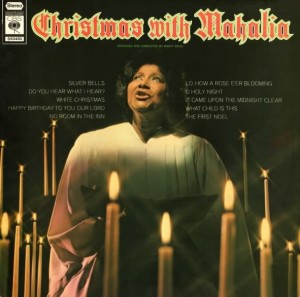
Mahalia Jackson – Christmas With Mahalia CBS S 63450 (1968)
If you already have some christmas music by Bing Crosby, Johnny Mathis, and the like, Christmas With Mahalia is good way to expand your collection. Mahalia is supported with string arrangements by Marty Paich. Her renditions of holiday favorites compare favorably with the best crooner versions, though her approach is distinctly more solemn.
Johnny Cash – Classic Christmas
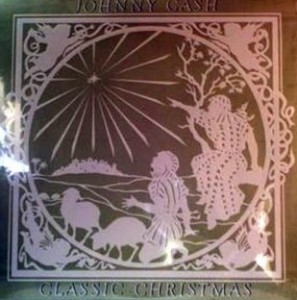
Johnny Cash – Classic Christmas Columbia JC 36866 (1980)
Big orchestral arrangements of stock christmas tunes suit crooners like Johnny Mathis, but are not the first thing that come to mind when you hear the name Johnny Cash. He just wasn’t a sweetly-voiced singer who couldn’t hold notes smoothly and steadily. So although his performances are minimally adequate they don’t impress. Classic Christmas doesn’t play to Cash’s strengths. This one is pretty generic.
Jingle-Cats – Meowy Christmas
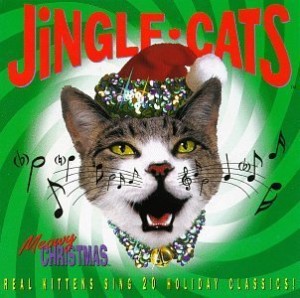
Jingle-Cats – Meowy Christmas: Real Kittens Sing 20 Holiday Classics! Jingle Cats Music 41226-2 (1993)
21 November 2009, the outskirts of Ankara.
Human beings are capable of some pretty horrible things, and you don’t have to look very far into history to find the horrible acts of Adolph Hitler, Dick Cheney and Jerry Seinfeld. But we also have achieved many wondrous, astounding things, from the Great Pyramid of Giza to the Great Wall of China (visible from space) to Rickrolling. Meowy Christmas has to fall in that same category with the Pyramid, the Wall and Rickrolling, somewhere in between. Personally, I once had a dream to rival any of those achievements. It was a noble dream indeed: to have kittens sing songs. It always seemed like a far off fantasy. How could I really get cats to sing? How many cats would it take? Would the staggering genius of the whole thing turn my singers, little Fluffers, Fatty, Ceiling Cat and Sgt. Catnip, or any of the rest, into pompous celebrities just like Bono? Could I live with myself for spreading the disease that is Bono to another species? Could I ever hope to control a monstrosity like that once I had created it? Was it even possible for something so wonderful to turn into something so evil? Too many questions. This seemed like playing with fire, like opening Pandora’s box. And so the idea was filed away in the back of my mind, until we have the technology to control it. I thought my mad secret was safe. Oh how wrong I was. As I blindly slumbered on this momentous concept, Mike Spalla came along and created The Jingle Cats (and Jingle Dogs!) to make “Real Kittens Sing 20 Holiday Classics!” Spalla! Damn you and your confounded synthesizer and handful of cat sounds! You see, he beat me to it, I must confess. The glorious bastard. But it was the synthesizer all along. HOW COULD I HAVE MISSED IT! I saw that episode of The Cosby Show where Theo and Vanessa take the Huxtable family to meet Stevie Wonder. That harmless situational comedy program emanating from my video box provided the crucial missing piece of the puzzle. It was right there in front of me. Only a few kitten sounds were needed. That misunderstood electronic sound machine could do the rest; it could modulate the kittens’ voices to any pitch. The keys could contain them. All that would be left would be to fill in the music behind the voices, something as simple as Ed Wood dropping stock footage into Glen or Glenda. But this isn’t over Spalla. No, not by a long shot. I can’t possibly reveal my secrets here. It’s not the right forum. Others won’t realize that it will be worth it to sacrifice Hasselhoff for the greater good. Some might…misunderstand, yes. But what I achieve will make singing kittens seem like child’s play. Ah, no, I must contain myself if possible. You will know when I have succeeded though. You will be able to hear me scream, “Made it Ma, top of the world!” And that day will come, so much sooner than you expect. By the time you read this, I may have already succeeded. I am already nearing Ankora, for a perfect Turkish Angora specimen will be essential to my plans. But enough. It will be more pleasant and useful to experience this revolution than to write about it. I must go, for it has already begun!
Johnny Cash – Sings Precious Memories
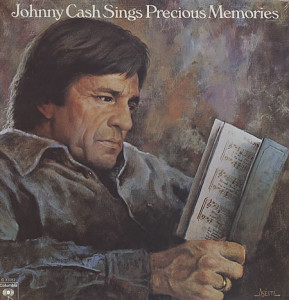
Johnny Cash – Sings Precious Memories Columbia C 33087 (1975)
Johnny Cash released no less than five albums in 1975. Among them was Sings Precious Memories, a gospel album. It is perhaps the worst of the year’s batch of offerings. It features a lot of wailing falsetto backing vocals likely to induce cringes, and tired, florid orchestral arrangements. The whole thing conjures up the kind of pastel-colored southern mega-church setting satirized nicely years later in the film Fletch Lives. An enormously superior demo version of “Farther Along” appeared posthumously on Personal File, which provides an excellent case study of how terribly the music is produced here. Cash, for his part, seems to be coasting on the fact that this music has religious content, without undertaking the necessary effort to make this compelling to the listener in musical terms. Pass.